



Artificial Intelligence in E-commerce Market Size, Key Companies, Company Market Share, User Adoption, Technology Deployment, Revenue Growth, Competitive Positioning, and Demand Forecast
Artificial Intelligence in E-commerce Market (By End User: IT and Telecommunication, Retail and E-Commerce, BFSI, Healthcare, Manufacturing, Automotive, Others) - Global Industry Analysis, Size, Trends, Leading Companies, Regional Outlook, and Forecast 2026 to 2035
Source: https://www.precedenceresearch.com/artificial-intelligence-in-e-commerce-market
 Get a Sample
 Table Of Content


What is the Artificial Intelligence in E-commerce Market Size?
The global artificial intelligence in e-commerce market size is calculated at USD 9.01 billion in 2025 and is predicted to increase from USD 11.21 billion in 2026 to approximately USD 74.93 billion by 2035, expanding at a CAGR of 23.59% from 2026 to 2035.
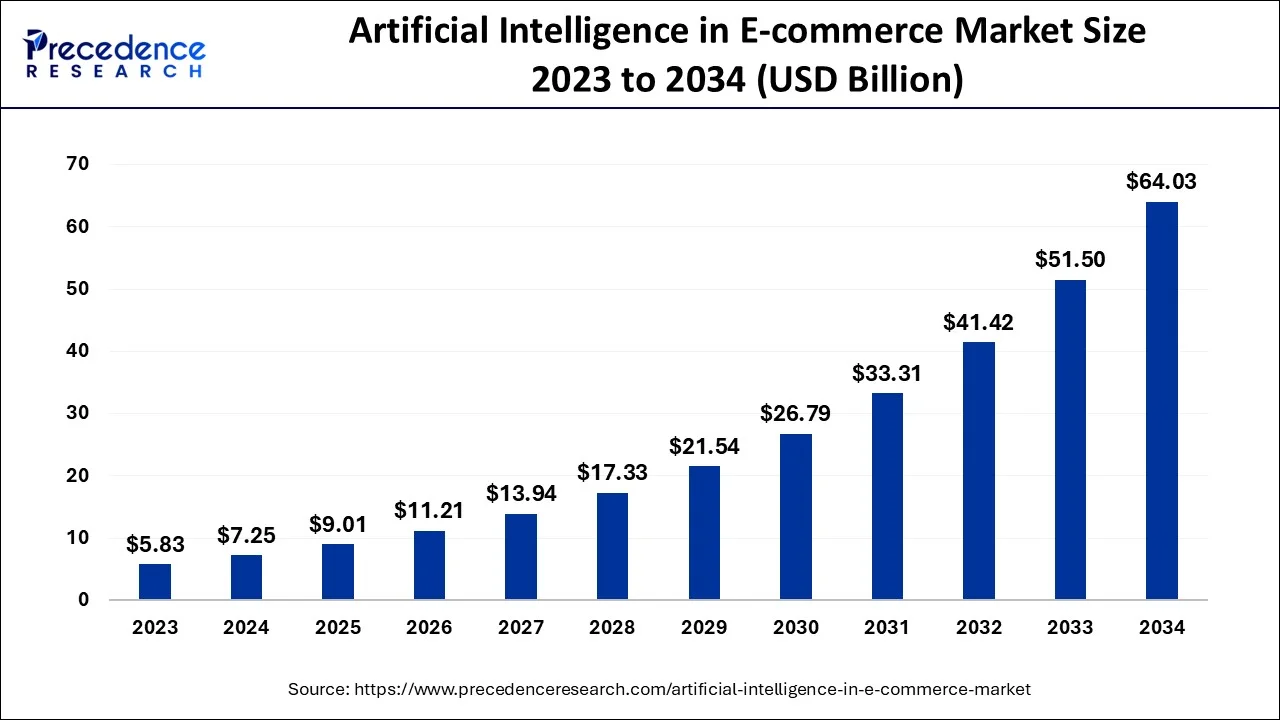
Artificial Intelligence in E-commerce Market Key Takeaways
- North America dominated artificial intelligence in e-commerce market with share of 39% in 2025.
- Asia Pacific will gain a significant market share over the forecast period.
Market Overview
The e-commerce industry's embrace of AI technology is a crucial step toward corporate growth. A developing trend in this digital era is the use of artificial intelligence in e-commerce. Thanks to AI technology. It produces wonders that are beyond the capacity of human measurement. AI apps are becoming more and more common in a variety of sectors, with the goal of completing tasks that are occasionally challenging for human workers.
E-commerce is another industry benefiting from AI technologies. The main advantage of AI for E-commerce enterprises is its ability to evaluate vast volumes of data and learn from the data provided to offer a better result. Businesses that use AI solutions better understand their clients, deliver more relevant goods, determine the ideal timing and pricing for their business offerings, and collect accurate and trustworthy analytic data.
Customized product suggestions are provided using artificial intelligence based on previous users' behavior and looks. Websites use machine learning to analyses your shopping history and recommend things you might like based on previous purchases. Dynamic pricing using AI is a strategy for changing the price of your product based on supply and demand. With the correct data, today's systems can dynamically compute the minimal discount required to sell when and how to discount. Dynamic pricing using AI is a strategy for changing the price of your product based on supply and demand. With the correct data, today's systems can dynamically compute the minimal discount required to sell when and how to discount.
The degree of product and service personalization available has a direct impact on customer retention. One strategy to improve client retention is to deliver individualized marketing material and shopping experiences to the targeted consumers. E-commerce merchants may analyze consumer behavior, demographics, and other data at scale using AI technology, in particular deep learning and statistical modeling. Retailers may create customized adverts, send targeted emails, suggest items, and set pricing specifically tailored to the customer based on their findings. Intelligent personalization enables online company owners to forge stronger emotional connections with their clients, which in turn boosts customer loyalty and retention.
Artificial Intelligence in E-commerce Market Growth Factors
AI technology has become a great tool for increasing sales and optimizing operations. Many small ecommerce enterprises are also utilizing AI-enabled technology. Amazon has long understood the value of artificial intelligence and associated technologies. Machine learning is used by the massive ecommerce firm to improve product selection and customer experience, as well as to streamline shipping. A recent report from McKinsey & Company and the Retail Industry Leaders Association identified seven imperatives for reimagining retail in 2021, each of which might be enabled in some manner by AI-informed technology. AI and machine learning advancements have enabled deep customization approaches to personalize material by user. It can hone in on what customers actually want and deliver the message that will best resonate by evaluating massive data from purchase histories and client interactions. By creating computer systems that mimic intelligent behavior, the field of artificial intelligence seeks to comprehend the fundamental characteristics of human intelligence. Most fields of research, engineering, education, business, etc. have successfully produced and utilized artificial intelligence products and processes.
According to a 2019 Ubisend survey, one in every five customers is willing to buy products or services from a chatbot, and 40% of online buyers are seeking for excellent discounts and shopping deals from chatbots. The global E-commerce sales were USD 4.8 billion in 2021.
Artificial intelligence in online shopping is revolutionizing the market by anticipating buying trends based on the things that customers buy and when they buy them. Inventory management is another area of e-commerce where AI's predictive analytics are transforming the landscape. Because storage facilities don't have the capacity or the funds to maintain everything in stock all of the time, it's critical to prioritize the things you need, when you need them. Inventory must be maintained up to date, properly stored, and ordered ahead of time based on client demand projections.
According to Narrative Science, 61% of people who are putting new ideas into practice claimed they are utilizing technology to find chances in data that might otherwise go unnoticed. Customers' behavior has been swiftly evolving, and businesses that care about their needs are aware that they must offer a fantastic experience. Constantly learning from consumer behavior and applying that data to make judgments in a variety of areas, including merchandising, selection, price matching, new product ideas, territory growth, inventory and pricing optimization, and many more, is a huge benefit that AI gives.
Market Outlook
- Industry Growth Overview: Artificial intelligence in online shopping is revolutionizing the market by anticipating buying trends based on the things that customers buy and when they buy them. Inventory management is another area of e-commerce where AI's predictive analytics are transforming the landscape.
- Global Expansion: The global Artificial Intelligence (AI) in e-commerce market is experiencing significant growth. This expansion is driven by the demand for hyper-personalization, enhanced customer experiences, and operational efficiencies, particularly in leading regions like North America and the Asia-Pacific.
- Major investors: Major investors in the AI in e-commerce market include large technology companies acting as corporate investors (such as Amazon, Google, and Microsoft), and major venture capital firms (such as SoftBank Vision Fund, Andreessen Horowitz, and Sequoia Capital).
- Startup Ecosystem: The market startup ecosystem is driven by technologies such as predictive analytics, chatbots, and recommendation engines that transform online retail by personalizing customer experiences, optimizing operations, and enhancing security.
Market Scope
| Report Coverage | Details |
| Market Size in 2025 | USD 9.01 Billion |
| Market Size in 2026 | USD 11.21 Billion |
| Market Size by 2035 | USD 74.93 Billion |
| Growth Rate from 2026 to 2035 | CAGR of 23.59% |
| Largest Market | North America |
| Base Year | 2025 |
| Forecast Period | 2026 To 2035 |
| Segments Covered | By End User |
| Regions Covered | North America, Europe, Asia-Pacific, Latin America, and Middle East & Africa |
Segment Insights
End User Insights
All three of these often-targeted AI categories – health, marketing, and finance – entail massive amounts of high-volume data and are practically limitless in size. The complex sales cycles and market dynamics in heath care will propel finance, eCommerce, and marketing to the forefront of AI adoption and innovation, albeit only time will tell. What appears clear is that these three industries will be among the most important regions of attention for AI corporations, and that these application areas will inspire numerous scientific discoveries in AI itself.
Re-commerce, as the name implies, is the resale of previously acquired things by others. This application is included on this list because eCommerce stores may collaborate with AI to design, develop, and implement systems that investigate this possibility. With the globe shifting toward sustainability and environmental friendliness, this might be something to keep an eye on in 2025. The e-commerce industry has long faced difficulties such as restricted reachability, poor end-user feedback, inaccurate search results, a lack of customer trust, little to no customization, and an inability to replicate the in-store experience. Organizations are greatly aided in overcoming these obstacles by the use of artificial intelligence in e-commerce. According to Statista, Instagram connects new 1 million monthly accounts those actively sell using their social media handles.
E-commerce is now accessible across a range of devices and product sectors thanks to evolving technologies. Customer segmentation strategy has grown more crucial as e-commerce platforms expand in order to improve interaction. This is due to the fact that before connecting with a consumer, firms should be aware of their preferences, gender, age, demography, and several other factors. By examining elements like semantic analysis, metadata, predictive suggestions, and collaborative filtering, AI may now be utilized to improve client segmentation in order to boost conversion rates and expand the platform. Therefore, businesses should use AI to determine precisely what users are seeking for on their platform. The focus of this paper is on how AI is altering client segmentation strategies.
Regional Insights
What is the U.S. Artificial Intelligence in E-commerce Market Size?
The U.S. artificial intelligence in e-commerce market size is evaluated at USD 3.06 billion in 2026 and is predicted to be worth around USD 20.92 billion by 2035, rising at a CAGR of 23.87% from 2026 to 2035.
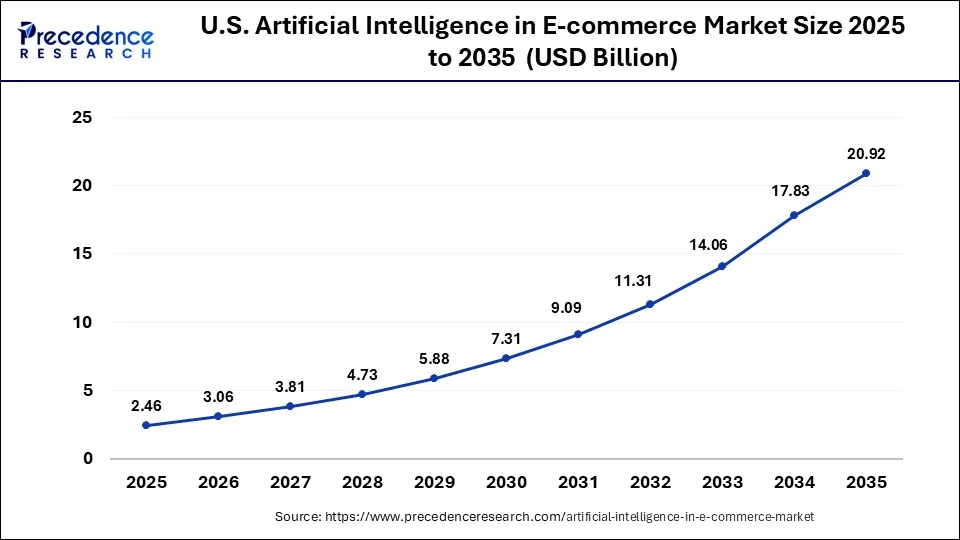
North America dominated the market in 2025 and is likely to maintain its position during the forecast period, owing to its high expenditure on artificial intelligence solutions in the government and public sector. Furthermore, throughout the forecast period, the usage of artificial intelligence (AI) technology for the automation of industrial machinery is likely to boost the market for artificial intelligence (AI) technology in e commerce. However, Asia-Pacific is predicted to rise significantly throughout the projection period as a result of the area's economic and technical improvements, which are expected to propel the expansion of artificial intelligence solutions in the region in the future years. Consumers are quite particular about the product's quality, content, and pricing. North America has one of the highest rates of internet penetration. The Middle East, Africa, and Latin America are likely to increase significantly in the next years as a result of a growing young population and a quickly evolving internet purchasing sector.
U.S. Artificial Intelligence in E-commerce Market Trends
From e-commerce to agriculture, the US is considered the leading adopter of cutting-edge technology in all fields. Many businesses in the US have embraced AI-driven e-commerce solutions, including Netflix, which makes tailored app recommendations using AI. Additionally, the nation is investing a sizable amount of money in technology with a focus on developing the use of AI in every industry.
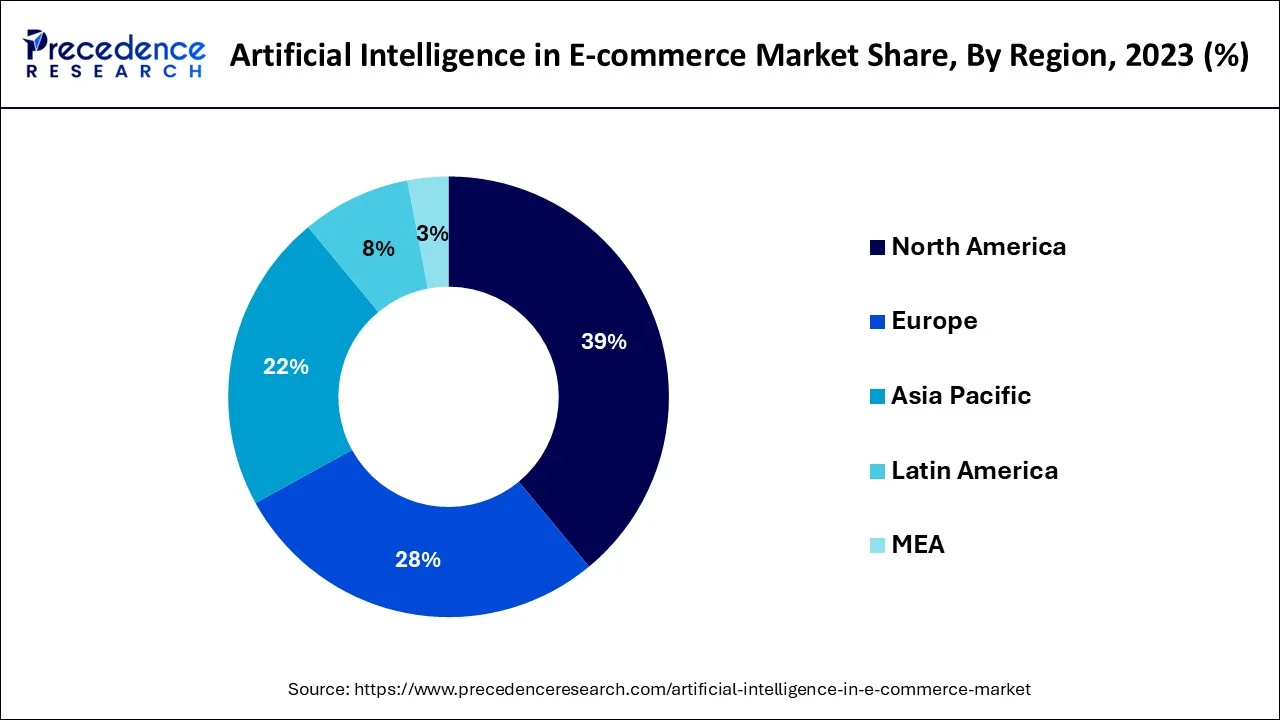
North America, Europe, Asia-Pacific, and the rest of the world are some of the geographical areas that are used to further evaluate the worldwide AI in e-commerce market. In 2025, North America made major contributions to the worldwide market for AI in e-commerce. From e-commerce to agriculture, the US is considered as the leading adopter of cutting-edge technology in all fields. Many businesses in the US have embraced AI-driven e-commerce solutions, including Netflix, which makes tailored app recommendations using AI. Additionally, the nation is investing a sizable number of money in technology with a focus on developing the uses of AI in every industry. In addition, Asia-Pacific is anticipated to develop at the quickest rate throughout the forecast period in the worldwide AI in e-commerce market. Asia-Pacific is making a mark in AI-driven solutions across several industries, including e-commerce.
China Artificial Intelligence in E-commerce Market Trends
In the Asia Pacific, China dominated the market owing to the ongoing development of customised and automated technologies such as recommendation engines and chatbots. Also, the country has been at the top of live streaming e-commerce, using AI to improve consumer engagement and sales through these platforms.
Europe is expected to grow at a notable CAGR over the forecast period. The growth of the region can be attributed to the ongoing government initiatives supporting AI development, coupled with the growing adoption of AI-powered solutions. In addition, businesses in the region are using AI to enhance demand forecasting and improve delivery times.
Germany Artificial Intelligence in E-commerce Market Trends
The growth of the market in Germany can be driven by growing demand for operational efficiency and a supportive AI innovation ecosystem. German consumers increasingly expect catered online shopping experiences, from individualized product recommendations to customized website layouts.
Artificial Intelligence in E-commerce Market Companies
- Google Cloud AI: Provides machine learning tools and infrastructure for e-commerce, allowing for custom model development and powerful data analysis.
- Amazon Web Services, Inc.: Offers AI services such as Rekognition for visual analysis and personalization for tailored product recommendations.
Other Major Key Players
- Google LLC
- IBM Corporation
- Intel Corporation
- Microsoft Corporation
- Nvidia
- Oracle Corporation
- SAP SE
- Siemens
Key market developments
- LivePerson, Inc. bought German conversational A.I. business e-bot7 in July 2021. The strategic purchase strengthens LivePerson's self-service capabilities, allowing companies of all sizes to swiftly create AI-powered messaging experiences, as well as its continuous expansion across Europe.
- LivePerson, Inc. announced A.I. Annotator in February 2021, a new solution that automates brand-consumer conservations quicker than ever before by using agents' knowledge to improve Conversational A.I.
- Nike purchased Boston-based predictive analytics business Celect (A.I. platform) in August 2019, the latest in a series of purchases to strengthen its direct-to-consumer strategy. This acquisition enabled Nike to link its inventory with the company's website and app.
Segments covered in the report
By End User
- IT and Telecommunication
- Retail and E-Commerce
- BFSI
- Healthcare
- Manufacturing
- Automotive
- Others
By Geography
- North America
- U.S.
- Canada
- Europe
- U.K.
- Germany
- France
- Asia-Pacific
- China
- India
- Japan
- South Korea
- Malaysia
- Philippines
- Latin America
- Brazil
- Rest of Latin America
- Middle East & Africa (MEA)
- GCC
- North Africa
- South Africa
- Rest of the Middle East & Africa
For inquiries regarding discounts, bulk purchases, or customization requests, please contact us at sales@precedenceresearch.com
Frequently Asked Questions





Ask For Sample
No cookie-cutter, only authentic analysis – take the 1st step to become a Precedence Research client
 Get a Sample




 sales@precedenceresearch.com
 Schedule a Meeting
