Carbon Nanotubes Market Size, Share, and Trends 2025 to 2034
Carbon Nanotubes Market (By Product Type: Single-Walled Carbon Nanotubes (SWCNTs), Multi-Walled Carbon Nanotubes (MWCNTs); By Technology: Laser Ablation of Graphite, Arc Discharge, Chemical Vapor Deposition, Catalytic CVD, High Pressure Carbon Monoxide, Floating Catalyst, Others; By Application: Electronics and Semiconductor, Energy Storage, Structural Composites, Aerospace and Defense, Chemical Materials, Medical and Pharmacy, Others) - Global Industry Analysis, Size, Trends, Leading Companies, Regional Outlook, and Forecast 2025 to 2034
 Get a Sample
 Table Of Content


What is the Carbon Nanotubes Market Size?
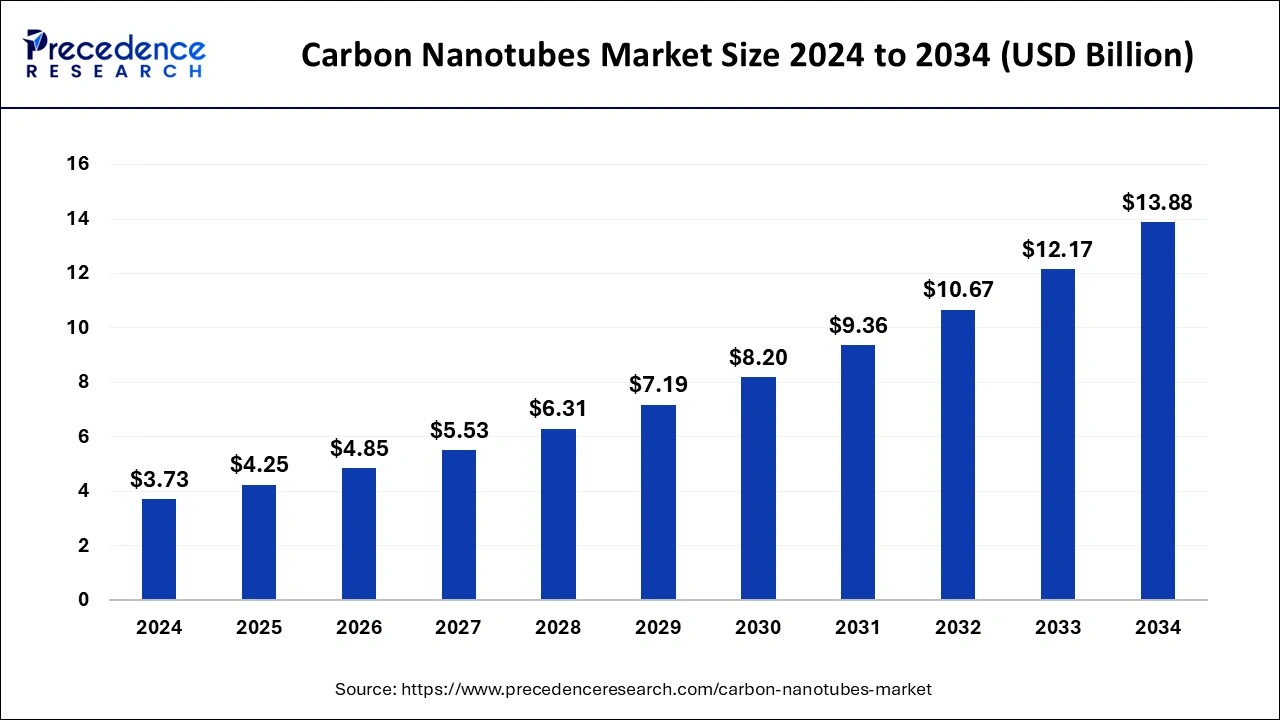
The global carbon nanotubes market size is valued at USD 4.25 billion in 2025 and is predicted to increase from USD 4.85 billion in 2026 to approximately USD 13.88 billion by 2034, expanding at a CAGR of 14.04% from 2025 to 2034.
Carbon Nanotubes Market Key Takeaways
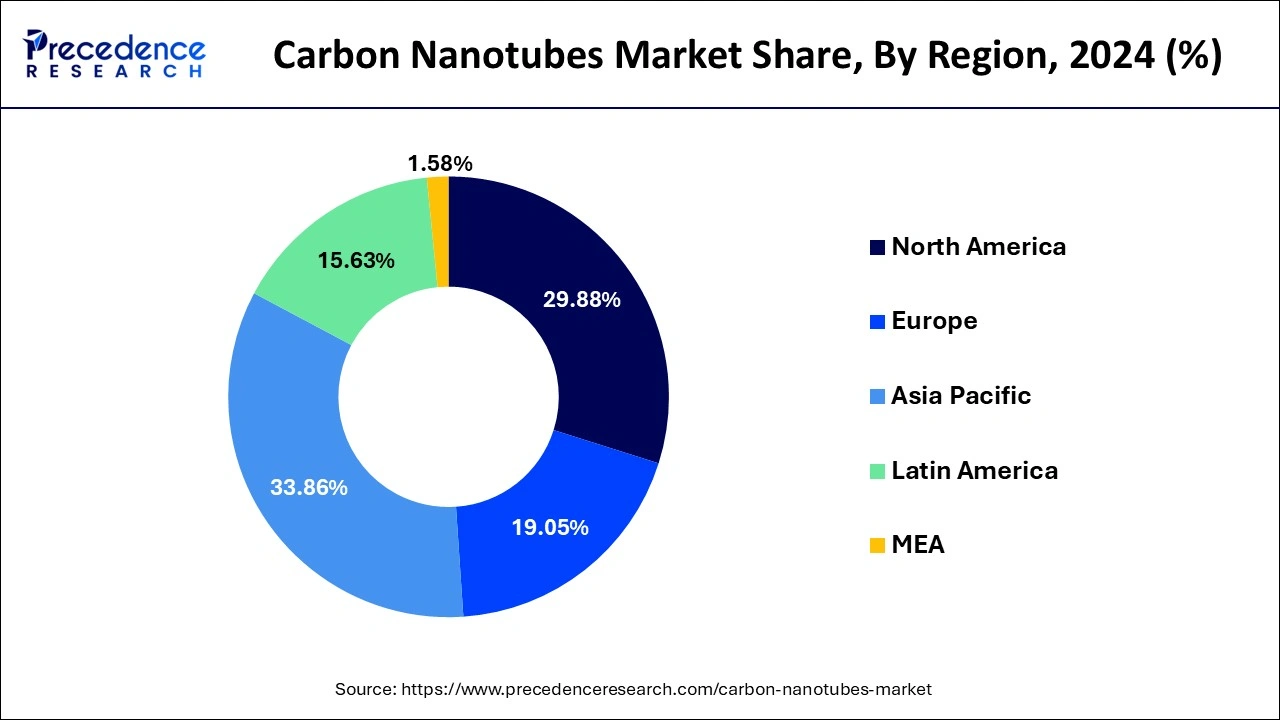
- Asia Pacific dominated the global market with the largest market share of 33.6% in 2024.
- North America is projected to expand at a notable CAGR during the forecast period.
- By product, the Multi-Walled Carbon Nanotubes segment contributed the highest market share in 2024.
- By technology , the chemical vapor deposition segment has held the largest market share in 2024.
Market Size and Forecast
- Market Size in 2025: USD 4.25 Billion
- Market Size in 2026: USD 4.85 Billion
- Forecasted Market Size by 2034: USD 13.88 Billion
- CAGR (2025-2034): 14.04%
- Largest Market in 2024: Asia Pacific
- Fastest Growing Market: North America
Market Overview
A carbon nanotube (CNT) is a tube which is made from carbon and its diameters typically measure a fewnanometres. Various health hazards which are associated with the manufacturing of carbon nanotubes are affecting the market growth to a great extent. Apart from this the high manufacturing cost also hampers the growth prospects of the carbon nanotubes market. However the increase in commercialization of carbon nanotubes and improvement in the quality will surge the demand going upward during the forecast period.
China and U.S. are major auto manufacturers and exporters of carbon nanotubes. China and the US what affected drastically due to the COVID-19 pandemic. Due to consequent lockdowns and other restrictions the supply chain and logistics were greatly affected. Most of the industries were temporarily shut down. Major supply chain disruptions were one of the most important factors that reduced the production capacity of carbon nanotubes. Many production plans were shut down during the pandemic. As there were restrictions on travel the logistics were also greatly affected. It was extremely difficult to move finished products from one place to another. Also acquiring the required raw materials was difficult during the pandemic.
- Several governments are funding nanotechnology research programs to promote innovation in CNT-based technologies.
- Incentives are being provided for the adoption of lightweight and high-performance materials in the defense and aerospace sectors.
- Regulations promoting green and sustainable technologies are encouraging the use of CNTs in renewable energy solutions.
- Educational collaborations and R&D partnerships with universities are being supported to foster advanced materials science.
AI Integration Accelerating Innovation and Efficiency in the Carbon Nanotubes Market
AI integration significantly improves the market by optimizing production processes, enhancing material design, and accelerating innovation. Through machine learning and predictive analytics, AI identifies ideal synthesis parameters, controls purity levels, and reduces defects in CNT fabrication. It also aids in modeling CNT behavior in composites, predicting performance outcomes, and discovering new functional applications in energy, electronics, and biotechnology . Additionally, AI-driven automation enhances scalability, minimizes waste, and supports sustainable anufacturing practices, ultimately driving efficiency, precision, and cost-effectiveness across the global carbon nanotubes value chain.
Key Market Trends
- Integration in electronics & semiconductors: CNTs are being increasingly used to replace silicon in transistor design, offering smaller, faster, and more energy-efficient chips.
- Growing use in energy storage: They enhance the performance of batteries and supercapacitors by improving charge capacity, conductivity, and life span.
- Eco-friendly applications: CNTs are gaining traction in water filtration, air purification, and green energy technologies, supporting the global sustainability push.
- Medical applications expanding: CNTs are being explored for targeted drug delivery, biosensors, and imaging techniques, showing promise in personalized medicine.
Carbon Nanotubes Market Growth Factors
Carbon nanotubes have electrical, physical and thermal properties which has varied application in many industries. The size of the carbon nanotubes it's a few nanometers and they have excellent properties like electrical conductivity, good amount of tensile strength and carbon nanotubes are particularly able to withstand great amount of temperature. In order to increase the strength and to provide lightweight polymers carbon nanotubes are used the reenforcing material in the polymers industry. Carbon nanotubes are also used in the manufacturing process of the turbine blades. The use of carbon nanotubes helps in improving the mechanical strength of these wind turbines. It provides a longer life for the wind turbines. Carbon nanotubes are also used for the manufacturing of electronic display screens for many electronic products. Carbon nanotubes are extensively used in the production of the display screens of television laptops, phones, computers etc as there is a great demand for electricals and electronics devices in many developing as well as the developed nations the demand for carbon nanotubes is expected to grow in these markets. The Asia Pacific region has a good amount of growth in the electrical and electronics industry.
Carbon nanotubes are extremely suitable for the electronics industry. Carbon nanotubes have great mechanical properties and electronic properties due to which they are preferred in the electronic applications. Due to the use of advancement in the technology and increasing development in this region the market is expected to grow during the forecast period. Well in the developing nations like Japan South Korea Singapore kind of China there is an increase in demand for the electronics items. Due to word demand for electronic items the manufacturing industries are procuring carbon nanotubes. There is a great demand for semiconductors in the electronics manufacturing industry. Due to the rapid technological advancements for the carbon nanotubes market and growing investments by many major market players the carbon nanotubes market is expected to have great demand in the coming years. Carbon nanotubes are finding its application in X rays. There's an increasing use of carbon nanotubes in the medical sector especially in case of tumors.
- The electronic industry is undergoing an expansion of demand in various segments as the production of semiconductors, sensors, and display screens is increasing, and CNT is thus being highlighted for its superior electrical and thermal conductivity properties.
- The trend of CNTs being utilized as reinforcement materials is gaining momentum in composites, which include polymers, metals, and ceramics, leading to the improvement of strength and the reduction of weight in the industrial sector.
- The pioneering work in renewable energy has seen CNTs playing a significant role in the enhancement of mechanical strength and efficiency of wind turbine blades, batteries, and fuel cells.
The medical and healthcare sectors have seen an increase in the application of CNTs that range from medical imaging, drug delivery, and cancer detection, which are all factors that promote their use in the healthcare sector. - Innovative technologies and R&D investments are the main drivers of the market for CNT-based materials, especially in the developing regions where the demand is higher.
Technological advancements in the market
- Multi-walled carbon nanotube (MWCNT) expansion: Ongoing improvements in synthesis methods like chemical vapor deposition (CVD) have increased yield and quality.
- Functionalization techniques: Advances in surface modification allow better dispersion in composite materials and greater compatibility with polymers and metals.
- 3D printing integration: CNTs are being used as reinforcement materials in 3D printing , leading to stronger and more conductive printed components.
- Hybrid nanomaterials: Blending CNTs with other nanomaterials like graphene is creating synergistic materials with enhanced mechanical and electronic characteristics.
Market Scope
| Report Coverage | Details |
| Market Size in 2034 | USD 13.88 Billion |
| Market Size in 2025 | USD 4.25 Billion |
| Market Size in 2024 | USD 3.73 Billion |
| Market Growth Rate from 2025 to 2034 | CAGR of 14.04% |
| Largest Market | Asia Pacific |
| Fastest Growing Region | North America |
| Base Year | 2024 |
| Forecast Period | 2025 to 2034 |
| Segments Covered | Product, Technology, Application, RegionProduct, Technology, Application, Region |
| Regions Covered | North America, Europe, Asia-Pacific, Latin America, and Middle East & Africa |
Segmental Insights
Product Insights
The Multi-Walled Carbon Nanotubes (MWCNTs) segment revenue is expected to register a significantly robust growth rate in the coming period.
The Multi-Walled Carbon Nanotubes consist of multiple layers of concentric tubes developed with graphene, and they are a nanoscale additive that can be helpful in improving the mechanical properties, as well as electrical conductivity and thermal conductivity of products in which they are combined.
Technology Insights
The chemical vapor deposition segment will have the largest market share in the future. The use of this technology helps in having carbon nanotubes which are better in quality. The chemical vapor deposition segment is also very helpful introducing the temperature of carbon decomposition. It is an important factor in the manufacturing of the carbon nanotubes.
Apart from the chemical vapor deposition segment the arc discharge segment will also show a good amount of growth rate during the forecast period. Arc discharge method helps in easy manufacturing of carbon nanotubes. With the help of Arc discharge method the complicated combination of components is created in a simpler way. The other technologies which are used in carbon nanotubes is the laser ablation of graphite , high pressure carbon monoxide and floating catalyst. due to continuous research and development work in this field for the techniques used in carbon nanotechnology the production of carbon nanotubes will increase in future.
Application Insights
Electronics & semiconductor segment is also estimated to register a good growth rate in the forecast period, due to an increasing demand to meet the needs from the various manufacturing industry across the globe. Also, CNTs are extensively used in the fabrication process of the diodes which is done with the help of polymer coating process and it is estimated to increase the revenue growth of this segment during the forecasted period. In the medical and pharmacy industry carbon nanotubes happen to be of great help in the diagnosis of cancer and its treatment. Carbon nanotubes happen to be a great antioxidant. With the use of carbon nanotubes the drugs can be delivered to the affected cells or tissues. All of these reasons or extremely important for the growth of the medical and pharmacy segment.
Regional insight
Asia Pacific Carbon Nanotubes Market Size and Growth 2025 to 2034
The Asia Pacific carbon nanotubes market size was evaluated at USD 1.25 billion in 2024 and is projected to be worth around USD 4.67 billion by 2034, growing at a CAGR of 14.04% from 2025 to 2034.

Due to a growth in the automobile industry, construction industry, aerospace industry and electronics industry in specific nations like India, China, Japan and Malaysia in the Asia Pacific region will boost the market in the future. There is an increase in the manufacturing of electronic items in South Korea, Japan, China and Singapore and it is expected to help in the growth of the market. Increasing demand for circuit boards will increase the usage of this product. The consumer electronics market expected to grow in the Asia Pacific region and this will strengthen it's shared in the global market. India imported electronics worth U.S.$50 billion in the recent years. 5G smartphones worth 4 million and above were shipped. As there is a growing demand for carbon nanotubes in many end user industries there shall be a growth in the market.
Developing nations in the Asia Pacific region are expected to drive the market during the forecast period. Nations like India China Japan and South Korea shall have the maximum market share during the forecast period. Low cost of Labor is one of the main reasons supporting the manufacturing of carbon nanomaterials in this region. Largely available raw materials in the Asia Pacific region we will drive the market growth. Asia Pacific region is seeing an increase in demand for electrical and electronics products. The automobile industries electronic industries instruction industries and the aerospace industries widely used carbon nanotubes in their manufacturing processes. The polymer industry is expected to have a good growth during the forecast period across many nations like Malaysia, Japan, India and China. Governments are investing on producing more and more solar cells which make use of carbon nanotubes. Increased production of the solar cells shall lead to the growth of the carbon nanotubes in this market.
Asia Pacific Top countries
Emerging as a Global Powerhouse
- China: Leads in both CNT production and consumption. Massive investments in electronics, automotive, and renewable energy drive demand.
- Japan: Known for high-end nanomaterials R&D, with leading companies integrating CNTs into advanced electronic components.
- South Korea: Strong presence in the semiconductor and battery industry makes it a significant player in CNT adoption.
- India: Rising interest in electric vehicles and clean energy has spurred CNT applications in battery tech and filtration.
North America Carbon Nanotubes Market Analysis
North America is expected to grow at the fastest rate in the coming years, primarily because it boasts a strong R&D ecosystem, robust manufacturing infrastructure, and substantial government backing. The U.S. leads the region's market thanks to increasing demand for CNTs in electronics, automotive (particularly EV battery applications), aerospace, and defense sectors. Technical advances in nanomaterial synthesis and the commercialization of CNTs for high-performance composites and energy storage further accelerate adoption. Moreover, supportive policies around clean energy and lightweight materials bolster the region's growth prospects.
North America's major factors leading towards the growth of this region
A Fertile Ground for Innovation and Scale
- Robust R&D ecosystem: World-class research institutions and universities are pushing the frontiers of CNT applications in electronics and medicine.
- Government funding: Agencies are investing in nanotech programmes for defence, aerospace, and clean energy.
Industrial demand: Key industries like aerospace, automotive, and healthcare are integrating CNTs for enhanced performance and reduced weight. - Focus on sustainability: CNTs' potential in energy-efficient solutions and environmental applications aligns with green energy policies.
Startup ecosystem: Numerous startups are innovating in CNT synthesis and product integration, contributing to a dynamic market landscape.
Europe Carbon Nanotubes Market Analysis
Europe is experiencing significant growth in the market thanks to strong policy support for advanced materials and sustainability, coupled with increasing demand across automotive, aerospace, and energy storage sectors. For instance, Germany leads the region, driven by its robust manufacturing base and a push to integrate CNT-reinforced composites into electric vehicles to reduce weight and improve battery efficiency. Research and development collaborations and public funding have also expanded nanotechnology adoption, especially in recyclable and lightweight materials. The regulatory emphasis on eco-friendly production and the European Green Deal further enhances the uptake of CNT applications across industries.
Latin America Carbon Nanotubes Market Analysis
Latin America's carbon nanotubes market is experiencing a notable rise, driven by increasing industrial and technological adoption across sectors such as automotive, energy storage, and electronics. Brazil, in particular, is a leading market in the region, driven by its sizeable automotive production base and growing investment in nanotechnology R&D hubs. The desire for lightweight composites in vehicles, the expansion of battery materials and energy storage applications, and the shift towards advanced materials in manufacturing underpin the rising demand for CNTs in Latin America.
Middle East and Africa Carbon Nanotubes Market Analysis
The Middle East & Africa (MEA) is poised for strong growth in the market, driven by significant investments in renewable energy projects, advanced materials for infrastructure, and the expanding electronics and aerospace sectors. For instance, Saudi Arabia is emerging as a regional leader, thanks to initiatives under its Vision 2030 plan that emphasize nanotechnology and composites for energy storage and lightweight transportation components. Additionally, government-backed nanotechnology R&D hubs in the Gulf and South Africa are increasing the adoption of CNTs across applications such as structural composites, semiconductors, and smart coatings.
Value Chain Analysis
1. Feedstock Procurement
- Sourcing hydrocarbon gases (methane, ethylene, acetylene) or graphite as raw materials.
- Ensuring quality control and stable supply chains for carbon precursors.
- Procuring catalysts such as iron, nickel, or cobalt for CNT synthesis.
Organizations:
ExxonMobil, BASF SE, SABIC, LG Chem, and Linde plc.
2. Chemical Synthesis and Processing
- CNT production via methods like Chemical Vapor Deposition (CVD), Arc Discharge, or Laser Ablation.
- Purification, sorting (single-walled vs multi-walled CNTs), and surface functionalization.
- Integration into composite materials, conductive films, or battery electrodes.
Organizations:
Arkema S.A., Showa Denko K.K., Nanocyl S.A., OCSiAl, and Hyperion Catalysis International.
3. Waste Management and Recycling
- Collecting and treating CNT-containing waste materials.
- Implementing filtration, chemical oxidation, or thermal decomposition for residue removal.
- Recovering usable carbon material and minimizing environmental impact.
Organizations:
Veolia Environnement, Covestro AG, Umicore, Clean Harbors, and BASF Circularity Solutions.
4. Regulatory Compliance and Safety Monitoring
- Ensuring compliance with occupational health, environmental, and nanomaterial handling regulations.
- Monitoring emissions, exposure levels, and toxicity testing.
- Obtaining certifications and adhering to global safety frameworks.
Organizations:
U.S. Environmental Protection Agency (EPA), European Chemicals Agency (ECHA), Occupational Safety and Health Administration (OSHA), ISO Nanotechnology Standards, and REACH (Registration, Evaluation, Authorisation, and Restriction of Chemicals).
Carbon Nanotubes Market Companies
- Arkema S.A.: Offers its Graphistrength line of carbon nanotubes and CNT-reinforced composites for high-performance applications such as lightweight materials and conductive additives.
- Cabot Corporation: Produces the ENERMAX™ series of CNTs with high conductivity for battery electrodes and energy storage applications, supported by strong R&D capabilities.
- Chasm Advanced Materials Inc.: Provides innovative CNT technologies and specializes in CNT-based materials for advanced composites, coatings, and electronic applications.
- Showa Denko K.K.: Develops high-performance CNT dispersions and advanced nanomaterial solutions for electronics, thermal management, and composite materials.
- Thomas Swan and Co. Ltd.: Supplies specialty CNTs through high-purity synthesis and tailored formulations for research and industrial use.
- Tokyo Chemical Industry Co. Ltd.: Offers carbon nanotube products for research and development, supporting academic and industrial innovation in nanomaterials.
- Toray Industries Inc.: Applies CNT-enhanced composites and films in lightweight automotive and aerospace components, leveraging its expertise in advanced materials.
- Cheap Tubes: Manufactures and distributes a wide range of CNTs for research and commercial applications, making CNT technology accessible to global markets.
- Hyperion Catalysis International: A pioneer in CNT technology, providing FIBRIL™ multi-walled carbon nanotubes and licensing CNT solutions for conductive composites.
- LG Chem Ltd.: Integrates CNTs into advanced battery and energy storage solutions, using them as conductive additives in lithium-ion electrodes.
- Nano-C: Develops CNT-based materials for electronics, sensors, and composite reinforcement, expanding CNT applications in high-tech industries.
- Nanocyl SA: Specializes in industrial-scale production of multi-walled carbon nanotubes (MWCNTs) and CNT dispersions for transport, electronics, and energy sectors.
- Nanostructured & Amorphous Materials Inc.: Provides CNTs and nanomaterials for use in advanced composites and functional materials, enhancing mechanical and electrical properties.
- NoPo Nanotechnologies: Supplies high-purity CNTs and nano-additives for electronics, energy storage, and conductive applications.
- Klean Industries Inc.: Develops CNT technologies to support sustainable and clean-energy materials markets, emphasizing eco-friendly production methods.
- Kumho Petrochemical Co., Ltd.: Produces CNT-reinforced materials for high-performance composites, particularly in automotive and industrial applications.
- Raymor Industries Inc.: Manufactures high-quality CNTs for advanced materials, including conductive coatings, batteries, and structural composites.
- Integra LifeSciences: While not a major CNT producer, it contributes indirectly through advanced material research relevant to biomedical and regenerative applications.
- Ossila Ltd.: Supplies CNT materials and related nanotechnology products for academic and industrial R&D in electronics and materials science.
Recent Developments
- In August 2025, Nanotherm and Battelle are launching Novara™ to advance next-generation heating solutions for automotive, industrial, and consumer markets.
(Source: https://www.businesswire.com) - In May 2025, Scientists from Japan's RIKEN Center found carbon nanotubes emit more energetic light than absorbed, impacting future solar energy technologies.
(Source: https://interestingengineering.com) - In January 2025, Researchers at Rice University developed a breakthrough method to recycle carbon nanotube fibers without compromising their structural integrity. This process enables the restoration of CNTs from waste and end-of-life products, supporting sustainable material usage. It has significant potential for large-scale industrial applications, particularly in electronics and composite materials.
(Source: news.rice.edu ) - In May 2025, OCSiAl partnered with Molicel to enhance ultra-high-power lithium-ion batteries using single-wall CNT additives. The incorporation of CNTs improves energy density, conductivity, and thermal stability in battery cells. This collaboration aims to accelerate the adoption of CNT-enhanced energy storage solutions in electric vehicles and high-performance electronics.
(Source: ocsial.com ) - In June 2025, Scientists at the Korea Institute of Science and Technology developed a purification process using liquid-crystal alignment to remove metallic impurities from CNTs. This method significantly increases electrical conductivity and reliability of CNTs for industrial applications. It opens new opportunities for high-performance electric motors and conductive composites.
(Source: nanotechnologyworld.org ) - In July 2025, NanoIntegris Technologies launched a high-purity CNT product line targeting electronics and next-generation display applications. These CNTs are optimized for semiconductors, flexible electronics, and advanced display technologies. The launch addresses the growing demand for high-performance nanomaterials in precision applications.
Segments Covered in the report
By Product Type
- Single-Walled Carbon Nanotubes (SWCNTs)
- Multi-Walled Carbon Nanotubes (MWCNTs)
By Technology
- Laser Ablation of Graphite
- Arc Discharge
- Chemical Vapor Deposition
- Catalytic CVD
- High Pressure Carbon Monoxide
- Floating Catalyst
- Others
By Application
- Electronics and Semiconductor
- Energy Storage
- Structural Composites
- Aerospace and Defense
- Chemical Materials
- Medical and Pharmacy
- Others
By Region
- North America
- Latin America
- Europe
- Asia-pacific
- Middle and East Africa
For inquiries regarding discounts, bulk purchases, or customization requests, please contact us at sales@precedenceresearch.com
Frequently Asked Questions
Tags





Ask For Sample
No cookie-cutter, only authentic analysis – take the 1st step to become a Precedence Research client



 sales@precedenceresearch.com
 +1 804-441-9344
 Schedule a Meeting