



Dark Store Market Size, Key Companies, Company Market Share, Sales Volume, Consumer Demand, Pricing Trends, Distribution Performance, Competitive Positioning, and Growth Forecast
Dark Store Market (By Age Group: Children, Adults, Elderly; By Category: Groceries, Meat, Dairy; By Delivery Options: Curbside Pickup, In-Store Pickup, Home Delivery; By Non-Food Products: Cleaning, Essentials, Bath & Body) - Global Industry Analysis, Size, Trends, Leading Companies, Regional Outlook, and Forecast 2026 to 2035
Source: https://www.precedenceresearch.com/dark-store-market
 Get a Sample
 Table Of Content


What is the Dark Store Market Size?
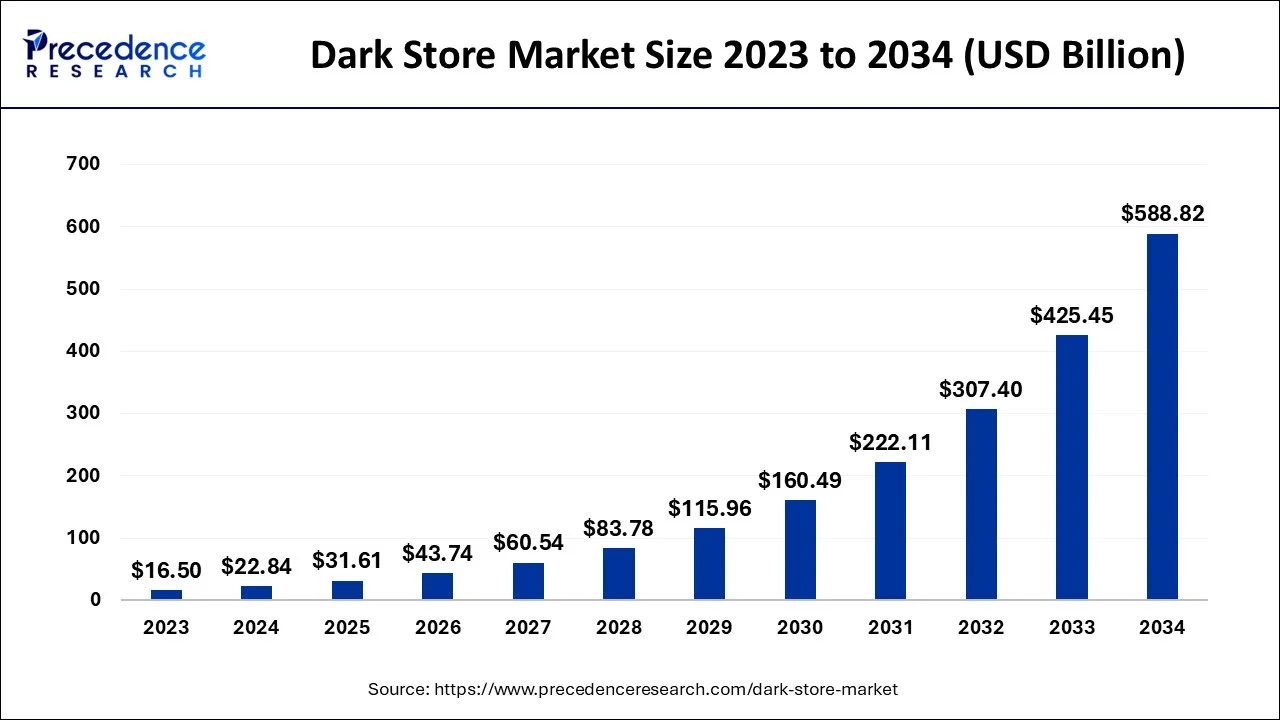
The global dark store market size accounted for USD 31.61 billion in 2025 and is anticipated to reach around USD 721.98 billion by 2035, expanding at a CAGR of 36.73% between 2026 to 2035. The market is driven by the rising trend of online grocery shopping, the expansion of e-commerce platforms, and the growing focus of retailers on faster, cost-efficient last-mile fulfilment models.
Market Insights
- In terms of revenue, the market is valued at USD 31.61 billion in 2025.
- It is projected to reach USD 721.98 billion by 2035.
- The market is expected to grow at a CAGR of 36.73% from 2026 to 2035.
- By region, North America dominated the dark store market in 2025.
- By age group, the adults segment dominated the market in 2025. 
- By category, the groceries segment dominated the market in 2025.
- By delivery options, the home delivery segment dominated the market in 2025.
- By non-food products, the essentials segment dominated the market in 2025.
Market Overview
A micro fulfillment center, with a small local store but without customers, basically dedicated to rapid online fulfillment is known as a Dark Store. The increased utilization of smartphones and easy availability of the internet boost the dark store industry. These stores mainly ship the orders directly to the convenient collection point or address specified by the customer. The Dark Stores are used for faster delivery and quick shopping. The Dark store became well-known due to the long lockdown during the COVID-19 Pandemic.
Dark stores are specialized fulfillment centers designed exclusively for processing online orders and are not accessible to walk-in customers. These facilities enable retailers to streamline order fulfillment, improve inventory management, and significantly reduce delivery times. As consumer preference for convenient online shopping and rapid home delivery services continues to grow, the adoption of the dark store model is increasing across retail markets.
The market is being driven by the rapid expansion of e-commerce, increasing urbanization, and rising demand for same-day and ultra-fast delivery services. Furthermore, advancements in inventory management technologies, automation systems, and logistics infrastructure are enhancing operational efficiency and supporting market growth. Improved supply chain visibility and optimized last-mile delivery operations are also contributing to the widespread adoption of dark stores.
In India and other emerging economies, dark stores have become a critical component of the quick-commerce ecosystem. To meet the growing demand for rapid delivery of groceries, household essentials, and daily-use products, retailers and quick-commerce providers are expanding their fulfillment networks through strategically located dark stores. Rising consumer expectations for convenience, coupled with increasing digital commerce penetration, are expected to further strengthen the role of dark stores in shaping the future of retail fulfillment and last-mile delivery services.
Today, a number of well-known supermarket chains across the world are experimenting with dark shops. The bulk of these stores are larger than 100,000 square feet and include specialized in-house equipment including food processing, cold press systems, slaughtering lines, etc. The typical dark stores, on the other hand, tend to be smaller in size, covering 10,000 to 20,000 square feet.
Market Trends
- Rapid growth of e-commerce and online growth is increasing demand for dark stores.
- Rising consumer preference for fast, convenient, and same-day delivery services is supporting market expansion.
- Growing urbanization and busy lifestyles are driving the adoption of quick commerce and on-demand delivery models.
- Automation, artificial intelligence, and advanced inventory management improve operational efficiency and order accuracy.
- Increased investment in logistics infrastructure and last-mile delivery networks is enhancing fulfilment capabilities.
- Retailers are expanding dark store networks to improve speed and strengthen customer satisfaction.
- The increase in the use of data analytics is helping businesses optimize inventory and reduce operational costs.
- Intensifying competition among market participants is driving innovation and delivery services, technology adoption, and customer experience.
- Extension of quick commerce platforms and growing internet penetration are creating new growth opportunities.
- Rising demand for efficient supply chain management and reliable order fulfilment is expected to support long-term market growth.
How Does AI Impact the Dark Store Market?
AI is the foundational technology driving the rapid expansion and efficiency of the dark store industry, allowing "Q-commerce" (quick commerce) to achieve delivery promises of 10–30 minutes. By improving inventory, automating picking, and forecasting demand, AI helps reduce operational expenses by 25–30% and dramatically lowers logistics costs. Robotics and computer vision thus cut order-processing time to as low as one minute, remarkably improving throughput.
Market Scope
| Report Coverage | Details |
| Market Size in 2025 | USD 31.61 Billion |
| Market Size in 2026 | USD 190.16 Billion |
| Market Size by 2035 | USD 721.98 Billion |
| Market Growth Rate from 2026 to 2035 | CAGR of 36.73% |
| Dominating Region | North America |
| Fastest Growing Region | Asia Pacific |
| Base Year | 2025 |
| Forecast Period | 2026 to 2035 |
| Segments Covered | By Age Group, Category, Delivery Options, Non-Food Products, and Region |
| Regions Covered | North America, Europe, Asia-Pacific, Latin America, and Middle East & Africa |
Market Dynamics
Driver
Rising Demand for Convenient Shopping Experience
The dark store market is primarily driven by the rising demand for quick, contactless, and convenient shopping experiences. Increasing consumer preference for faster delivery services and a wider product assortment has encouraged retailers to adopt dark store models for efficient order fulfilment. These facilities enable improved product distribution, optimized inventory management, and enhanced storage capabilities for multiple brands.
Additionally, dark stores allow retailers to expand into new geographic regions without the need to establish traditional physical retail outlets. The rapid growth of e-commerce, coupled with increasing urbanization and shifting consumer buying behavior toward online platforms, has further accelerated market adoption. The expansion of product categories beyond FMCG and groceries, as highlighted by industry observations, is also contributing to market growth.
Restraint
Concerns Over Product Safety
The dark store market faces several operational challenges. Product perishability remains a key concern, particularly for groceries and temperature-sensitive items, requiring strict storage and handling conditions. Improper packaging or handling issues, such as leakage or loss of product integrity, can negatively impact operational efficiency.
Location strategy also plays a crucial role, as poorly placed dark stores can increase delivery time and logistics costs. Additionally, longer delivery routes and the need for handling click-and-collect orders contribute to higher transportation and operational expenses. Limited scalability in certain densely populated or high-cost urban areas further constrains market expansion.
Opportunity
Growing Demand for Ultra-Fast Delivery
The growing demand for ultra-fast delivery services presents significant opportunities for the dark store market. Increasing consumer reliance on online shopping has permanently shifted buying behavior toward digital channels. This trend has created strong demand for same-day and rapid delivery models. Retailers are increasingly investing in automation and advanced technologies such as robots for order picking, packing, and fulfillment to improve efficiency and reduce operational costs.
The integration of autonomous systems, AI-driven inventory management, and smart logistics solutions is expected to further enhance scalability and performance. Additionally, the expansion of quick-commerce platforms and evolving consumer expectations for convenience continue to open new growth avenues for dark store operators globally.
Segment Analysis
Age Group Insights
Why Did the Adults Segment Dominated the Dark Store Market in 2025?
The adults segment dominated the market with the largest share in 2025. This is mainly due to high digital adoption, stronger purchasing power, and busy lifestyles that prioritize convenience. Working professionals and family households increasingly rely on dark store services for groceries and daily essentials due to the time-saving benefits and rapid delivery options. In addition, strong familiarity with e-commerce platforms, digital payments, and quick-commerce applications further reinforces adoption among adults, establishing them as the key consumer group in the market.
The elderly segment is expected to grow at the fastest rate in the market during the forecast period, driven by increasing digital literacy, rising smartphone usage, and growing preference for home delivery services. Elderly consumers are increasingly adopting online platforms to purchase groceries, medicines, and household essentials, reducing the need for physical store visits. The availability of user-friendly applications, simplified ordering processes, and reliable delivery systems is further enhancing accessibility and supporting segment growth.
Category Insights
The Groceries Segment Dominated the Dark Store Market in 2025
The groceries segment held the largest market share in 2025. This dominance is driven by the high frequency of grocery purchases and the increasing shift toward online shopping for daily essentials. Demand for fresh food, packaged goods, and household necessities delivered through quick-commerce platforms has significantly increased. The expansion of dark store networks, improved digital infrastructure, and growing consumer preference for convenience have further strengthened this segment's leading position.
The meat segment is projected to grow at the fastest CAGR during the forecast period, driven by increasing consumer demand for fresh, high-quality meat products available through rapid delivery services. Dark stores support this demand through advanced cold storage systems, temperature-controlled logistics, and efficient inventory management. These capabilities ensure product freshness while enabling faster fulfillment. As quick-commerce platforms continue to expand and cold-chain logistics improve, the meat segment is expected to witness strong growth.
Delivery Options Insights
What Made Home Delivery the Dominant Segment in the Dark Store Market?
The home delivery segment dominated the market in 2025 due to strong consumer preference for convenience, time savings, and contactless shopping. Increasing urbanization, busy lifestyles, and growing online shopping adoption have further strengthened demand for doorstep delivery services. Advanced logistics systems, optimized routing, and real-time inventory management enable dark stores to provide fast and reliable delivery, making home delivery the preferred fulfillment method for most consumers.
The curbside pickup segment is expected to grow at the fastest rate during the forecast period. This growth is driven by its convenience, speed, and cost-effectiveness, allowing consumers to collect orders without entering stores or paying delivery fees. Retailers benefit from reduced last-mile delivery costs and improved operational efficiency. Increasing consumer preference for flexible and contactless shopping options, along with expanding pickup infrastructure in urban and suburban areas, is further supporting segment growth.
Non-Food Products Insights
Why Did The Essentials Segment Dominated the Dark Store Market in 2025?
The essentials segment dominated the market with a major share in 2025. This is because people keep buying household supplies, personal care, cleaning stuff, and healthcare products constantly. The convenience of quick online ordering and fast delivery has significantly increased demand for these everyday necessities. Dark stores enable efficient inventory management and rapid order fulfillment, while the expansion of quick-commerce platforms further supports consistent demand.
The cleaning segment is expected to grow at the fastest CAGR during the forecast period, driven by increasing awareness of hygiene and cleanliness, leading to higher consumption of cleaning products such as detergents and disinfectants. The availability of fast delivery services through quick-commerce platforms has further boosted demand. Rising consumer preference for convenient home delivery and improved accessibility to cleaning essentials are key factors supporting strong growth in this segment.
Key Emerging Innovations in the Dark Store Market
|
Innovation Focus |
Core Description |
Primary Benefit |
|
AI and Predictive Analytics |
ML and automated dashboards that analyze real-time consumer data and geospatial density to optimize stock. |
Eliminates stockouts, minimizes food/product waste, and forecasts hyper-local demand. |
|
Automated Picking Systems |
Integration of compact robotics, A-Frame dispensers, and smart conveyors into urban micro-fulfillment centers. |
Reduces picker walking time, accelerates packing speeds, and drives improvements in inventory accuracy. |
|
Sustainable Micro-Logistics |
Real-time smart route optimization via Shadowfax and adoption of electric vehicle last-mile fleets. |
Cuts final-mile travel distance, reduces carbon emissions, and ensures profitability for rapid delivery models. |
Regional Insights
What is the U.S. Dark Store Market Size?
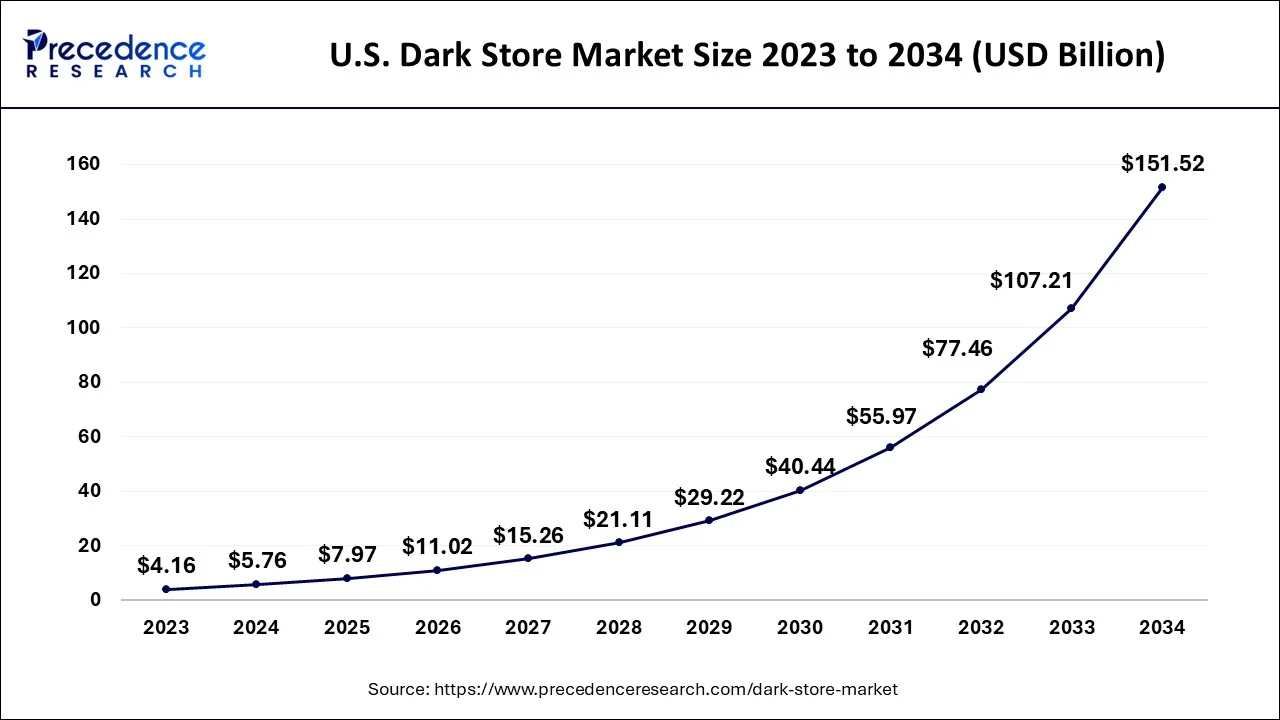
The U.S. dark store market size was estimated at USD 7.97 billion in 2025 and is expected to be worth around USD 186.12 billion by 2035, growing at a CAGR of 37.04% between 2026 to 2035.
Why Did North America Dominate the Dark Store Market in 2025?
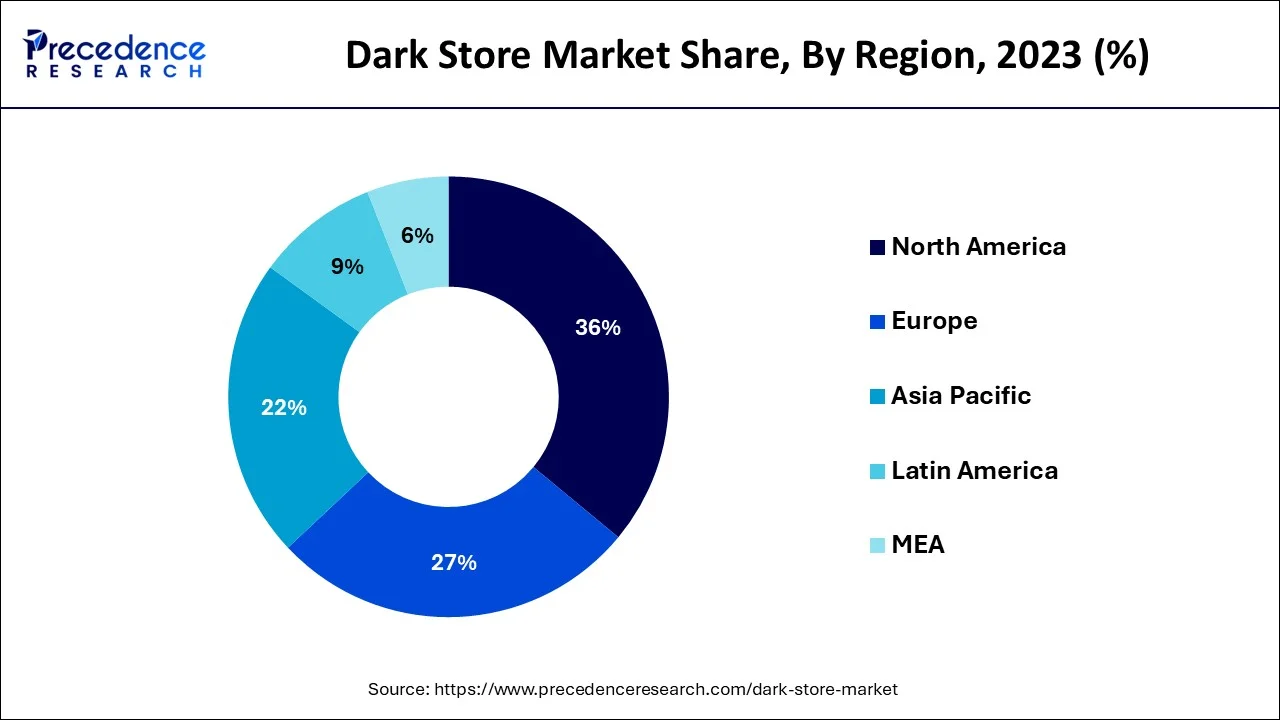
North America dominated the market in 2025 by capturing the largest share. This is because of its highly developed retail ecosystem, advanced logistics infrastructure, and strong consumer expectations for fast delivery services. Widespread internet penetration and high smartphone usage have significantly boosted online grocery ordering across the region. In addition, substantial investments in automation technologies and micro-fulfillment centers have enabled retailers and quick-commerce companies to scale operations efficiently, further strengthening North America's market position.
U.S. Dark Store Market Trends
The U.S. market is experiencing strong growth due to rising demand for fast grocery delivery and enhanced convenience. Retailers are increasingly investing in AI-driven automation and advanced fulfillment technologies to improve operational efficiency. The expansion of micro-fulfillment centers is playing a key role in accelerating order processing and reducing delivery times.
The growth of omnichannel retail strategies and continuous improvements in logistics infrastructure are supporting market expansion. Increasing urbanization is also facilitating the adoption of same-day and rapid delivery services. Companies are heavily investing in last-mile delivery innovations to enhance customer experience and maintain a competitive advantage in the U.S. market.
How Does Asia Pacific Influence the Dark Store Market?
Asia-Pacific region is experiencing rapid growth in the dark store market during the forecast period. This growth is driven by the surge in online shopping, increasing urbanization, and the adoption of technology. Consumers are demanding faster and more convenient delivery options, leading to a preference for online grocery shopping and same-day delivery services provided by dark stores that can efficiently handle orders. Additionally, in countries like Japan, where labor shortages pose challenges, automation plays a crucial role in improving efficiency and speeding up order fulfillment.
China Dark Store Market Trends
The market in China is expanding rapidly due to its large e-commerce user base, widespread smartphone adoption, and increasing demand for ultra-fast delivery services. Retailers and quick-commerce platforms are actively expanding their dark store networks to improve fulfillment efficiency and reduce delivery times. Moreover, advancements in digital payment systems, AI-based inventory management, and smart logistics solutions are streamlining operations and improving supply chain efficiency. Continued urbanization and evolving consumer shopping preferences are further driving demand for fast, convenient online purchasing options across the country.
Why is the Dark Store Market Becoming Essential in Latin America?
Latin America is expected to show notable growth during the forecast period. They directly tackle the region's intense urban congestion, fragmented infrastructure, and rising consumer need for sub-hour delivery. By acting as hyperlocal, thus, closed-to-the-public mini-warehouses placed in densely populated areas, and even dark stores, solve the "last mile" puzzle, decreasing delivery times from days to minutes.
Brazil Market Trends
It is driven by high e-commerce needs and a demand for fast logistics; dark stores are seeing strong investment in metropolitan areas to facilitate same-day or near-instant delivery. Consumers are increasingly opting for subscription-driven, routine delivery services, encouraging dark stores to provide regular, tailored deliveries.
Will the Middle East and Africa Grow in the Dark Store Market?
The Middle East and Africa are expected to show lucrative growth during the forecast period. By acting as hyperlocal, customer-free fulfillment centres, they are thus addressing infrastructure difficulties and driving the need for 10–30 minute delivery in urban centers, such as Dubai. Integrated cold and dry storage in dark stores allows the safe and fresh delivery of dairy, meat, and frozen products, addressing a major challenge in hot climates.
UAE Market Trends
It is driven by high smartphone penetration and the need for fast e-commerce. Operators are thus heavily investing in AI-driven inventory management and automated picking, alongside advanced cold-chain storage to raise speed and accuracy. Groceries are having a growing impact on fresh, local, and organic dairy products because of advancements in cold-chain logistics.
A notable Region in the Dark Store Market
Europe is a notable region in the dark store market. This growth is stemming from High internet penetration, and substantial investments by e-commerce companies are driving this expansion. Major players in the e-commerce sector are heavily investing in dark stores across Europe to minimize delivery times and reduce operational costs. These dark stores are often strategically located in major urban centers, optimizing delivery times and enhancing efficiency for online orders. As a result, the European dark store market is becoming a key area for growth and development, with many countries, including the U.K., Germany, and France, at the forefront of dark store adoption. Retailers in these regions are actively implementing dark store models to boost their online sales.
UK Market Trends
The UK is a major contributor to the European dark store market due to its highly developed e-commerce ecosystem, strong penetration of quick-commerce services, and dense urban population that supports rapid delivery models. High consumer demand for convenience, along with advanced logistics infrastructure and widespread adoption of online grocery shopping, has accelerated the expansion of dark stores across major UK cities. In addition, significant investments by retailers and quick-commerce companies in micro-fulfillment centers and same-day delivery services further strengthen the country's leadership in the region.
Competitive Landscape
The dark store market is highly competitive, with quick-commerce companies, e-commerce platforms, and large retail chains leading the industry. Competition is primarily based on delivery speed, operational efficiency, and customer convenience. Major players such as Blinkit, Zepto, and Swiggy Instamart are expanding their market presence by strengthening fulfillment networks and adopting advanced technologies.
These companies are increasingly investing in AI-driven inventory management systems, real-time demand forecasting, and optimized supply chain operations to improve efficiency and reduce delivery times. The rapid rollout of same-day and ultra-fast delivery services, along with strategic partnerships with retailers, is further enhancing market expansion.
Key Players of the Market
To make groceries and other necessities easily accessible and quickly available on one platform, a number of market players are working to improve their current products. For instance, meal delivery services like Deliveroo and Uber Eats included groceries in August 2020.
Value Chain Analysis – Dark Store Market
- Research and Development
This identifies target consumer demographics, develops proprietary algorithms, and performs initial testing in laboratory and tech-sandbox environments.
Key Players: Instacart, Ocado, Bringg, and Amazon. - Supply Chain and Procurement
This negotiates and procures high-velocity inventory directly from FMCG brands and local manufacturers.
Key Players: Unilever and Nestle. - Micro-Warehousing
This focuses on the highly optimized, physical storage and picking process. Dark stores function as micro-fulfillment centers closed to the public.
Key Players: Zepto, Blinkit, Swiggy Instamart, Getir, JOKR, and AutoStore. - Hyperlocal Logistics and Delivery
This involves specialized, short-haul, and real-time logistics to transport bespoke orders from micro-warehouses directly to consumer doorsteps.
Key Players: Shadowfax and Uber Direct.
Dark Store Market Companies
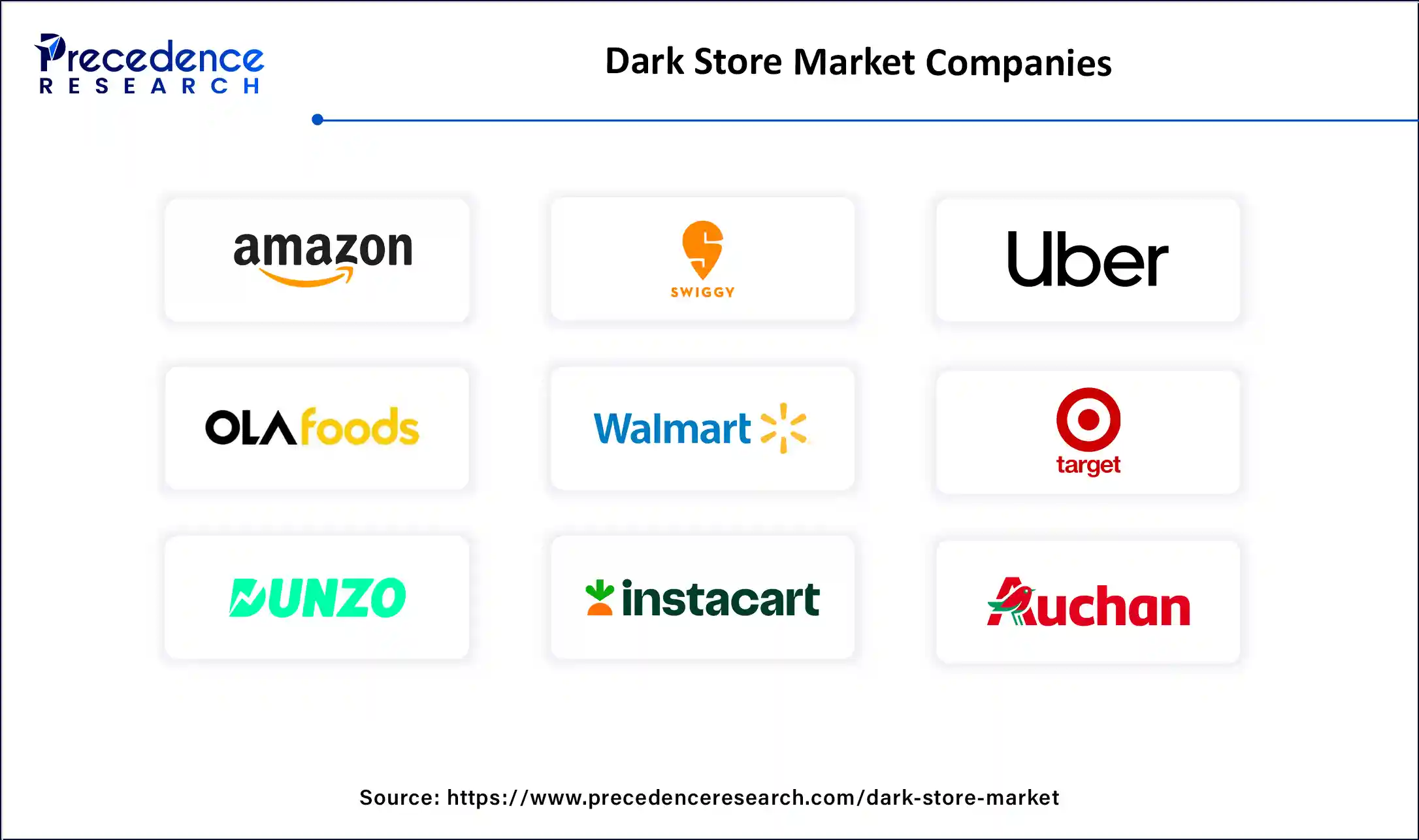
- Amazon.com, Inc.: Amazon is expanding its Amazon Now quick-commerce service in India, utilizing a rapidly rising network of dark stores to allow 10–15-minute delivery of groceries and essentials.
- Swiggy: Swiggy provides a rapidly expanding network of "mega dark stores" for its Instamart service, thus pivoting towards larger facilities to store 3X more SKUs than standard dark stores. Moreover, these stores allow 10–20-minute delivery of groceries, electronics, and even lifestyle products, while offering collaboration opportunities for entrepreneurs.
- Uber: Uber supports the dark store and even quick commerce market via on-demand, hyperlocal delivery through Uber Direct and Uber Eats, connecting local fulfillment centers to users. They enable rapid delivery, usually using two-wheeler fleets for fast urban, "last-mile" logistics. Uber also provides "Store Pickups" to retrieve prepaid orders from dark stores, thus acting as a flexible delivery layer.
- Ola Foods: Ola Foods provides a high-speed, 10-minute grocery along with essentials delivery service, targeting to establish a massive network of highly automated dark stores. They focus on hyperlocal, rapid fulfillment across 2,500 SKUs, leveraging automated, container-driven micro-fulfillment centers together with electric two-wheelers for cost-efficient logistics.
Other Major Key Players
- Supermarket Grocery Supplies Pvt Ltd.
- Walmart, Inc.
- Target Brands, Inc
- Dunzo Daily
- Instacart
- Auchan
- Wolt
- Flipkart
- Grab
Recent Development
- In June 2025, Tata-backed BigBasket plans to launch nationwide 10-minute food delivery services by the end of fiscal 2026. The company aims to capitalize on the USD 7.1 billion quick-commerce market, utilizing its dark stores to compete with fast-delivery services like Swiggy's Snacc and Zepto Café, to attract new and existing food delivery customers.
(Source: https://hospitality.economictimes.indiatimes.com) - In November 2025, DTDC Express Ltd. introduced its first all-women-operated "Dream Store" to strengthen its rapid commerce operations under the DTDC Raftaar service. This 700-square-foot facility is entirely managed and staffed by a highly trained female workforce who oversee all logistics, including warehousing, last-mile delivery, and client servicing.
(Source: https://www.livemint.com) - In April 2025, the festive season brings bustling markets and a surge in online orders, making Flipkart's launch of 100 dark stores for quick commerce a significant move. As a leader in the e-commerce sector of India, this expansion aims to meet the rising demand for faster deliveries. This initiative enables hyperlocal deliveries, reducing delivery times. Quicker deliveries enhance customer satisfaction and loyalty, as well as decentralized inventory helps manage fluctuations in demand.
- In September 2022, with the acquisition of Rosie, Instacart intensifies its technology solutions for independently owned and locally operated grocery stores.
- In September 2022, Walmart Invites Canadian Ecommerce Companies to Expand U.S. Online Marketplace.
- In August 2022, Amazon India Signs MoU with Council of Handicrafts Development Corporations (COHANDS) under the Karigar Program.
- In June 2022, Door Dash, Inc. (NYSE: DASH) announced the complete acquisition of Wolt Enterprises Oy (Wolt).
- In June 2022, NATUREPRO launches same-day delivery across India with ZFW Dark Stores. ZFW Dark store announced a partnership with personal care brand NATUREPRO to promote luxury as well as sustainable yet affordable products to the customers through same-day deliveries across India.
- In December 2020, Uber Technology, Inc. acquired Postmates, Inc. to improve the delivery of food, groceries, necessities, and other commodities.
- In August 2022, Coca-Cola and Grab Work Together to Promote Digitalization and Growth in Southeast Asia.
- The service providers are integrating smart technologies like dynamic route optimization, smart tracking, and sophisticated analytics to improve the efficiency of their delivery supply chains.
- Dark shop owners are developing technology and data models in order to deliver the most commonly purchased products in densely populated metropolitan zip areas in less than 15 minutes.
- To keep ahead of the competition, grocery delivery firms must take advantage of dark stores.
Segments Covered in the Report
By Age Group
- Children
- Adults
- Elderly
By Category
- Groceries
- Meat
- Dairy
By Delivery Options
- Curbside Pickup
- In-Store Pickup
- Home Delivery
By Non-Food Products
- Cleaning
- Essentials
- Bath & Body
By Region
- North America
- Europe
- Asia-Pacific
- Latin America
- Middle East & Africa (MEA)
For inquiries regarding discounts, bulk purchases, or customization requests, please contact us at sales@precedenceresearch.com
Frequently Asked Questions
Tags





Ask For Sample
No cookie-cutter, only authentic analysis – take the 1st step to become a Precedence Research client
 Get a Sample




 sales@precedenceresearch.com
 Schedule a Meeting
