



Gasoline Direct Injection Device Market Trends, Manufacturing Capacity, Production Cost, Supply Chain Performance, Sales Volume, Pricing Analysis, and Industry Outlook
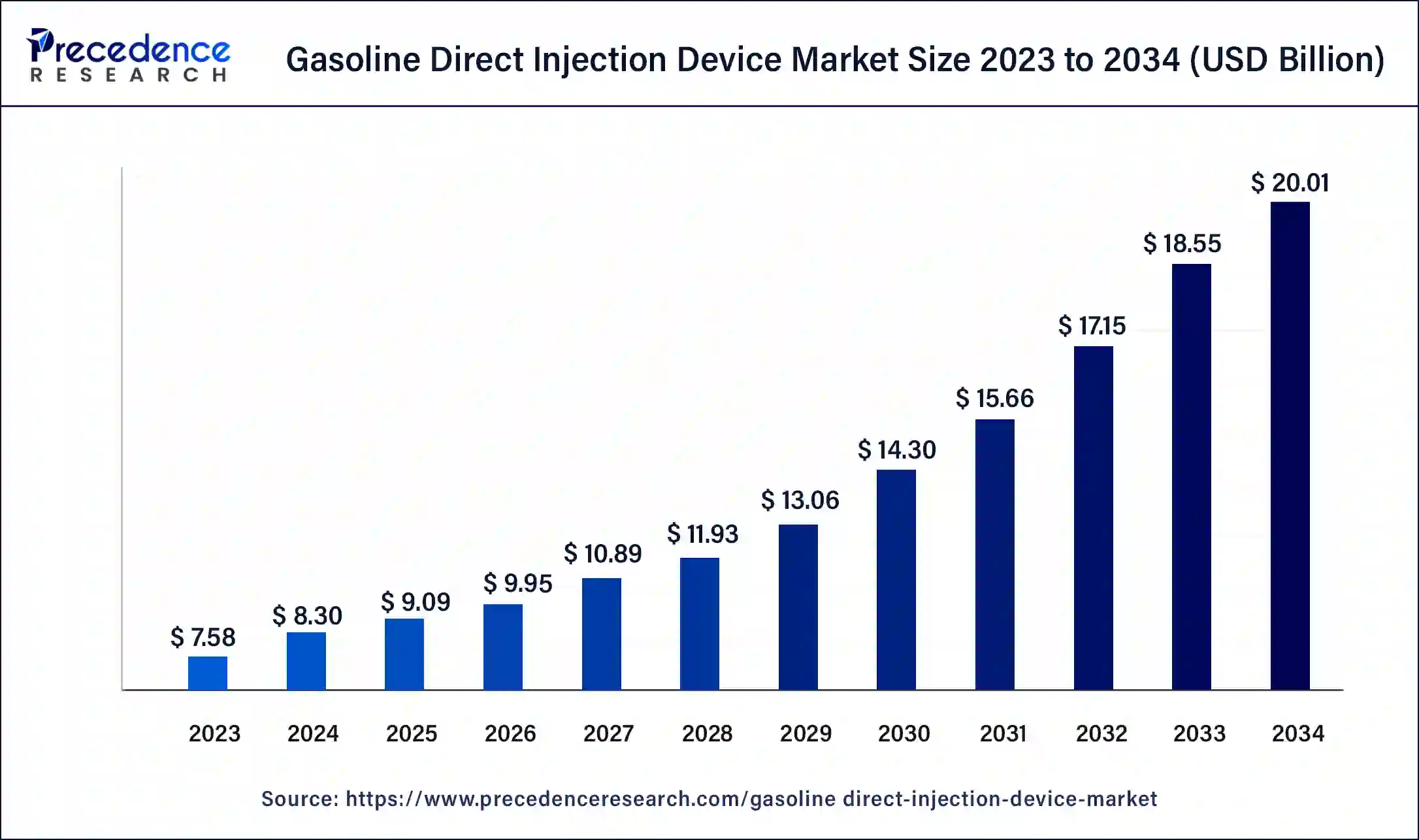
The global gasoline direct injection (GDI) device market is projected to grow from USD 9.09 billion in 2025 to USD 21.43 billion by 2035, registering a CAGR of 8.95%. Growth is driven by increasing demand for fuel-efficient and high-performance vehicles, stringent global emission regulations, rising adoption of engine downsizing technologies, expanding automotive production, and continuous advancements in fuel injection systems that improve engine efficiency while reducing emissions.
Source: https://www.precedenceresearch.com/gasoline-direct-injection-device-market
 Get a Sample
 Table Of Content


What is the Gasoline Direct Injection Device Market Size?
The global gasoline direct injection device market size is calculated at USD 9.09 billion in 2025 and is predicted to increase from USD 9.95 billion in 2026 to approximately USD 21.43 billion by 2035, expanding at a CAGR of 8.95% from 2026 to 2035. The rigorous emission mandates in the power fuel and electrifying sectors are driving demand for suitable combustion technologies that meet both quality and mandatory standards, contributing to the environmental ecosystem. The hybrid models and the modernized range of vehicles are bolstering the market base with heavy deployment of GDI systems. The GDI technologies are a boon to market efficiency.
Gasoline Direct Injection Device Market Key Takeaways
- Asia Pacific led the global market with the highest market share in 2025.
- By Component, the fuel injectors segment is likely to have a significant increase throughout the forecast period.
- By Application, the passenger cars segment registered the maximum market share in 2025.
- By Application, the commercial vehicle segment is expected to grow at a remarkable CAGR during the forecast period.
Market Overview
The gasoline direct injection device market is gradually evolving, driven by demand for fuel-efficient vehicles, stringent emission regulations, and advancements in automotive engine technologies. A GDI system enables a more exact fuel delivery directly to the combustion chamber, which enhances engine performance, fuel economy, and power output while reducing overall emissions. To comply with the standard rules without sacrificing the vehicle's performance, GDI devices are on the list of the suppliers' requirements that automakers must meet.
AI's Precision in the Gasoline Direct Injection Device Market
Artificial Intelligence attends to the measurement and predictive analytical factors featuring research and development activities that support computational fluid dynamics, which allows the developers to complete their learning and revision on the design and highly concentrated areas connected to precision usage volume of the solution. The prediction of the spray intensity avoids unfavorable errors, which are largely spotted in the old models, such as fluid interpolation. The unified machine learning forecast fetched liquid volume and injected fuel mass. The modernized fuel spray unlocks the core potential of the associated ML models. The tree-related models bring more accuracy to the predictions. The AI excellence in the spraying functionality is a dynamic mechanism for the market. The tech development has been largely occupying the standardized area, such as research and development, to gain accuracy and expand tech-driven businesses into market development and expansion.
Gasoline Direct Injection Device Market Growth Factors
Increasing motorized mobility along with rising consumer preferences for fuel efficient vehicles expected to escalate the Gasoline Direct Injection (GDI) device market size over the forecast period. Increasing demand for regulating pollution levels related to greenhouse gases coupled with improving the air quality are the key factors propelling the adoption of vehicles incorporated with the advanced fuel injection systems.
Improved engine performance together with high thermal efficiency that significantly assists in reducing the fuel emissions prominently supports the growth of the GDI industry. Rising inclination of manufacturers towards vehicle efficiency and engine downsizing anticipated to augment the market share. In addition, multiple financing firms for passenger vehicles together with increasing individual spending projected to considerably boost the adoption of GDI devices.
Gasoline Direct Injection Device Market Trends
- Automakers' Initiatives – The well-known companies are promoting the installation of the combining injection systems that contribute to the environmental ecosystem. The unified AI-combating sensors drive tech advancements in the market developmental operations.
- High performance of the components – The high-quality of the components complies with the reduced emissions standards, promoting the capacity of the GDI systems. The growing use of ECUs and GPFs is bolstering the value chain analysis momentum.
- Sustainability Surge – The automotive industries are highly performing its best in class eco-friendly solutions that involve the market dynamics, accelerating the revenue chain in the market businesses.
Market Outlook
- Market Overview: The gasoline direct injection device market is growing due to rising demand for fuel-efficient vehicles, stringent emission regulations, and continuous advancements in automotive engine technologies. Increasing adoption of lightweight and high-performance engines is further fueling market expansion.
- Major Investors: Major investors in the market include automotive OEMs, engine component manufacturers, and tier-1 suppliers, who fund R&D and production of advanced injection technologies. Their investments drive innovation, improve fuel efficiency, and help automakers meet regulatory emission standards.
- Global Expansion: The market is expanding globally with high adoption in Europe, North America, and Asia Pacific due to strict emission norms and growing automotive production. Emerging regions, such as Latin America and the Middle East, offer opportunities through increasing vehicle demand, modernization of engines, and adoption of fuel-efficient technologies.
Market Scope
| Report Highlights | Details |
| Market Size in 2035 | USD 21.43 Billion |
| Market Size in 2025 | USD 9.09 Billion |
| Market Size by 2026 | USD 9.95 Billion |
| Growth Rate from 2026 to 2035 | CAGR of 8.95% |
| Dominating Region | Asia Pacific |
| Fastest Growing Region | Europe |
| Base Year | 2025 |
| Forecast Period | 2026 to 2035 |
| Segments Covered | Product, Application, Region |
| Regions Covered | North America, Europe, Asia-Pacific, Latin America, and Middle East & Africa |
Segment Insights
Component Insights
Fuel injectors anticipated to witness prominent growth over the analysis period owing to need for precise control over fuel injection to ensure complete combustion of fuel. In addition, need for effective controlling of air-fuel mixture along with exhaust emissions in the gasoline engine predicted to escalate the growth of the segment over the forecast timeline. Further, the fuel injector assists in monitoring the fuel regulator that helps in maintaining the fuel pressure of delivery pipe at a constant level.
On the other side, the Electronic Control Unit (ECU) segment projected to witness significant growth in the Gasoline Direct Injection (GDI) device market due to the flexible multiple input and output channels that enhances the signal transfer within the vehicle system components. High control along with mapping the status of automotive components as well as vehicle performance on the basis of selected system inputs expected to flourish the growth of the segment.
Companies involved in the manufacturing of automotive ECU are significantly engaged in new product launch that improves the reliability and functions to cater the rising customer demand. For instance, in September 2018, Delphi Technologies introduced generation 7 electronic controllers used particularly in commercial vehicles that include trucks, buses, and off-highway vehicles. The new product enables extreme flexibility provided with multiple applications that supports the user requirements.
Application Insights
Passenger cars leads the gasoline direct injection device market in terms of revenue because of rising inclination of consumers towards luxury & premium cars especially in developed countries coupled with implementation of direct injection systems in those vehicles. Escalating demand for passenger cars together with the introduction to stringent emission norms for such vehicles expected to further impel the penetration of passenger cars over the analysis period. Consistent developments in the passenger vehicles owing to implementation of new functions for comfort and vehicle safety anticipated to propel the growth of the segment in the coming years.
Besides this, the commercial vehicle segment projected to witness a steady growth due to the rising road transportation along with domestic trading activities across the world. Heavy and medium commercial vehicles that operate on diesel contribute significantly towards the vehicular emissions and thus necessitate the implementation of gasoline powered engines for curtailing the environmental impact. Commercial vehicles also require highly durability and long-lasting engines that boosts the installation of GDI devices for enhanced reliability. Further, rising research & development (R&D) activities along with integration of advanced technologies in GDI devices anticipated to positively influence the growth of the segment over the forecast timeframe.
Regional Insights
What is the Asia Pacific Gasoline Direct Injection (GDI) Device Market Size?
The Asia Pacific gasoline direct injection (GDI) device market size was valued at USD 4 billion in 2025 and is expected to reach USD 9.43 billion by 2035, growing at a CAGR of 8.95% from 2026 to 2035.
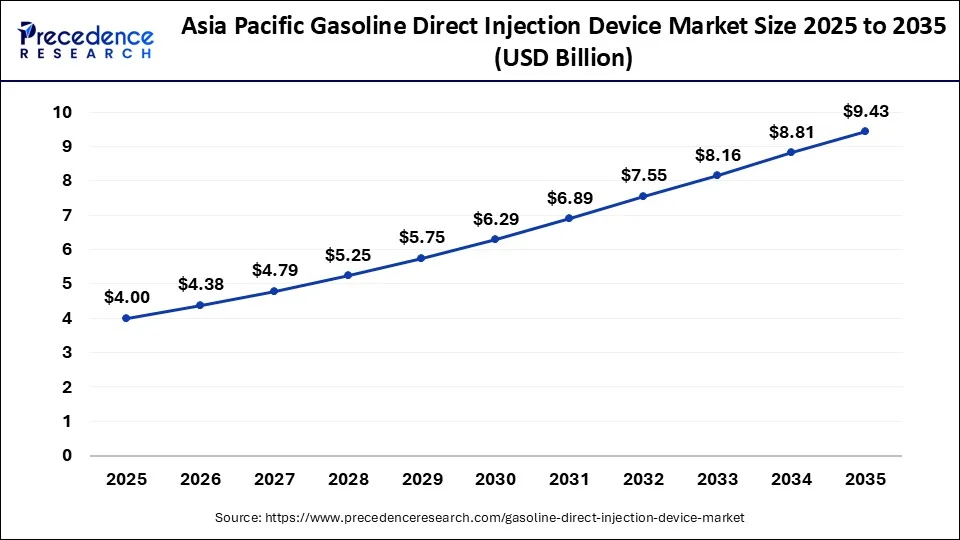
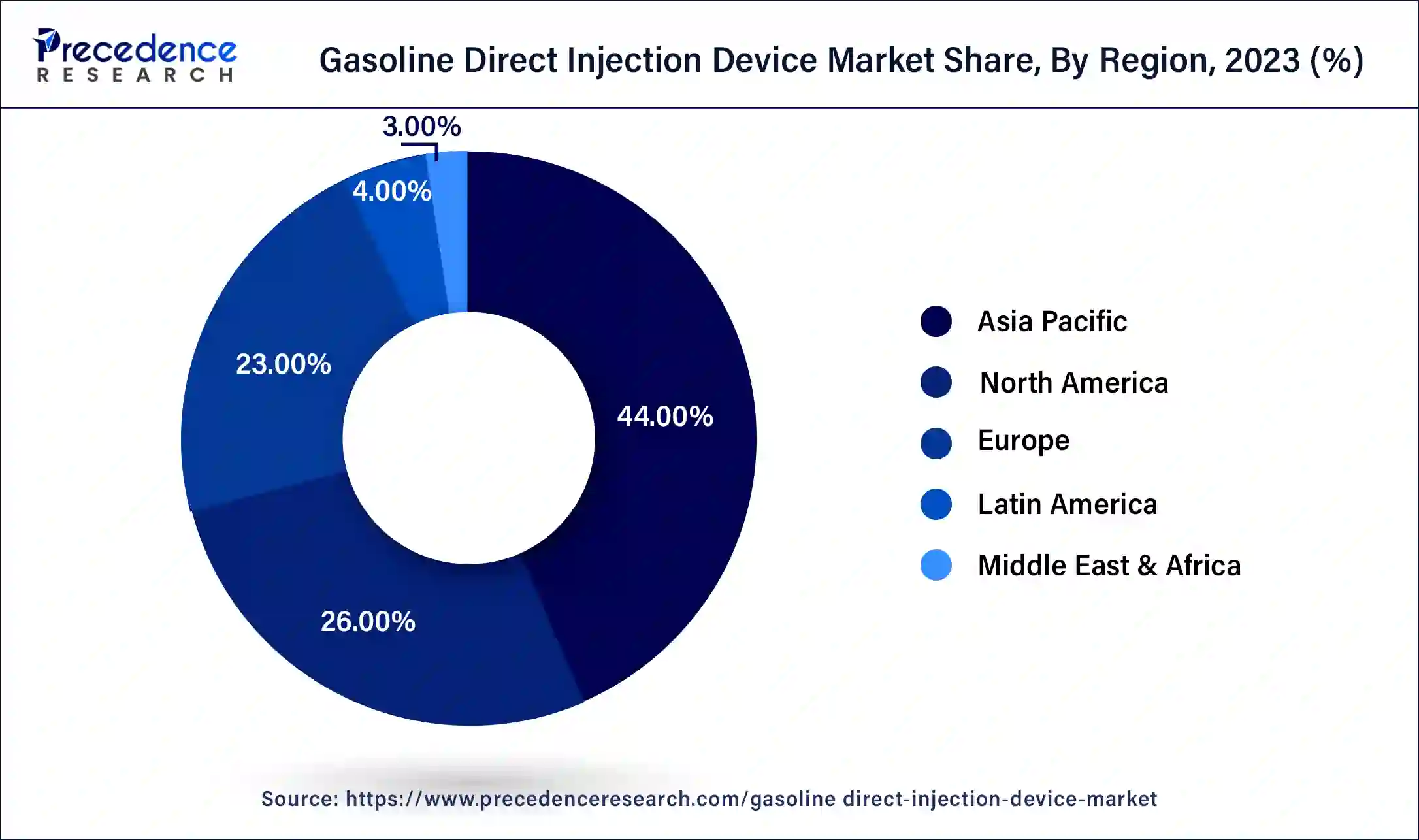
Asia Pacific led the global GDI device market due to the increased focus of automotive market players towards untapped opportunities in the region. Further, shifting consumer trends towards vehicles with superior fuel efficiency are anticipated to spur industry growth during the projected period. Government authorities are taking strict measures to control the carbon footprint including fuel economy standards and engine upgrades.
What Drives the Market within North America?
The gasoline direct injection device market in North America is driven by the region's strong automotive industry, increasing demand for fuel-efficient and high-performance vehicles, and stringent emission regulations. Growing adoption of turbocharged and downsized engines, which rely on GDI technology for improved power and reduced fuel consumption, further fuels market growth. Additionally, investments by OEMs and tier-1 suppliers in advanced engine technologies and emission-compliant solutions support the expansion of the GDI device market.
What Makes Europe the Fastest-Growing Region in the Market?
Europe region is expected to register the highest growth over the forthcoming years pertaining to the stringent norms for fuel efficiency and emission targets. OEMs are prominently adopting GDI systems to achieve compliance standards. The significant presence of automotive players including BMW AG, Daimler AG, and Audi AG in the region is projected to positively impact the growth of the GDI system over the analysis timeframe.
How is the Opportunistic Rise of Latin America in the Market?
Latin America is expected to experience an opportunistic rise in the gasoline direct injection device market, driven by rising automotive production, increasing demand for eco-friendly vehicles, and strengthening regulatory frameworks. OEMs expanding their factories in the region are adopting GDI technology, benefiting local manufacturers focused on efficient engines and helping them meet upcoming emission standards.
Brazil is the largest contributor to the Latin American gasoline direct injection (GDI) device market, driven by its extensive automotive manufacturing base, high vehicle production, and prevalent use of gasoline engines. Mexico follows closely, supported by strong automotive exports, investment inflows, and the presence of global OEMs introducing new vehicle models equipped with GDI systems.
The market in Latin America is also driven by increasing vehicle production and rising fuel efficiency standards. Countries like Brazil and Mexico are at the forefront, with a growing automotive industry that is embracing new technologies to enhance performance and reduce emissions. The demand for advanced fuel injection systems is being spurred by a burgeoning middle class seeking more efficient vehicles. Moreover, government initiatives aimed at promoting cleaner fuels and reducing pollution significantly influence the market landscape.
Countries such as Brazil, Argentina, and Chile are contributing to the market. These countries are investing in infrastructure and technology to support the adoption of advanced automotive solutions. The increasing availability of GDI-equipped vehicles is set to capture consumer interest across the region. Furthermore, with international automotive companies establishing a presence in Latin America, the market is likely to benefit from shared technology and innovation.
What Potentiates the Gasoline Direct Injection Device Market in the Middle East & Africa?
The market in the Middle East & Africa is being driven by rising vehicle sales, rapid urbanization, and stricter emission standards. GCC countries are actively promoting energy-efficient engines and phasing out traditional fuel-consuming systems to support market growth. Saudi Arabia leads the market, driven by extensive automotive manufacturing activity and rising passenger vehicle demand. Recent government initiatives focused on reducing fuel consumption and lowering air pollution have further supported the adoption of GDI devices in the country.
Saudi Arabia is leading the market by investing in local manufacturing capabilities and partnerships with automotive production companies. This move not only supports economic development but also fosters technological advancements within the region. Meanwhile, countries like Egypt and Morocco are beginning to explore GDI technology as part of their automotive evolution, capitalizing on increasing population and urbanization rates.
Value Chain Analysis
- Raw Material Sourcing
This stage involves sourcing raw materials like steel, aluminum, and alloys for injectors, high-pressure pumps, motors, fuel rails, and ECUs.
Key players: Bosch and Denso Continental. - Vehicle Assembly and Integration
This stage focuses on assembling several parts to deliver a smooth and seamless, highly pressurized fuel into the combustion chamber.
Key players: Delphi Automotive LLP
Market Companies and Their Offerings
- BorgWarner Inc. – BorgWarner contributes to the OEMs, serving a commitment to direct injection components engineering. The expanding business of components is the next milestone listed in the company's success.
- DENSO Corporation – The company focus on precision injection, and heavy spending on sustainable direct injection components drives improvement in the automotive, power and fuel sector.
- Marelli Holdings Co., Ltd. – Marelli aims to expand its tech business for delivering perfection in the propulsion systems to support all ranges of vehicle models.
Gasoline Direct Injection Device Market Companies
- Delphi Automotive LLP
- Eaton Corporation
- Continental Corporation GmbH
- Robert Bosch GmbH
- Stanadyne LLC
- Keihin Corporation
- Hitachi Automotive Systems, Ltd.
- TI Automotive
- Magneti Marelli S.p.A
Key Companies & Market Share Insights
The global GDI device industry seeks significant new product launch, development, and enhancement that turn the market into competitive. This approach from industry players helps them to increase their consumer base. For instance, in July 2019, Xtreme-DI introduced GDI high-flow fuel injectors that offer more than 45% of additional fuel flow compared to stock products. The aftermarket injectors deliver outstanding and consistent performance by offering compatible injection pressures as that of the OEM equipment.
Furthermore, the market players are majorly focused on establishing long term contract for supplying specific vehicle model along with designing customized solutions for commercial and passenger vehicles this in turn will strengthen their footprint in the global market.
Segments Covered in the Report
This research study comprises complete assessment of the market by means of far-reaching qualitative and quantitative perceptions, and predictions regarding the market. This report delivers classification of marketplace into impending and niche sectors. Further, this research study calculates market size and its development drift at global, regional, and country from 2024 to 2034. This report contains market breakdown and its revenue estimation by classifying it based on component, application, and region:
By Component
- Fuel Injectors
- Electronic Control Units
- Sensors
- Fuel Pumps
By Application
- Passenger Cars (PC)
- Commercial Vehicles (CV)
By Regional Outlook
- North America
- U.S.
- Canada
- Europe
- U.K.
- Germany
- France
- Asia Pacific
- China
- India
- Japan
- South Korea
- Rest of the World
For inquiries regarding discounts, bulk purchases, or customization requests, please contact us at sales@precedenceresearch.com
Frequently Asked Questions





Ask For Sample
No cookie-cutter, only authentic analysis – take the 1st step to become a Precedence Research client
 Get a Sample




 sales@precedenceresearch.com
 Schedule a Meeting
