



Heat Meter Market Size, Key Companies, Company Market Share, Equipment Production Volume, Sales Performance, Manufacturing Cost, Export & Import Trends, Competitive Positioning, and Market Analysis
Heat Meter Market (By Type: Turbine Meters, Ultrasonic Meters, Vortex Meters, Others; By Connectivity: Wired, Wireless; By Technology: Mechanical, Static; By Application: Residential, Commercial and Public, Industrial) - Global Industry Analysis, Size, Trends, Leading Companies, Regional Outlook, and Forecast 2026 to 2035
Source: https://www.precedenceresearch.com/heat-meter-market
 Get a Sample
 Table Of Content


What is the Heat Meter Market Size?
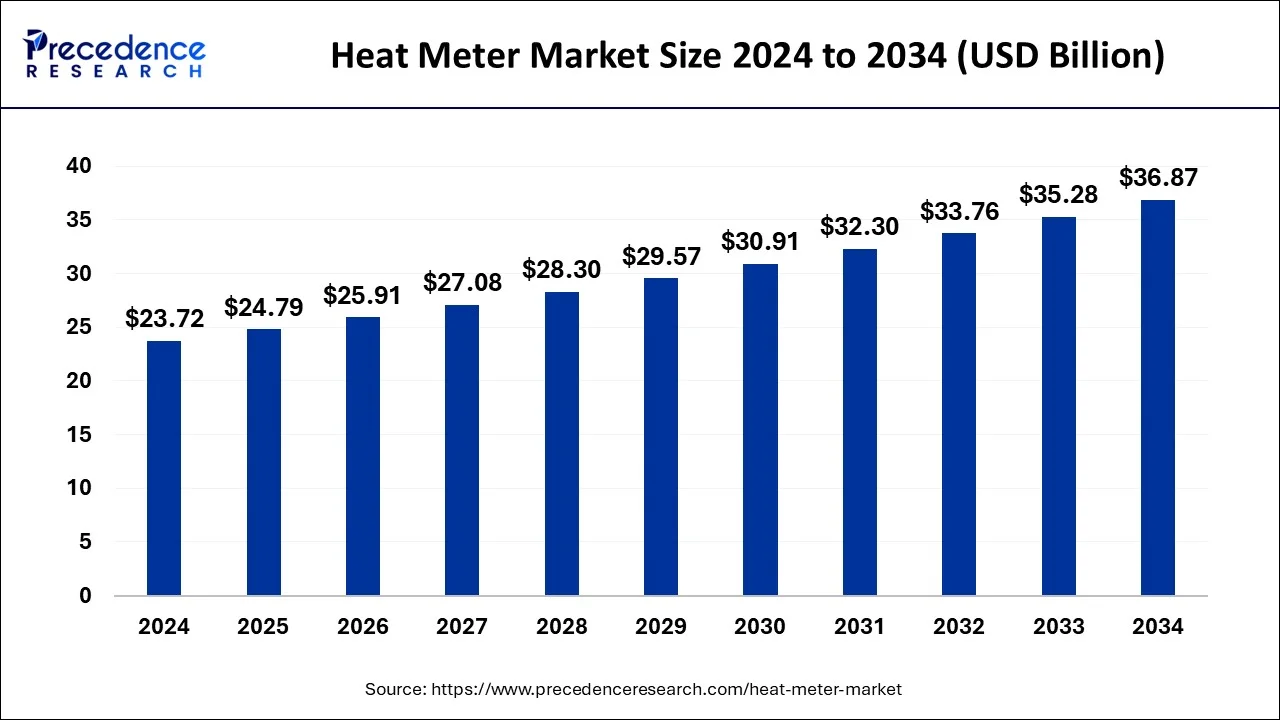
The global heat meter market size was exhibited at USD 25.91 billion in 2026 and is anticipated to reach around USD 38.41 billion by 2035, expanding at a CAGR of 4.48% from 2026 to 2035. The rising energy costs, infrastructure development, and government policies to promote heat meters drive the market's growth.
Heat Meter Market Key Takeaways
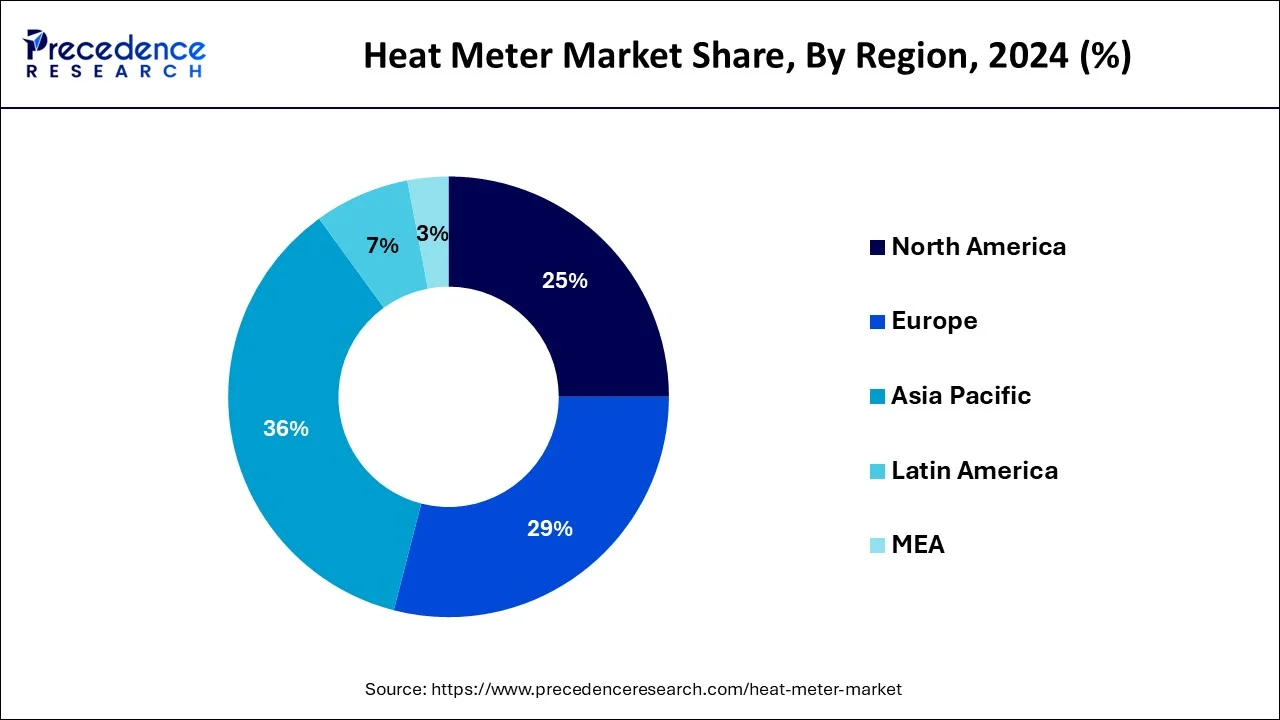
- North America led the global heat meter market with the highest market share of 35% in 2025.
- By type, the ultrasonic meters segment has held the largest revenue share in 2025.
- By technology, the static segment has held the highest market share in 2025.
- By application, the residential segment dominated the global market in 2025.
Market Overview
Mandatory regulations in some countries that require installation of heat meters have turned out to be a major driver for the progress of the worldwide heat meter market. Moreover, administrations around the world are developing guidelines to encourage the usage of energy conservation, because of energy import carried out in numerous developing economies.
The European Union member nations are mandated to have a nationwide regulation grounded on the EED 2012, that implies the setting up of measurement equipment's for separate apartment billing. Furthermore, heat meter equipment's must be included inside several schemes for new structure and renovation of area heating networks conforming with EU standards in the immediate future, with Poland, Denmark,and France providing some of the biggest volumes for heat meter consignments.
In other nations, regulatory modification is currently taking effect. For instance, in Russia all big structures on the district heating array must contain a hub (district) meter connected. The Canadian market has observed increased demand for sub-metering thermal energy and seems to be adhering to endorsements from organizations like The Pacific Institute for Climate Solutions which has suggested thermal sub-metering as a way to accomplish energy management and cost regulation.
The technological advancement has today changed the entire usability of heat meters. There are smart heat meters with billing meters designed to offer landlords and service providers a reliable, cost-effective and secure metering solution. This brings the customer a feature-rich and intuitive system which provides information to make informed decision in their energy usage. The credit billing mode and pre-payment mode options are the features among them which indirectly enable the consumer to increase their saving by heat conservation.
How does AI Impact the Heat Meter Market?
Integration of artificial intelligence (AI) is revolutionizing the energy sector. AI algorithms improve the accuracy of heat meters by analyzing data. AI led to the development of smart meters, which are rapidly gaining traction. These advanced devices provide real-time data on energy consumption, which is invaluable for various stakeholders, including consumers, energy suppliers, and grid operators. Smart meters facilitate a comprehensive analysis of energy usage over time and across different demographics by capturing and transmitting precise information about how energy is utilized in homes and businesses. This data empowers consumers to make informed decisions about their energy consumption, potentially leading to reduced bills and more efficient energy use. Insights from this data enable suppliers to forecast demand, optimize energy distribution, and improve customer service by addressing individual consumer needs.
Smart meters play a critical role in grid management. The real-time data analysis by AI allows grid operators to monitor system performance and identify inefficiencies or potential disruptions in the supply chain. This capability is essential for implementing AI-driven solutions to optimize energy distribution, enhance grid reliability, and minimize outages. Moreover, the information from smart meters supports the broader transition to a low-carbon economy. By analyzing energy consumption trends, AI applications can identify opportunities for energy savings, promote the integration of renewable energy sources, and encourage the adoption of more sustainable practices among consumers. This data-driven approach not only helps in reducing operational costs for energy providers but also aligns with the global imperative to combat climate change by fostering more efficient energy consumption.
Heat Meter Market Growth Factors
- Increasing construction activity in developing regions
- Changes in the climate conditions
- Rapidly growing awareness in customers
- Increasing number of heat meter installations by individuals
- Growth in the luxury housing market
- Technological advancements and integration of latest technologies
- Rapidly increasing awareness regarding energy conservation
Heat Meter Market Outlook
- Industry Growth Overview: The heat meter market is dominated by stricter government regulations on energy efficiency, a rapid transition toward digital utility services, and the expansion of heating systems. The strong legislative mandates, rapid urban expansion, and the transition to low-carbon centralized heating infrastructure mainly drive the market's expansion. Industry leaders are embedding advanced communication protocols.
- Sustainability Trends: The emerging trends are a rapid shift to static and ultrasonic technology, integration with low-temperature and multi-source district heating, eco-design, and extended battery lifespans. The industry focuses on enhancing resource circularity, reducing energy waste, and integrating renewable thermal grids. Heat meters are expected to meet new operational standards because cities are modernizing their heating grids.
- Startup Ecosystem: Climate startups are considered early-stage ventures that deliver innovative solutions to build resilience, cut emissions, and drive the low-carbon transition. These startups design markets, deliver services, structure governing institutions, and organize production. They drive climate innovation, where flexibility, speed, and experimentation matter most.
- Global Expansion: The growth of the heat meter market is fueled by strict carbon-reduction mandates, energy efficiency, and the digitalization of public utilities. The mandatory energy legislation, modernization of district heating, and integration of smart building and IoT are also expanding the heat meter industry globally. Industry operators prefer ultrasonic units for their non-invasive design, precision, and high physical reliability.
Market Scope
| Report Highlights | Details |
| Growth Rate from 2026 to 2035 | CAGR of 4.48% |
| Market Size in 2025 | USD 24.79 Billion |
| Market Size in 2026 | USD 25.91 Billion |
| Market Size by 2035 | USD 38.41 Billion |
| Base Year | 2025 |
| Forecast Period | 2026 to 2035 |
| Segments Covered | Type, Connectivity, Technology, Application and Region |
| Regional Scope | North America, Europe, Asia Pacific, Latin America, Middle East & Africa (MEA) |
Significant Market Trends
Ultrasonic Meters Segment Reported Foremost Market Stake in 2025
The ultrasonic meters segment has held the largest revenue share in 2025. High durability and accuracy of the ultrasonic meters are expected to boost the growth of the segment in the near future. Vortex Meters are expected to grow at highest CAGR within the forecast time-duration.
Static Segment Dominated the Market Revenue By Technology in 2025
The static segment has held the highest market share in 2025, in the target industry due to increasing demand for combined cooling and heating applications.
Residential Segment Will Dominate the Heat Meter Market Revenue By Application
Factors such as rapidly increasing demand for home automation systems are driving growth of the segment. Industrial segment is expected to grow at highest CAGR within the forecast time-duration.
Future opportunities for the heat meter market
- Growing use of heating and cooling systems: Heat meters find extensive applications in heating and cooling systems used in various industries. Heat meters offer precise and efficient measurement solutions for complex infrastructures.
- IoT expansion: A future opportunity that the heat meters market holds is the integration of IoT systems with heat meters, which provide remote monitoring and predictive maintenance along with data analytics.
- Integration with renewable energy systems: Over the past years, renewable energy sources like geothermal energy and solar thermal energy have seen a notable surge across the globe as a preferable choice for energy generation. Here, heat meters can play a crucial role by measuring precise energy readings and keeping its track record holds significant opportunity for the future market.
Market Dynamics
Driver
What are the Potential Driving Forces in the Heat Meter Market?
A significant industrial transformation is driven by energy regulations and rapid building digitization. The government mandates and stringent environmental regulations globally boost the shift toward smart heat tracking. The other major growth drivers are volatile energy costs, rapid global urbanization, and a move toward green building certifications.
Restraint
What are the Major Challenges in the Heat Meter Market?
The complex technical integration, high initial installation costs, and strict regulatory timelines are imposing major challenges in the market. Moreover, technical interoperability and connectivity issues are related to network stability, system integration, and data fragmentation.
Opportunity
What is the Major Impact of the Heat Meter Market?
The major commercial opportunities are driven by structural energy grid upgrades, digital transformation, and regulatory mandates. Energy grids and commercial operators are investing in electromagnetic meters due to their high precision. Modern battery innovations offer a 15-year lifespan for smart meters, which also allow companies to provide long-term solutions.
Segments Insights
Type Insights
How does the Ultrasonic Meters Segment Dominate the Heat Meter Market in 2025?
The ultrasonic meters segment dominated the market in 2025. The segment is expected to grow at the fastest CAGR in the market during the forecast period due to their extreme accuracy and ability to provide real-time data for easy billing, monitoring, and reporting. These flow meters are ideal for heating applications and are able to measure liquid flow in both directions.
The turbine meters segment is expected to grow significantly in the market in the coming years, owing to their precision in measuring the quantity of liquid or gas flow. They streamline processes and keep quality in check across various sectors.
Connectivity Insights
What made Wired the Dominant Segment in the Heat Meter Market in 2025?
The wired segment dominated the market in 2025, owing to the critical importance of wired connectivity in ensuring high security, uninterrupted data transmission, and long-term operational reliability in required conditions. Wired infrastructure offers a continuous path for data transmission.
The wireless segment is estimated to grow at the fastest rate in the market during the predicted timeframe due to the key benefits of wireless heat meters, such as automated data billing, real-time data access, fast leak detection, predictive maintenance monitoring, optimized grid distribution, and improved tenant transparency. The common wireless technologies used are wireless M-bus, LoRaWAN, and NB-IoT.
Technology Insights
How did the Static Segment Dominate the Heat Meter Market in 2025?
The static segment dominated the market in 2025. The segment is anticipated to grow at the fastest rate in the market during the upcoming period due to the two main static metering technologies, such as ultrasonic meters and electromagnetic meters. Both static technologies are more vital and accurate than mechanical meters.
Application Insights
Why did the Residential Segment Dominate the Heat Meter Market in 2025?
The residential segment dominated the market in 2025, owing to significant energy savings and financial accountability that motivate residents to reduce waste and adjust thermostats. Residents focus on fair-consumption-based billing and pay only for the exact amount of thermal energy they use.
The commercial and public segment is predicted to grow at a rapid rate in the market during the studied period due to the importance of heat meters as basic tools for legal compliance, energy efficiency, and accurate cost allocation in modern commercial and public buildings. Heat meters eliminate disputes in commercial real estate, while commercial property managers use data to create precise utility bills for office floors and individual retail units.
Regioanl Insights
North America is Estimated to be the Largest Market for Heat Meter
The comprehensive research account covers substantial projections and inclinations of heat meter throughout chief regions encompassing Africa, Asia Pacific, Europe, Latin America, North America, and Middle East.By region, North America led the global heat meter market with the highest market share of 35% in 2024, Europe is projected to advance at top-most CAGR predominantly due to high demand from new markets such as Turkey, Russia, and Germany. African, South America, and Middle Eastern region is expected to exhibit note-worthy growth in the projected time-frame.
Government policies emphasize the use of heat meters, and they aim to reduce carbon emissions. Technological advancements such as wireless connectivity and data analytics have driven the market growth. In addition, increased use of smart meters bolstered the market in the region. In a study, Berg Insight reports that at the end of 2023, the overall penetration in North America surpassed 80%, with 130.6 million smart electricity meters in the U.S. and 15.4 million in Canada.
What is the U.S. Heat Meter Market Size?
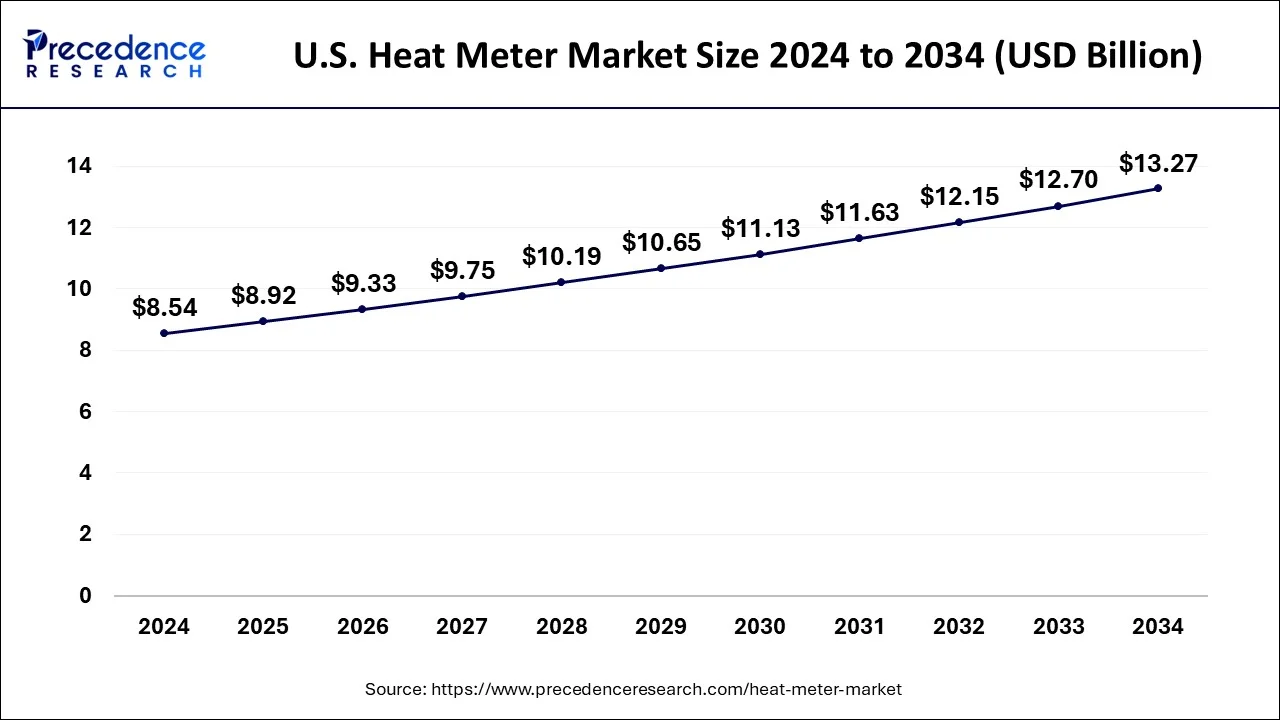
The U.S. heat meter market size was evaluated at USD 8.92 billion in 2025 and is predicted to be worth around USD 13.83 billion by 2035, rising at a CAGR of 4.48% from 2026 to 2035.
U.S. Market Trends
The aging thermal metering infrastructure is being replaced with advanced digital solutions in the U.S., making the country a market leader in the heat meter space. To cut installation costs and enhance operating efficiency, utilities are moving to wireless and AMI systems. Intelligent heat metering solutions are driving adoption in the country further with the use of predictive analytics, smart building management systems, and long-life battery technologies.
Europe heat meter market is significantly expanding
The European heat meter market is significantly expanding owing to the growing awareness about energy efficiency and stringent regulations for the conservation of energy. Countries in the European region are increasingly adopting heat metering systems to strengthen energy management and improve accuracy in the billing process. Moreover, government are also promoting renewable energy usage and encouraging people to adopt district heating systems are some of the major growth factors for the heat meter market in the European region.
Germany Market Trends
Strict regulations on energy efficiency and smart metering technologies in Europe are driving market growth in Germany. The country is quickly moving to ultrasonic and IoT-based heat meters that are connected to renewable district heating systems. Germany's energy infrastructure sector continues to enjoy robust market growth with rising quantities of retrofitting projects in residential buildings, climate-neutrality targets, and demand for accurate consumption-based billing.
What are the Advancements in the Heat Meter Industry in the Asia-Pacific Region?
The Asia Pacific heat meter market is expanding rapidly due to growing industrial heating requirements for various reasons. According to the international energy agency, China has been the largest heat consumer in the past decade. Additionally, increasing industrialization in developing countries like India and Japan are contributing to the expansion of the heat meters market in the Asia.
Asia Pacific is expected to have the fastest growth throughout the forecast period. This rapid growth is due to the increasing adoption of district heating and cooling solutions in urban areas, coupled with a growing awareness about environmental impact, which thus fosters the high adoption of heat meters. Moreover, as the region embraces renewable energy sources, the integration of accurate heat measurement becomes vital. Countries like China and Japan are leading players.
China Heat Meter Market Trends
China is experiencing rapid urbanization and infrastructural development, thus leading to a significant rise in the construction of residential and commercial buildings. There is a strong focus on sustainable development and energy efficiency.
What are the Key Trends in the Heat Meter Industry in Latin America?
Latin America is expected to witness substantial growth in the market, driven by urbanization, industrial growth, and increasing energy consumption. Government initiatives aimed at enhancing energy efficiency and sustainability are also gaining traction, further propelling the demand for advanced metering solutions in this region. Countries such as Brazil and Mexico are leading players.
Brazil Heat Meter Market Trends
Brazil's market landscape is evolving steadily, with local manufacturers emerging alongside established global players. Investments in smart city projects and infrastructure development are expected to further boost the market, creating various opportunities for market growth.
How is the Middle East and Africa Region Growing in the Heat Meter Industry?
The Middle East and Africa region is witnessing steady growth in the market. This growth is driven by the need for efficient energy management and resource optimization. Government initiatives aimed at improving energy efficiency and sustainability are key drivers of market growth. Countries like the UAE and South Africa are leading players in the region.
Saudi Arabia Heat Meter Market Trends
The country is seen increasingly focusing on innovative solutions in order to meet the growing demand. As the region continues to develop its infrastructure, the heat meter market is poised for substantial growth in the upcoming years.
Supply Chain Analysis
Raw Material Sourcing (Metals, Electronics)
- This process is accelerated by the transition from mechanical to static smart meters and the sourcing of materials.
- Key Players: Wieland-Werke AG, Aurubis AG, ArcelorMittal, Aperam, Indium Corporation, MacDermid Alpha Electronics Solutions, Henkel AG & Co. KGaA, Kyocera Corporation, Sanmina Corporation, Benchmark Electronics.
Component Fabrication and Machining
- This process includes raw material processing, blank fabrication, high-precision CNC machining, advanced surface treatment, and finishing.
- Key Players: DMG MORI Co., Ltd., Yamazaki Mazak Corporation, TRUMPF Group, FANUC Corporation, Bystronic AG, Jabil Inc. & Flex Ltd., Western Heat Forge (WHF), Heatcon Sensors, Heatcon Sensors, Kamstrup A/S, Danfoss A/S, Siemens AG, Zenner International.
Product Lifecycle Management
-  In this process, there is a management of connected, complex, and data-driven IoT systems and strict climate regulations.
- Key Players: Siemens AG, PTC Inc., Dassault Systèmes, Autodesk, Inc., Aras Corporation, SAP SE & Oracle Corporation, Kamstrup A/S, Landis+Gyr, Diehl Metering & Danfoss A/S.
Competitive Landscape
The heat meter market is dominated by global market leaders such as Kamstrup A/S, Danfoss A/S, Siemens AG, Diehl Metering GmbH, Landis+Gyr, Itron Inc., Zenner International GmbH & Co. KG, Apator SA, Qundis GmbH, Wasion Group, Huizhong Instrumentation Co., Ltd., and Zhejiang Bove Intelligent Technology. The core product offerings are ultrasonic heat and cooling meters, ECL comfort series controllers, SonoMeter 40, ULTRAHEAT T550, ULTRAHEAT T330, return temperature optimizer, etc. The major R&D trends that are shaping the industry are ultrasonic heat meters, regulatory compliance tech, and software-as-a-service (SaaS). The leading manufacturers are directing their R&D budgets toward long-range IoT connectivity, ultrasonic static sensors, and cloud-based AI analytics.
Heat Meter Market Companies
The companies focusing on research and development are expected to lead the global heat meter market. Leading competitors contending in global heat meter market are as follows:
- Weihai Ploumeter Co. Ltd.: Creates ultrasonic heat and water meters, and provides data acquisition for global smart heating efficiency and energy conservation management solutions that are enabled by the Internet of Things (IoT).
- Quadlogic Meters Canada Inc: Provides intelligent submetering, remote consumption analytics, and utility billing solutions powered by LoRaWAN for electricity, water, and energy management.
- Zenner International GmbH & Co. KG: Globally, manufacturers power meters, heat meters, and gas meters using IoT sensors for the purpose of smart city integration and for enabling remote meter consumption monitoring.
- Kamstrup: Supplies ultrasonic heat and cooling meters with advanced communications, accuracy in energy measurement, and smart metering analytics solutions around the world.
Other Major Key Players
- Micronics Ltd
- MWA Technology Ltd
- Qundis
- Apator S.A.
- Qundis
- Sontex SA
- Siemens AG
- WECAN Precision Instruments Co. Ltd.
- Ista
- Huizhong Instrumentation Co. Ltd.
- Techem
- Secure Meters Ltd
- Weihai Ploumeter Co. Ltd.
Latest Announcement by Industry Leader
- In July 2024, Utilita Energy and Cheshire College South & West entered into a collaboration and launched a smart metering apprenticeship designed to overcome many of the communications issues engineers face during a smart meter installation. George Walters, Utilita Energy's Chief Home Services Officer, stated that they have successfully installed smart meters in 92% of the households they supply their energy.
Recent Development
- In May 2026, CATL's Xiamen Energy Storage Validation Research Institute (ESVL), the largest and a one-stop testing and validation platform, announced the launch of the World's largest energy storage testbed. It will advance industry into an era of real-world validation. It is backed by an investment of roughly RMB 3 billion and spans 10 hectares. (Source: https://www.catl.com)
- In February 2026, the European Council, Council of the European Union, reported on technical harmonisation and approved new requirements for car chargers and other measuring instruments. The new measuring instruments directive has set common standards for gas dispensers and electric chargers. It will also enable the deployment of thermal energy meters, electric vehicle chargers, and compressed gas dispensers. (Source: https://www.consilium.europa.eu)
- In June 2025, Micro-Epsilon introduced a new range of in-house developed non-contact infrared temperature sensors (pyrometers), marking a significant update to over 20 years of technology. The portfolio includes the UC, SE, and FI series, featuring enhanced performance, integration with Micro-Epsilon software, and suitability for industrial applications and OEM customizations. (Source: https://www.scientistlive.com)
Segments Covered in the Report
By Type
- Turbine Meters
- Ultrasonic Meters
- Vortex Meters
- Others
By Connectivity
- Wired
- Wireless
By Technology
- Mechanical
- Static
By Application
- Residential
- Commercial and Public
- Industrial
By Region
- North America
- Asia Pacific
- Europe
- Latin America
- Middle East and Africa
For inquiries regarding discounts, bulk purchases, or customization requests, please contact us at sales@precedenceresearch.com
Frequently Asked Questions
Tags





Ask For Sample
No cookie-cutter, only authentic analysis – take the 1st step to become a Precedence Research client
 Get a Sample




 sales@precedenceresearch.com
 Schedule a Meeting
