



Nanocoatings Market Size, Key Companies, Company Market Share, Production Capacity, Raw Material Pricing, Export & Import Analysis, Manufacturing Cost, Competitive Positioning, and Demand Forecast
Nanocoatings Market (By Type: Anti-fingerprint, Anti-microbial, Anti-corrosion, Abrasion & Wear Resistance, Anti-fouling, Self-cleaning, UV Resistance, Anti-icing, Thermal Barrier & Flame Retardant, Conductive, Others; By Coating Methods: Cvd, Pvd; By Raw Material: Al2 O3, Ti O2; By Application: Health Care, Aerospace, Automotive, Textiles, Construction, Electronics, Food & Packaging, Energy, Marine, Others) - Global Industry Analysis, Size, Trends, Leading Companies, Regional Outlook, and Forecast 2026 to 2035
Source: https://www.precedenceresearch.com/nanocoatings-market
 Get a Sample
 Table Of Content


What is the Nanocoatings Market Size?
The global nanocoatings market size is calculated at USD 19.98 billion in 2025 and is predicted to increase from USD 23.72 billion in 2026 to approximately USD 106.64 billion by 2035, expanding at a CAGR of 18.23% from 2026 to 2035. The nanocoatings market is driven by rising demand for protective coatings and advanced surface technologies.
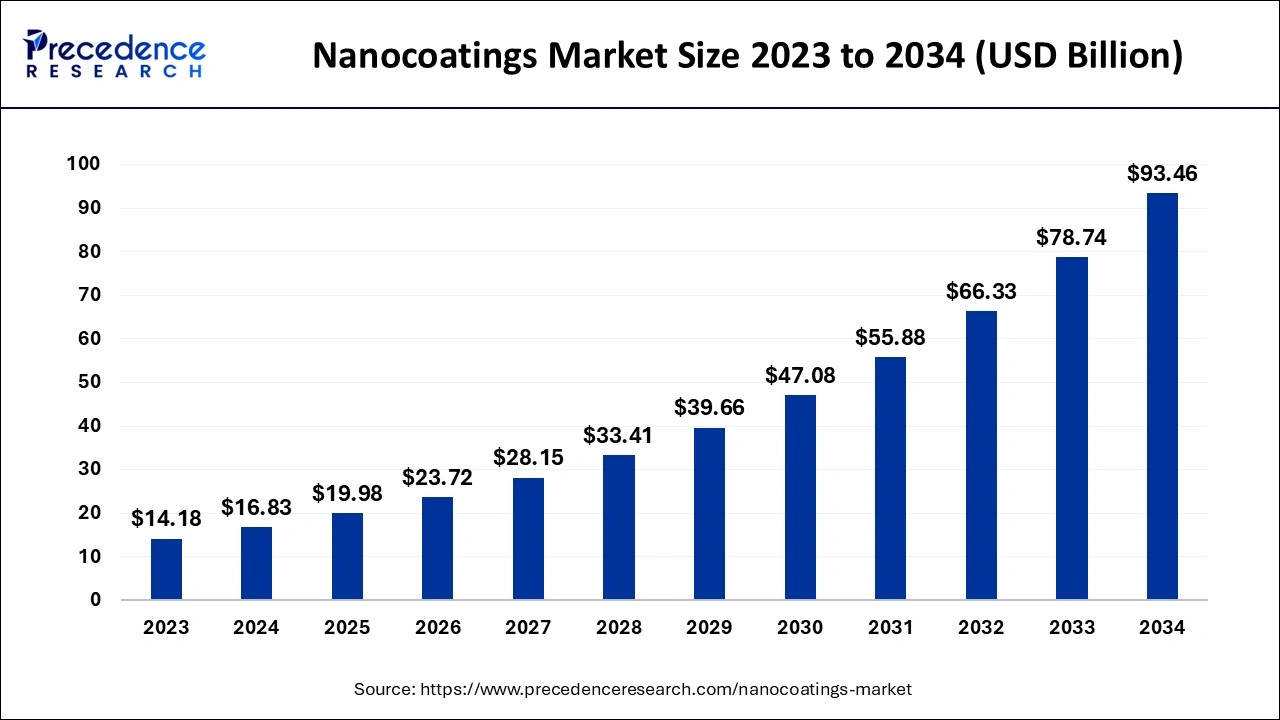
Nanocoatings Market Key Takeaways
- By Region, North America held a majority revenue share of the nanocoatings market in 2025.
- By Region, Europe is expected to grow at the fastest CAGR in the market during the forecast period.
- By type, the self-cleaning segment held a dominant position in the market in 2025.
- By type, the anti-microbial segment is expected to grow at the fastest CAGR in the market between 2026 and 2035.
- By coating methods, the CVD segment accounted for a considerable revenue market in 2025.
- By coating methods, the PVD segment is expected to grow with the highest CAGR in the market during the studied years.
- By raw material, the Al2O3 segment led the global market in 2025.
- By raw material, the TiO2 segment is expected to expand rapidly in the market with a CAGR in the coming years.
- By application, the construction segment registered its dominance over the global market in 2025.
- By application, the electronics segment is expected to witness the fastest growth in the market with a CAGR over the forecast period.
Market Overview
Nanocoatings are utilized for protecting a surface against dirt, corrosion, dust and damage which takes place as a result of the external environment. The external factors such as moisture, friction, bacteria, water and heat radiations have a direct impact on the surface which can be protected with the help of nanocoatings that provide a very thin layer which takes up all the external impressions falling on the surface. This thin layer of nano coating can be in the form of a chemical or material that is applied on the surface which needs protection.
The building and construction sector has emerged as a major consumer for nanocoatings as a result of the chances of damage and corrosion. The usage of nanocoating for the purpose of conserving the building materials has emerged as a major growing phase for the market. The products which are utilized in the construction sector become sustainable after they are coated with the help of nanocoatings. The property of abrasion resistant which is provided by the nanocoatings proves to be a very useful for increasing the life of the materials. Abrasion resistant products are highly demanded in the field of construction and building as it helps to provide a premium experience to the consumers and also helps to maintain the cost of the final products.
The automotive sector also makes use of such chemicals and materials that provide a premium look to the final products and also protect it against the external environmental impressions that have the capacity to change the appearance or quality of the final product. The outbreak of the pandemic had considerable impact on the market as a result of the reduced workforce. Various initiatives have been taken by the government in order to deal with the situation in the form of lockdowns and other restrictions. The demand and supply chain were hampered tremendously during the course of the pandemic.
How is AI Influencing the Nanocoatings Industry?
AI is changing the nanocoatings industry by accelerating materials discovery, improving production via automation, and improving quality control. AI systems determine equipment data to forecast potential failures in the production line, decreasing downtime and optimizing energy consumption.
AI thus facilitates the creation of smarter, more sustainable coatings by forecasting the performance of new, eco-friendly formulations, like reducing volatile organic compounds. It enables, for example, the rapid replacement of harmful substances such as APEO surfactants.
Nanocoatings Market Growth Factors
The utilization of nanocoatings in the construction and building industry has emerged as a major opportunity for the market as it helps to provide protection against the external environmental impressions such as UV radiations and moisture which have a considerable impact on the quality of the final product. The durability of the structure mainly depends upon the quality of the materials that are utilized for construction. Protection against corrosion, abrasion and staining is provided with the help of nanocoatings.
Hydrophobic coatings are utilized in the construction and building industry to protect the materials against damp and rust which helps to improve the shelf life of the structure. The health care sector also makes use of nanocoatings on a large scale owing to the high risk of contamination which is involved. Properties such as self-cleaning are mainly applied in this particular sector to prevent the surface of the surgical from being infected and hence prevent hospital-acquired infections.
Hospital acquired infections has emerged as one of the major reasons for complicating a number of cases especially in the geriatric population who are vulnerable to external impressions. The utilization of nanotechnology in the automobile industry has also helped to boost the demand and supply of vehicles to a great extent. Properties such as anti-fingerprint and anti-corrosion are mainly used in this particular sector for the interiors and the electronics that are fixed inside the vehicles.
Major Key Trends in Nanocoatings Market
- Growing Demand for Protective Coatings: Nano-coatings are used in numerous industries and products, such as vehicles, electronics, healthcare, and industry, for protection from corrosion and from scratches and for durability.
- Advancements in Nanotechnology: A significant improvement in nanomaterials and coating technologies has been achieved, which has demonstrated improvements in performance, functionality, and application efficiency, leading to broad application in many end-use areas.
- Increasing Adoption in Healthcare and Electronics: In healthcare devices and electronics, applications include antimicrobial properties that resist environmental marks and damage, and also improve durability.
- Rising Demand for Sustainable Coating Solutions: As the volume of use on the environment has been growing, the growth is also led by eco-friendly nanocoatings that minimize the release of harmful chemical materials or improve their efficiency.
- Expansion Across Automotive and Construction Industries: The increase in applications is pushing protection, weatherproofing, and enhanced performance applications for surfaces in the automotive and construction industries to higher levels of nanocoatings.
Strategic Growth Opportunities
- High Growth Commercial Opportunities: The electronics, automotive, healthcare, and aerospace sectors demand protective, antimicrobial, and functional coatings on a variety of complex components, providing important commercial opportunities. The growth of the market is when the durable surface solutions will be expected to support.
- Emerging Technology Opportunities: New growth prospects exist through the development of nanomaterials, self-healing coatings, smart coatings, and sustainable nanotechnology. The use of advanced manufacturing technologies can enhance the performance of coatings and how they are applied.
- Geographic Expansion Opportunities: Growth in emerging economies in Asia Pacific, Latin America, and the Middle East is derived from industrialization and increasing manufacturing activities. Businesses can grow by forming partnerships, manufacturing locally, and selling on local networks.
Market Scope
| Report Coverage | Details |
| Growth Rate from 2026 to 2035 | CAGR of 18.23% |
| Market Size in 2025 | USD 19.98 Billion |
| Market Size in 2026 | USD 23.72 Billion |
| Market Size by 2035 | USD 106.64 Billion |
| Base Year | 2025 |
| Forecast Period | 2026 to 2035 |
| Segments Covered | Type, Coating Methods, Raw Material, Application, and Geography |
Market Dynamics
Drivers
- Increasing demand from the construction sector - The application of nanocoatings benefits the material by making it resistant against a number of external environmental impressions which hampers the quality of the product. Nanocoatings provide exceptional characteristics which makes the material premium. It protects the surface against a number of impressions such as abrasion, corrosion and staining. the infrastructure can be protected against the UV radiations, rain and moisture with the help of good quality nanocoatings which makes the structure long lasting. Durability of the final product is increased considerably with the use of nanocoatings.
Challenges
- Expensive raw materials - The raw materials that are required for manufacturing of nanocoatings include ceramics, nitrides and carbides. A number of advanced technologies and machineries are required for the manufacturing process and application of the nanocoatings on the desired surface. Raw materials that are utilized for this process have constantly fluctuating prices which makes the cost of the final product uncertain. Constant variations in the price and quality of the product hampers the demand and supply of nanocoatings. The price of nanocoatings is much higher as compared to the other conventional coatings that are available in the market which emerges as a major challenge for the industry.
Opportunities
- Increasing demand for nanocoatings from the automotive industry - Nanocoatings are widely used in the modern automobiles to provide a protective layer over the surface of the products that are used inside the vehicles. This protective layer makes the products resistance against the external environmental conditions and impressions and hence maintains the premium look of the devices. The durability of the products which are utilized is increased considerably with the help of this coating. They proved to be thermal barriers and provide maximum protection against extreme climatic conditions which makes the product durable and long-lasting. Manufacturers such as Mercedes, Hyundai, Tesla and Ford make use of this technology on a large scale which helps the market to present a considerable growth.
Segment Insights
Type Insights
On the basis of type, the segment of self-cleaning has emerged as the largest segment under this category owing to the rapid demand of this facility among many consumers all over the world which helps to save a huge amount of time and effort. As a result of the busy lifestyle practices that are followed by the people it is not possible for everyone to constantly clean up a particular surface in order to maintain hygiene which is taken care with the help of this particular segment and hence makes it quite easier for the consumers in the long run. The segment of self-cleaning provides facilities such as Protection against foreign objects dust and other materials. The maintenance of the final product is reduced to a great extent with the help of this self-cleaning technology.
The segment of antimicrobial coatings it's mainly utilized in the healthcare sector where hygiene plays an important role for protecting vulnerable patients against hospital-acquired diseases and infections. The surgical instruments and equipment have a high exposure to microbial and bacterial infestations which can be protected with the help of this antimicrobial coating. The recent rules and regulations regarding hygiene and cleanliness in the healthcare sector has helped the market to record a considerable revenue over the period of time. The technology of self-cleaning is also applied by the glass industry for making the final product more attractive and durable. The property of scratch resistance helps to increase the life and look of the final product which increases the demand and supply.
The anti-fingerprint segment is projected to grow at a notable pace as surface cleanliness and durability are in rising demand. Electronics, automotive displays, and consumer devices are among the various applications that widely use these coatings. Adoption is facilitated by consumer demand for stylish and low-maintenance products. Progress in coatings technology is enhancing the performance of coatings.
The anti-corrosion segment is expected to witness steady growth during the forecast period as the demand for protective solutions that last long. Nanocoatings offer increased moisture, chemical, and environmental resistance. The automotive, aerospace, marine, and industrial markets are growing and offer prospects for market expansion. New coatings are being developed by industry to lower maintenance costs and product life cycle.
Application Insights
On the basis of application, the segment of construction and building has emerged as the largest segment owing to the rapidly increasing number of new structures that are being erected all over the world as a result of urbanization. The durability of the construction materials is increase to a great extent with the use of nanocoatings. Advanced technological solutions are being employed for making the products of better quality that helps to increase the demand and supply. Properties such as thermal insulation, hydrophobic and hydrophilic coatings are used for increasing the shelf life of the raw materials as well as the final product.
The materials are protected against external climatic conditions and hence helps to maintain the quality of the product. Moisture proves to be a major factor that affects the quality of the construction materials and hence degrades the quality of the final product.
The entire infrastructure gets damaged with the effect of moisture which can be prevented with the help of nanocoatings. External climatic impressions are avoided with the help of the nanocoatings which are applied on the surface of the construction materials. Fungal and bacterial accumulation can we spotted on various surfaces which keeps the area damp. This can be avoided when the surface is coated by nanocoatings.
The life of the final product is increased considerably when it receives protection against external environmental impressions. The other segments which make use of nanocoatings includes the automobile industry, marine industry, electronics and the medical sector. Rapid demand for nanocoatings has been experienced by the automotive industry owing to the increasing demand for premium cars among the people.
The electronics segment is expected to witness notable growth owing to the rising demand for advanced protective coatings used in electronics. Nanocoatings can increase the strength, resistance to moisture, and protection of surfaces of the elements. Smartphone and semiconductor production continues, as well as the production of wearable electronics, which is driving adoption.
The healthcare segment is expected to grow steadily, as healthcare devices are being designed with antimicrobial and protective nanocoatings at a growing rate. Nanocoatings help minimize contamination hazards and enhance device durability. As more sophisticated healthcare devices are in demand, market growth is propelled. Infection control solutions are the target of attention by hospitals and manufacturers.
The aerospace segment is projected to witness stable growth during the forecast period. Nanocoatings are used to provide corrosion and wear protection and improve component performance. Some aerospace companies use new materials for more efficient operations. Demand is supported by growing aircraft production/maintenance activities.
Coating Methods Insights
Why Did the CVD Segment Dominate the Nanocoatings Market?
The CVD segment dominated the market in 2025, with excellent performance, which was a key factor that fueled the market growth in the CVD segment for the same period. CVD has great adhesion to diverse substrates and durability. It is a technique used in electronics, semiconductors, and industrial applications. There is increasing demand for advanced surface engineering solutions to drive take-up.
The PVD segment is expected to grow significantly during the forecast period due to the increased need for long-lasting and robust coatings. Increased surface protection and wear resistance are offered by PVD. Increasing applications development in electronic components, automotive components, cutting tools, etc contributes to market growth. Improvements are being made in coating performance and efficiency due to advancements in deposition technologies.
Raw Material Insights
How the Al2O3 Segment Dominated the Nanocoatings Market?
The Al2O3 segment dominated the market in 2025 due to its high hardness, good thermal stability, and protective characteristics. Nano-coatings of Al2O3 give very good wear resistance, corrosion resistance, and chemical resistance. It is commonly found in electronics, industrial equipment, and protection applications. The performance characteristics of nanomaterials are being enhanced with the development of processes. 
The TiOâ‚‚ segment is anticipated to witness consistent growth through the occurrence of an upward trend in the TiOâ‚‚ coating application of photocatalytic and self-cleaning solutions during the forecast period. Titanium dioxide nanocoatings are UV-resistant, antimicrobial, and environmentally friendly. Rapid adoption in healthcare, construction, and the automotive industry contributes to growth.
Regional Insights
What is the U.S. Nanocoatings Market Size?
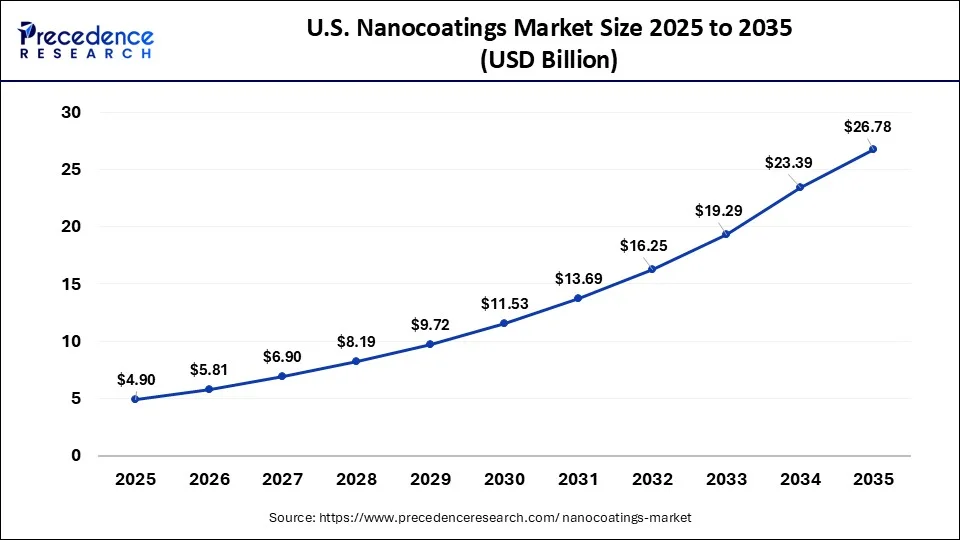
The U.S. nanocoatings market size was evaluated at USD 5.81 billion in 2026 and is predicted to be worth around USD 26.78 billion by 2035, rising at a CAGR of 18.51% from 2026 to 2035.
On the basis of geography, the region of North America has emerged as the largest market owing to the extensive demand and usage of nanocoatings in various sectors. Rapid acceptance to modern technology in this particular region has emerged as a major growth factor for the market. The huge number of construction activities that are carried out in this particular region has also emerged as a major opportunity for the growth of the market. As a result of the increasing spending capacity of the people, the demand for premium products has increased rapidly which emerges as another major opportunity for the growth of the nanocoatings market.
The utilization of premium vehicles has been observed in this particular region which increases the consumption of nanocoatings to a great extent. The expenditure that is made on construction and infrastructure has emerged as a major growth factor for the market in this region. The active participation of the government to encourage sustainable development has boosted the demand for nanocoatings to a great extent. The rapidly growing aerospace industry has also emerged as a major growth factor for the nanocoatings market.
The industry of electronics has also helped considerably by contributing a decent share as a result of the premium products that are demanded by the people. The research and development programs that are carried out in this region by the key market players emerge as a major growth factor for the market.
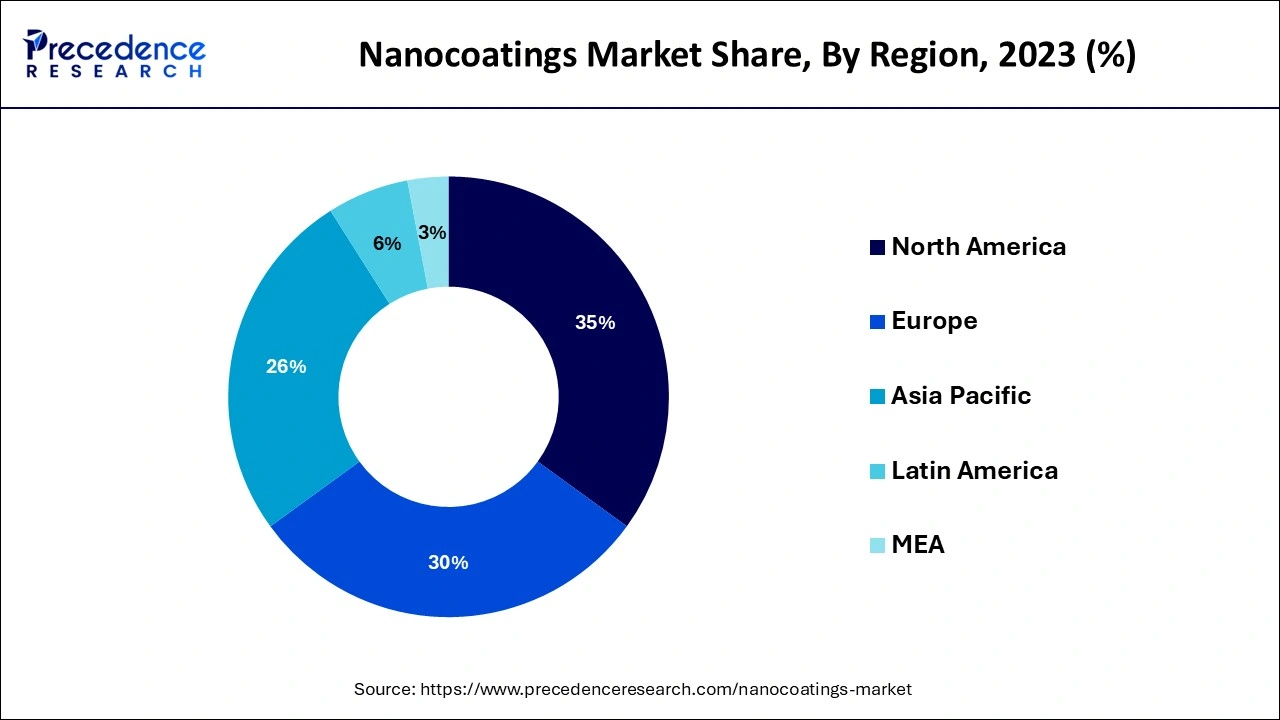
Asia Pacific is the fastest growing market for the nanocoatings market with a significant CAGR during the forecast period, fueled by swift industrial growth, an expanding manufacturing landscape, and a rising need for high-performance, long-lasting surface solutions. Sectors such as automotive, healthcare, construction, and electronics are adopting nanocoatings due to their advantages, including corrosion resistance, antimicrobial features, and improved surface durability. Increasing environmental consciousness and tighter regulations are motivating companies to shift towards eco-friendly coatings. Furthermore, regional governments are actively encouraging innovation in nanotechnology, fostering a conducive atmosphere for the growth of the nanocoatings sector. This expansion is also backed by heightened urbanization, infrastructure projects, and a strong supply chain across major Asia Pacific nations.
China Nanocoatings Market & Trends
China stands out as a major player in the Asia Pacific nanocoatings sector, bolstered by its robust manufacturing foundation and advancements in technology. There is a growing need for protective and functional coatings across construction, automotive, and electronics due to a wide range of applications. The proactive involvement of the government in advancing nanotechnology and facilitating industrial improvements contributes to the market's progress. Moreover, the drive for environmentally sustainable materials is prompting industries to embrace eco-friendly nanocoating solutions.
Antimicrobial and Anti-Corrosion Nanocoatings Market Analysis in Europe
Europe shows a significant growth during the forecast period. It is driven by the increasing need for high-performance, durable, and sustainable coating solutions in the automotive, aerospace, and healthcare sectors. Europe is pioneering environmentally-friendly, non-toxic coatings with low VOC emissions, boosting the need for sustainable alternatives such as sol-gel nanocoatings.
Germany Market Trends
The German market is anticipated to grow significantly due to its strong automotive, aerospace, and industrial manufacturing industry. Demand for nanocoating is supported by the use of advanced surface technology. The Government's strategy toward innovation and sustainable materials promotes market development. Increased investments in research and development are helping to drive the adoption of technologies.
Eco-Friendly Nanocoatings and EU Environmental Regulations Impact in Latin America
Latin America shows a notable growth during the forecast period. It is driven by the demand to meet stringent EU environmental regulations for exports, along with regional sustainability goals. These coatings, utilized in construction and automotive, provide high performance with lower environmental impact, assisting compliance with global standards, decreasing VOCs, and enhancing durability.
Brazil Market Trends
Brazil's nanocoatings market is anticipated to grow significantly, owing to the surging industrialization and the demand for enhanced protective coatings. Small and medium-sized enterprises contribute to the growth of adoption in the automotive, construction, and electronics product areas. Businesses are concerned with building products that can last longer and work better.
Growth of the Middle East and Africa in the Nanocoatings Market
The Middle East and Africa region is expected to witness significant growth in the market due to the growing focus on this region. Nanocoating is encouraged by rising construction and infrastructure activities. Growth in automotive, healthcare, and energy contributes to demand. Coatings are being used by industries to enhance durability in adverse conditions.
Saudi Arabia Market Trends
Saudi Arabia market is anticipated to grow significantly due to surging infrastructure projects and diversification efforts of industries in the country. Demand for nanocoatings is robust on the back of investment in the construction, energy, and manufacturing industries. Advancements in corrosion protection as a result of challenging surroundings are prompting adoption.
Government Initiatives
United States
The U.S. government encourages commercialization of and research into advanced nanomaterials' use through the National Nanotechnology Initiative (NNI), a U.S. government initiative to further advance the field of nanotechnology. Few areas of activity are as encouraged by federal programs as nanocoating applications are for the healthcare community, the electronics industry, defense, and industry in general.
China
China is undertaking nanotechnology R&D and the development of new materials via national-level innovation programs. The government backs research into the development of more applications for nanocoating, which can be used in electronics, the automotive industry, healthcare, and industrial manufacturing.
Japan
Japan is fostering the development of nanotechnology research in such areas as advanced materials and electronics, medical science, and energy. The commercialization of novel nanocoating technologies is accelerated with the use of collaborations between the public and private sectors.
South Korea
The South Korean government operates a nanotechnology and advanced materials innovation program. These programs back the development of nanocoatings for automotive, industrial, and electronic applications, as well as semiconductors.
European Union
In response to the EU support for nanotechnology development, specific programs can be found under Horizon Europe, among them Sustainable Materials and Advanced Manufacturing. Safe and innovative nanomaterial use in diverse sectors of the economy is encouraged through these efforts.
Value Chain Analysis for the Nanocoatings Market
- Feedstock Procurement: It is a vital, foundational element for the nanocoatings market, thus directly influencing production expenses, product performance, and sustainability.
Key Players: Nanophase Technologies Corporation, Strem Chemicals, Inc., American Elements, - Chemical Synthesis and Processing: They offer the precision, scalability, and functional customization necessary to move nanocoatings from the laboratory curiosity to industrial-grade products.
Key Players: ACTnano Inc., Tesla NanoCoatings Inc., Nanovere Technologies LLC - Compound Formulation and Blending: It provides the ability to customize and optimize coating performance by integrating specifically engineered nanoparticles into polymer matrices.
Key Players: PPG Industries, Inc., Nanophase Technologies Corporation, ACTnano, Inc.
Competitive Landscape
The nanocoatings market is competitive and is expected to witness significant product innovation, advanced coating technology, and market expansion by the key players such as Bio-Gate AG, Integran Technologies Inc., Nanofilm Ltd., Buhler PARTEC GmbH, and Inframat Corporation. Business firms spend on research and development to improve coatings for their durability, performance, and application efficiency in their various industries. Participants are moving into the area with partnerships between industry partners, manufacturers, research institutions, and application companies.
Companies are prioritizing innovation, sustainability, and customized applications by targeting advanced nanomaterials and sustainable coating solutions to streamline their operations and maintain a competitive edge. Electronics, healthcare, mechanical engineering, automotive, and aerospace industries rely on this, and demand increases continuously to create a more competitive landscape.
Nanocoatings Market Top Companies
- Cima NanoTech Inc.: Cima NanoTech Inc. specializes in the development as well as manufacturing of high-performance, transparent conductive coatings and even films driven by their proprietary SANTE self-assembling nanoparticle technology.
- Eikos Inc.: Eikos Inc. specializes in the advancement of Invisicon, a technology based on carbon nanotube inks programmed to provide transparent conductive coatings, mainly as a flexible alternative to Indium Tin Oxide (ITO).
- Inframat Corporation: Inframat Corporation provides a range of nanocoatings and advanced materials designed to enhance material performance, aiming on durability and wear resistance.
Other Major Key Players
- Bio-Gate AG
- Buhler PARTEC GmbH
- Integran Technologies Inc.
- Nanofilm Ltd.
Recent Development
- In April 2024, actnano, Inc. secured a USD 40 million investment from Anthelion Capital to enhance its technical sales and services, boost production, and cater to the rising demand for its cutting-edge nanocoating technology, which provides superior protection for electronics.
- In October 2023, FendX Technologies Inc. completed a successful pilot production run of its REPELWRAP film using commercial-grade equipment from Dunmore International. This achievement represented a significant advancement toward large-scale production of the nanocoating-based film aimed at minimizing the spread of pathogens on surfaces, with applications in healthcare and public spaces.
- In November 2023, Nanofilm Technologies International and NTU formed a partnership to create a $66 million corporate lab, focusing on the development of innovative nanotechnology solutions for various industries.
- In April 2021 - a significant milestone was achieved by the company of Actnano in the year 2020 as it received a contract of production of 1.2 million vehicles under its brand of nano guard. A variety of autonomous vehicles were also included in this particular contract.
Segments Covered in the Report
By Type
- Anti-fingerprint
- Anti-microbial
- Anti-corrosion
- Abrasion & Wear Resistance
- Anti-fouling
- Self-cleaning
- UV Resistance
- Anti-icing
- Thermal Barrier & Flame Retardant
- Conductive
- Others
By Coating Methods
- Cvd
- Pvd
By Raw Material
- Al2 O3
- Ti O2
By Application
- Health Care
- Aerospace
- Automotive
- Textiles
- Construction
- Electronics
- Food & Packaging
- Energy
- Marine
- Others
By Geography
- North America
- Europe
- Asia-Pacific
- Latin America
- Middle East & Africa (MEA)
For inquiries regarding discounts, bulk purchases, or customization requests, please contact us at sales@precedenceresearch.com
Frequently Asked Questions
Tags





Ask For Sample
No cookie-cutter, only authentic analysis – take the 1st step to become a Precedence Research client
 Get a Sample




 sales@precedenceresearch.com
 Schedule a Meeting
