



Skin Care Products Market Size, Production Capacity, Healthcare Infrastructure Growth, Product Utilization, Investment Trends, and Sales Analysis
Skin Care Products Market (By Type: Facial Care, Body Care, Lip Care; By Packaging: Tubes, Bottles, Jars, Others; By Products: Face Creams & Moisturizers, Cleansers & Face Wash, Sunscreen, Body Creams & Moisturizers, Shaving Lotions & Creams, Face Masks, Others; By Distribution Channel: Supermarkets & Hypermarkets, Convenience Stores, Pharmacy & Drugstore, Online, Others; By End-User: Female, Male, Unisex; By Category: Premium Skincare Products, Mass Skincare Products; By Ingredient: Chemical, Natural) - Global Industry Analysis, Size, Trends, Leading Companies, Regional Outlook, and Forecast 2025 to 2034
Source: https://www.precedenceresearch.com/skin-care-products-market
 Get a Sample
 Table Of Content
What is the Skin Care Products Market Size?
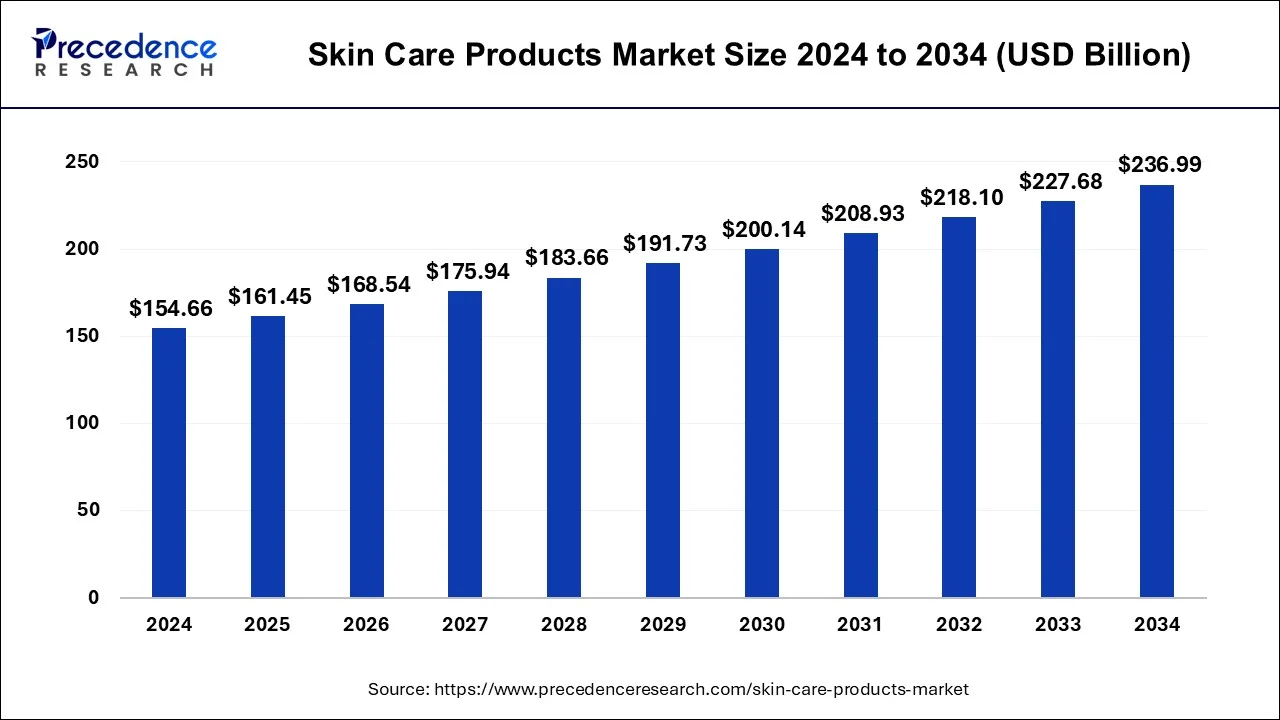
The global skin care products market size is projected at USD 161.45 billion in 2025 and is predicted to increase from USD 168.54 billion in 2026 to approximately USD 236.99 billion by 2034, expanding at a CAGR of 4.36% from 2025 to 2034. The overall growth of the global skincare products market is driven by increased spending on personal care products across the globe.
Market Highlights
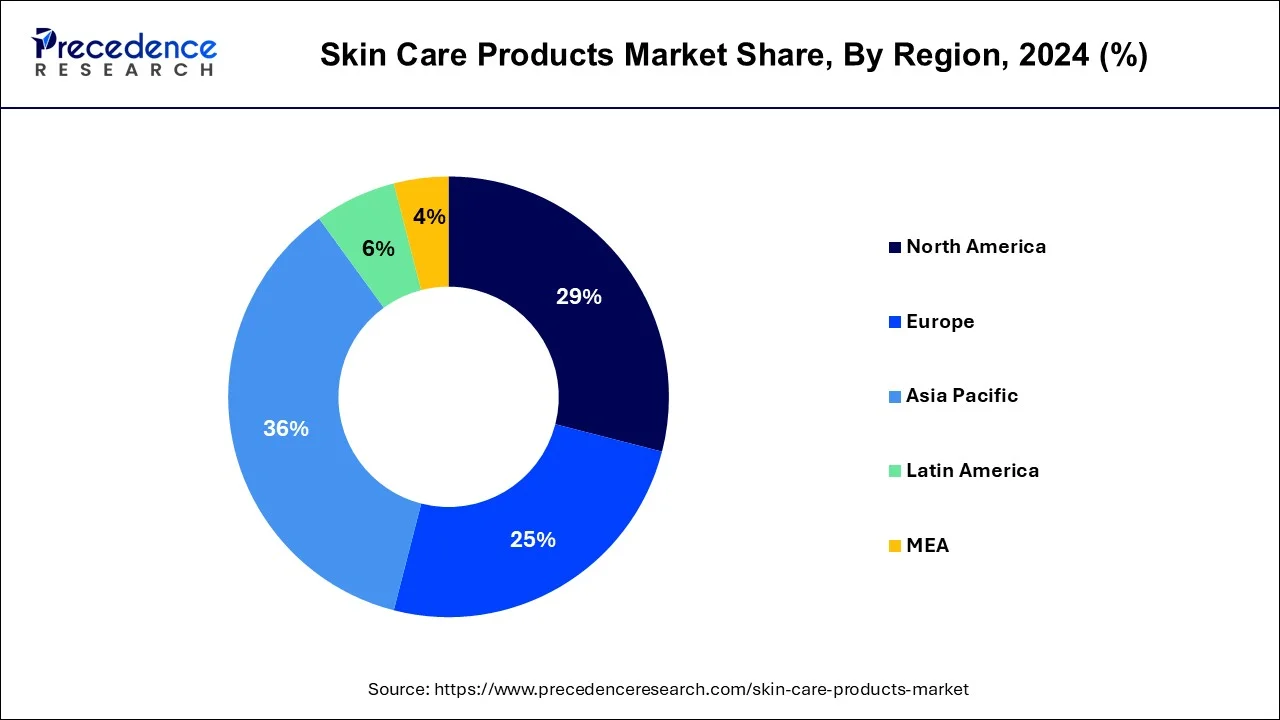
- Asia Pacific dominated the market and generated more than 36% of the revenue share in 2025. And also expected to grow at fastest CAGR during forecasted period.
- By type, the facial care type segment dominates the global market.
- By type, the female gender segment generated more than 61% of the revenue share in 2025.
- By end user, the male segment is predicted to significantly boost from 2026 to 2035.
- By end user, the tube packaging segment dominates the global market.
- By product, the face creams & moisturizers products segment captured more than 41% of revenue share in 2025.
- By product, the supermarkets & hypermarkets distribution channel segment dominated the market and accounted for over 41% of revenue share in 2025.
Market Size and Forecast
- Market Size in 2025: USD 161.45 Billion
- Market Size in 2026: USD 168.54 Billion
- Forecasted Market Size by 2034: USD 236.99 Billion
- CAGR (2025-2034): 4.36%
- Largest Market in 2024: North America
- Fastest Growing Market: Asia Pacific
Market Overview
The global skin care products market plays around the discovery, manufacturing, sale and marketing of various facial, body care, lip care and other personal care products. Using skin care products in a routine life fight ageing signs, dying cells, wrinkles, acne, dryness and many other skin issues. A quality skincare routine promotes healthy skin and maintains the production of healthy cells. People have adopted a skincare routine that is quick, easily adaptable, and easy to argue for extended periods. The global skincare products market is growing as people focus on physical appearance. The sudden growth of the skincare products market is attributed to the rapid changes in lifestyle and the easy availability of skincare products everywhere.
The global skincare products market shows potential for discovering new and advanced products during the forecast period. Face toners, face serums, essential oils, night face masks, exfoliators, and face-sheet masks are a few products in the trend to maintain healthy skin. Rising pollution brings various skin issues. The sales of skincare products that combat dull and pollution-affected skin have increased in recent years.
How Can AI Change the Future of Skincare?
Artificial intelligence is changing the face of the skincare products industry through better personalized products, better interaction with clients, and other tools based on data. AI-driven skin analysis systems look at the client's skin hydration, skin color, level of acne and wrinkles, and sensitivity by analyzing images from the smartphone or any other connected device. Machine learning helps to find new ingredients much easier because the large pool of datasets allows one to analyze which ingredients will be the most appropriate.
When it comes to production, AI tools can be also used in quality control, demand forecasting, and inventory management processes to improve the quality of operations and minimize waste. Many companies use AI-driven chatbots and advisors to provide personalized experience for their clients and improve customer retention. AI allows companies to continue innovating and improving their products while they respond to the demand for effective skin care solutions.
Skin Care Products Market Growth Factors
- Increasing Awareness: More individuals are aware and conscious of skin care products as a result of the growing working population, rising public knowledge, and growing disposable income. Moreover, innovative promos and marketing are fueling customer demand. Consumer purchasing power has increased as a result of growing urbanization and a trend of organic skin care products. Millennial want a wider range of skin care products.
- Increased use of Organic Products: Organic skin care products have become a major driver of the global skin care products market. The customers prefer products that contain organic and natural ingredients and are free of harmful.
- Rise in Investment: The large investments in research and development as well as growing knowledge of the negative impacts of synthetic alternatives are expected to offer long-term growth prospects. The imitated or false items introduced by many small manufacturers result in the demise of natural and branded products, posing a threat to the growth of the global skin care products market.
- Skin brightening creams have a strong market: potential because they contain goods for both men and women. Due to the growing ageing population in Asia-Pacific, ant-aging and sun protection creams have a lot of potential. In developed nations, the skin brightening creams is expected to increase rapidly during the forecast period. Thus, both men and women are turning to skin care products to achieve nourished and hydrated skin. As a result, the global demand for skin care products is predicted to rise at a rapid pace.
Future Trends For Skin Care Products Market
- Clean Beauty: The interest of consumers in clean, safe, and naturally-sourced ingredients will keep increasing. Many manufacturers will invest in plant-based products and sustainable packaging materials.
- Microbiome Care: The popularity of microbiome-friendly skincare products that help keep healthy skin microflora will increase. Moreover, innovations in probiotic, prebiotic, and postbiotic formulations will contribute to skin barrier health and solve such problems as sensitivity, acne, and inflammation.
- Sustainable Packaging: Companies will use more refillable containers, biodegradable materials, and recyclable packages. Thus, the sustainability initiatives will help boost brand's image and attract environmentally-conscious customers.
- Beauty Tech: Smart devices for skincare, mobile apps, and digital skin diagnostics will be more incorporated into skincare routines. Integration of technology and beauty products will bring new level of efficiency and personalization to users.
Market Scope
| Report Coverage | Details |
| Market Size in 2025 | USD 161.45 Billion |
| Market Size in 2026 | USD 168.54 Billion |
| Market Size by 2034 | USD 236.99 Billion |
| Market Growth Rate from 2025 to 2034 | CAGR of 4.36% |
| Largest Market | Asia Pacific |
| Base Year | 2024 |
| Forecast Period | 2025 to 2034 |
| Segments Covered | Type, Packaging, Products, Distribution Channel, End-User, Category Ingredient, and Region |
| Regions Covered | North America, Europe, Asia-Pacific, Latin America, and Middle East & Africa |
Market Dynamics
- Organic skin care products have become a major driver of the global skin care products market. The customers prefer products that contain organic and natural ingredients and are free of harmful chemicals. As a result, the demand for skin care products market is growing at a rapid pace.
- The need for skin care products in Asia-Pacific is being met by rising consumer awareness and rising income levels. In addition, throughout the forecast period, penetration of foreign brands, urbanization, and expansion of e-commerce platforms and offline channels such as hypermarkets specializing in the sale of skin care products are expected to enhance the market growth.
- People are quite conscious regarding their skin tone and texture. Thus, the major market players are developing and launching skin care products that fulfil all the requirements of the people. As a result, growing standards of living and increased awareness regarding wide range of skin care products is driving the growth of global skin care products over the projection period.
- The large investments in research and development as well as growing knowledge of the negative impacts of synthetic alternatives are expected to offer long-term growth prospects. The imitated or false items introduced by many small manufacturers result in the demise of natural and branded products, posing a threat to the growth of the global skin care products market.
- Skin brightening creams have a strong market potential because they contain goods for both men and women. Due to the growing ageing population in Asia-Pacific, ant-aging and sun protection creams have a lot of potential. In developed nations, the skin brightening creams is expected to increase rapidly during the forecast period. Thus, both men and women are turning to skin care products to achieve nourished and hydrated skin. As a result, the global demand for skin care products is predicted to rise at a rapid pace.
Segments Insights
Type Insights
Based on type, the global skincare products market is segmented into facial, body, and lip care. The facial care segment dominates the global skincare products market. The availability of a wide range of products for facial care to be involved in a daily skincare routine. Products such as face creams, sunscreen protection, serums, essential oils, eye cream, face wash, exfoliators and face masks are involved in the facial care segment. Furthermore, the rising awareness of healthy skin and self-care has boosted the body care segment; the segment is projected to grow during the forecast period.
Packaging Insights
Based on packaging, the global skincare products market is segmented into tubes, bottles, jars and others. The tube segment dominates the global skincare products market. Skincare products in tube packaging offer convenience for use. Tubes are compact and can be carried easily, and the risk of tube content getting imposed by sunlight is less. Considering these factors, many products such as sunscreen lotions, lip balm, shaving creams, moisturizers and eye creams are sold in tube packaging.
The jar segment is projected to grow during the forecast period owing to the aesthetic packaging brands provide for glass jars. Jars are reusable and recyclable, which is a significant factor behind the growth of the segment in the global skincare products market.
Products Insights
In 2024, the face creams & moisturizers segment dominated the skin care products market with a revenue share of 41%. The face creams and moisturizers are skin care products are frequently used by consumers. The face creams and moisturizers are quick alternative and easy to use for addressing dry skin. Moreover, the benefits such as fewer breakouts, rapid hydration, and refreshed skin.
The face masks segment, on the other hand, is predicted to develop at the quickest rate in the future years. The antioxidants and other important elements found in facial masks are good to diverse skin types. The face masks provide spa-like experience which is drawing a lot of customers.
Distribution Channel Insights
The supermarkets & hypermarkets segment dominated the skin care products market in 2024 with a market share of 41%. Consumers benefit from supermarkets & hypermarkets because they have more choices, higher visibility of foreign brands, and lower pricing. These characteristics make them an ideal platform for all types of skin care product shoppers.
The convenience stores segment is the fastest-growing segment of the skin care products market during the projection period. Some consumers prefer to buy skin care products from these businesses since they are easy to find, have a large network, and can purchase the same items on a regular basis.
End-User Insights
Based on end-users, the global skincare products market is segmented into female, male and unisex. The female segment accounted largest revenue share of over 61% in 2024. Increased spending by the female population on personal care products involved in daily skincare regimes has boosted the demand for advanced skin care products for female skin. Moreover, the rising importance of healthy skin, relaxation sessions for the face and self-care experiences have propelled the growth of the female segment in the market.
The male segment is expected to significantly boost during the forecast period. Skin care products such as sun protection creams, lotions, shaving gels, face wash and deodorant are in demand from the male population. The awareness among the male population for a quality skincare routine has emerged in recent years, which has provided lucrative opportunities for multiple brands to formulate skincare products for male skin. For instance, in March 2022, IDAM House of Brands, a skincare and hair care products company based in India, launched a men's skincare brand 'Brave Essentials'. Products under the brand for male skin are formulated with natural ingredients and no harsh chemicals.
Regional Insights
Asia Pacific Dominated the Skin Care Products Market Analysis
Asia Pacific dominated the skin care products market and accounted for more than 36% of revenue share in 2024. The Asia Pacific market is expected to grow during the forecast period. The expansion of the chemical industry in China, Japan and India is a significant factor in the growth of the skincare products market. The increasing population in China and India is another driver for the development of the market.
Asia Pacific Skin Care Products Market Size and Growth 2025 to 2034
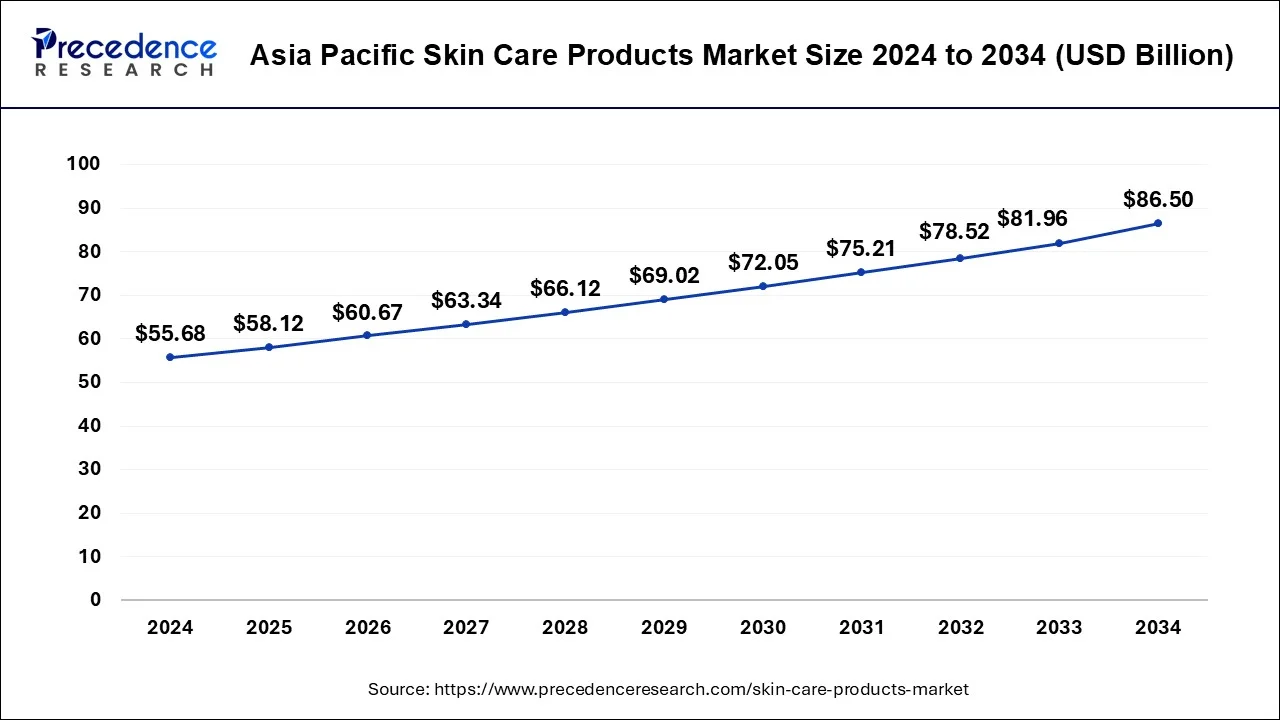
The Asia Pacific skin care products market size is valued at USD 58.12 billion in 2025 and is expected to reach USD 86.50 billion by 2034, growing at a CAGR of 4.50% from 2025 to 2034.
South Korea Skin Care Products Market Analysis
South Korea plays a significant role in the skincare products market of Asia Pacific owing to the flourishing concept of the Korean skincare regime. North America is the fastest-growing region in the global skincare products market. Increased spending on personal care products in the US and Canada has surged the growth of the skin care products market in North America. The presence of well-established companies in the region has contributed to the development of the market.
Europe Skin Care Products Market Analysis
Europe is the most significantly growing region in skin care products Market. The rapidly ageing population in the region increases the demand for anti-aging skin care products. The skincare products market in Europe shows potential growth, and the online store segment for skin care products is flourishing in the region. Increased demand for luxurious skincare products is a significant driving factor for the skin care products market in Europe.
Germany Skin Care Products Market Analysis
Germany is leading the skin care product segment in the European region due to rising demand for natural skin care products and growing awareness among consumers. Continuous innovations in sustainable formulations and premium category skin care products have helped the country stay ahead of its competitors in the market.
North America Skin Care Products Market Analysis
A significantly high percentage of the skin care product market is being held by North America owing to factors such as high consumer expenditure on the personal care market, high demand for premium skin care products and the growing awareness regarding skin care. Strong increase in the popularity of clean-label products and anti-aging formulations along with continuous innovations in products and the growth of e-commerce platforms are contributing to the growth of the market in the region.
U.S. Skin Care Products Market Analysis
The U.S. holds the major share in the market as consumer purchasing power is high and demand for premium skin care products along with rapid innovations is high. The market is positively being affected by growing presence of major beauty brands in the region, retailing channels in the region and high consumer interest in clean skin care formulations.
Moreover, the rapidly ageing population in the region increases the demand for anti-aging skin care products. The skincare products market in Europe shows potential growth, and the online store segment for skin care products is flourishing in the region. Increased demand for luxurious skincare products is a significant driving factor for the skin care products market in Europe.
Middle East and Africa Skin Care Products Market Analysis
The sales of women's skincare products that can be quickly applied have increased immensely in Brazil. A new formulation of natural ingredients-based skin care products and attractive packaging offered by multiple companies are the driving factors for the market's growth in Latin America. Developing the chemical industry and the presence of local skincare brands are anticipated to fuel the market's growth in the Middle East and Africa.
The Middle East and Africa are expected to grow significantly in the skin care products market during the forecast period. The growing awareness about skin care is increasing the demand for various skin care products in the Middle East and Africa. Thus, the use of skin products for sun protection, against acne, as well as for hyperpigmentation, is also rising. This, in turn, also increases the use and demand for various sunscreens as well as moisturizers. Additionally, growing digitalization is enhancing the awareness, which in turn, is also increasing the use of natural skin care products. Thus, new start-ups as well as collaboration are also contributing to the same. Hence, this promotes the market growth.
Competitive Analysis
The skincare products marketplace is an extremely fragmented one. There are many different global brands, local companies, and promising new direct-to-consumer brands. Companies compete through new product development efforts, pricing strategies, branding, and means of distribution. Increasing demand of consumers and their preferences for beauty products fuel competition and create low entry barriers into the industry. Well-established companies like L'Oréal, Unilever, Estée Lauder, and Beiersdorf utilize their portfolios, global presence, innovations in R&D, and high level of brand recognition. At the same time, niche companies emphasize clean and customized skin care.
Competition is driven by product launches, strategic partnerships, acquisitions, environmentally friendly packaging initiatives, and investment into dermatological research. Regulatory compliance, product formulation, brand loyalty, and innovation costs are some of the major barriers to entry into the industry.
Skin Care Products Market Companies
- Colgate-Palmolive Company
- L'Oreal S.A.
- Procter & Gamble
- Unilever
- Coty Inc.
- Shiseido Co. Ltd
- Avon Products Inc.
- Revlon
- Beiersdorf AG
- Johnson & Johnson Inc.
Recent Developments
- In July 2026, Aptar Beauty launched its next-generation Auto-Loading Dropper technology, designed to improve skincare product dispensing with easier, cleaner, and more precise dosing. The innovation enhances consumer convenience, minimizes product waste, and supports premium packaging solutions for cosmetic brands. (Source: https://www.businesswire.com)
- In July 2026, Cleanlogic introduced its new Infusions Collection exclusively at Ulta Beauty, featuring bath tools infused with skincare-focused ingredients. The collection combines cleansing accessories with skin-enhancing benefits, reflecting growing demand for multifunctional personal care and beauty products. (Source: https://www.prnewswire.com)
- In April 2025, Body Repair Treatment, which offers a hydrating, corrective body serum used to deal with visible signs of aging, was revealed as the newest innovation by Doctor Rogers Skin Care. Furthermore, this innovation is proven to diminish wrinkles, and provide even skin tone, smooth and firm crepey skin without any irritation, and is successfully developed by Dr. Heather Rogers, MD, who is a board-certified dermatologist and founder of Doctor Rogers Skin Care. (Source: https://finance.yahoo.com)
- In June 2025, Skin Ultra™, which is a dermatologist-tested lineup developed specifically for male consumers, and Face Buffer Pro, an electric exfoliating tool for men's skin, were launched by the men's grooming brand MANSCAPED, which helped in the official entry of MANSCAPED in the skincare arena. Thus, with the launch of these products, a strategic step forward in the men's personal care market, to enhance the male interest in skincare solutions that are easy to use, functional, and tech-forward, was achieved by MANSCAPED. (Source: https://www.globalcosmeticsnews.com)
Mergers and acquisitions, partnerships, new product development, business expansions, collaborations, supply contracts, agreements, and contracts are some of the important marketing strategies used by the major market players to maintain their market position. The major market players are diversifying their product line by creating industry specific products and solutions.
Segments Covered in the Report
By Type
- Facial Care
- Body Care
- Lip Care
By Packaging
- Tubes
- Bottles
- Jars
- Others
By Products
- Face Creams & Moisturizers
- Cleansers & Face Wash
- Sunscreen
- Body Creams & Moisturizers
- Shaving Lotions & Creams
- Face Masks
- Others
By Distribution Channel
- Supermarkets & Hypermarkets
- Convenience Stores
- Pharmacy & Drugstore
- Online
- Others
By End-User
- Female
- Male
- Unisex
By Category
- Premium Skincare Products
- Mass Skincare Products
By Ingredient
- Chemical
- Natural
By Region
- North America
- Europe
- Asia-Pacific
- Latin America
- Middle East & Africa (MEA)
For inquiries regarding discounts, bulk purchases, or customization requests, please contact us at sales@precedenceresearch.com
Frequently Asked Questions





Ask For Sample
No cookie-cutter, only authentic analysis – take the 1st step to become a Precedence Research client
 Get a Sample
.webp)



 sales@precedenceresearch.com
 Schedule a Meeting
