


Construction Bolts Market Size, Key Companies, Company Market Share, Equipment Production Volume, Sales Performance, Manufacturing Cost, Export & Import Trends, Competitive Positioning, and Market Analysis
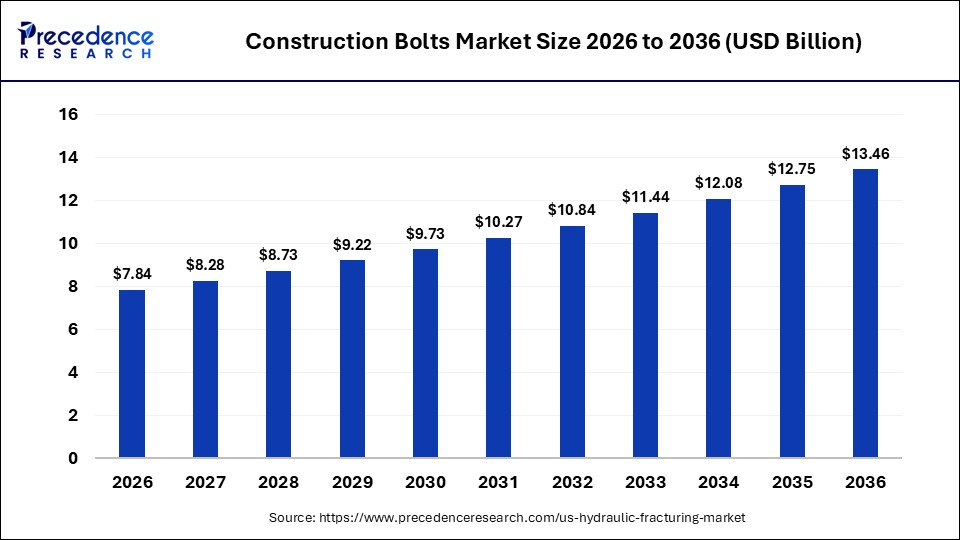
The construction bolts market is projected to grow at a CAGR of 5.55% through 2036. Market growth is driven by increasing infrastructure investment, rising demand for structural steel connections, expanding commercial and industrial construction, and ongoing development of transportation and public infrastructure. Key trends include growing need for high-strength structural bolts, galvanized products, corrosion-resistant fasteners, and application-specific fastening solutions. Increasing emphasis on structural safety, durability, quality standards, and reliable supply for large construction projects is expected to create opportunities for bolt manufacturers, specialty fastener suppliers, along with engineered fastening solution providers through 2036.
Source: https://www.precedenceresearch.com/construction-bolts-market
 Get a Sample
 Table Of Content


Construction Bolts Market Analysis, Demand, and Growth Rate Forecast 2036
The construction bolts market is forecasted to expand from USD 8.28 billion in 2027 to USD 13.46 billion by 2036, growing at a CAGR of 5.55% from 2027 to 2036.
Key Takeaways
- Market expansion is influenced by infrastructure investment, commercial and industrial construction, structural steel demand, and renovation activity across major economies.
- Heavy hex structural bolts and other high-strength fastening products play a critical role in steel-frame buildings, bridges, industrial facilities, and large infrastructure projects.
- Carbon steel remains important for cost-sensitive applications, while stainless steel and protective coatings address corrosion resistance and durability requirements in demanding environments.
- Raw-material costs, strength grades, coating requirements, manufacturing processes, and logistics influence selling prices and supplier margins. Premium specifications can support differentiation but do not guarantee higher profitability.
- Increasing emphasis on structural integrity, connection reliability, and compliance with engineering specifications supports demand for certified, application-specific bolt solutions.
- Transportation networks, bridges, public infrastructure, warehouses, and industrial facilities create demand linked to project pipelines and structural steel usage.
- Competition spans specialized structural-bolt manufacturers, diversified fastener producers, engineered fastening-system providers, and distributors.
- Technical compliance, product availability, manufacturing consistency, and distribution reach influence competitive positioning.
- Demand varies by construction investment, industrialization, infrastructure spending, local manufacturing capacity, and import dependence. Regional opportunities therefore require assessment beyond overall construction growth.
- Steel availability and pricing, heat treatment, coating capacity, quality control, and lead times affect supply reliability and cost competitiveness.
- Improvements in manufacturing precision, automated inspection, traceability, and corrosion-protection processes can help suppliers improve product consistency and meet demanding project specifications.
- Potential opportunities exist in high-strength structural fasteners, corrosion-resistant products, infrastructure projects, industrial construction, and markets where local supply capabilities can improve availability and delivery times.
- Suppliers that align product portfolios with application requirements, manage input-cost volatility, and strengthen distribution and quality assurance may be better positioned to compete across both standardized and specification-driven segments.
Infrastructure Investment and Structural Safety Sustain Demand for High-Performance Construction Bolts
The global construction bolts market is an essential segment of the construction fasteners industry, supplying threaded fastening products used to connect structural steel, assemble building frameworks, secure concrete fixtures, and support bridges, industrial facilities, commercial buildings, and energy infrastructure. Market estimates vary considerably depending on whether the scope includes only construction-specific bolts or extends to structural fasteners, anchoring systems, along with related fastening products. The commercial opportunity is therefore not determined solely by construction spending: product specifications, corrosion resistance, installation requirements, material grades, and certification can materially affect the value generated per fastening unit.
Construction bolts serve a broad range of applications, from standard hex bolts used in general building work to high-strength structural bolts, foundation bolts, anchor bolts, and specialized fasteners for bridges, industrial structures, towers, and renewable-energy installations. Carbon steel supports cost-sensitive, high-volume applications, while alloy steel and stainless steel address strength, durability, and environmental-performance requirements. Asia Pacific is an important growth region because of its manufacturing base, urban development, and infrastructure investment, while North America and Europe provide substantial demand for engineered fastening systems, replacement products, and specification-led applications.
The market is moderately fragmented across general-purpose manufacturers, regional suppliers, distributors, and specialized fastening-system providers. Competitive advantage increasingly depends on more than unit price: dependable quality, traceability, product availability, technical support, and compliance with engineering specifications are important differentiators in safety-critical applications.
Key Coverage
- Product segmentation across hex bolts, structural bolts, anchor bolts, foundation bolts, carriage bolts, U-bolts, and specialty configurations.
- Material and coating analysis covering carbon steel, alloy steel, stainless steel, zinc plating, and hot-dip galvanizing.
- Demand assessment across residential, commercial, industrial, infrastructure, transportation, and energy construction.
- Competitive analysis of global fastening-system suppliers, structural fastener specialists, regional manufacturers, and distribution-led businesses.
Specification-Driven Demand Supports Steady Expansion
The construction bolts market combines high-volume standard products with higher-value engineered fasteners. Its revenue trajectory is influenced by new construction, infrastructure replacement, steel-intensive building projects, non-residential development, and maintenance expenditure.
The full market assessment distinguishes nominal revenue growth from underlying unit demand. Steel-price changes, coating costs, product-mix shifts, and freight expenses can increase sales value without a corresponding increase in bolt consumption. Conversely, a shift toward standardized procurement or lower-cost products can raise shipment volumes while restraining average selling prices. Further, the forecast framework evaluates base, upside, and downside scenarios. The upside case reflects stronger infrastructure spending, faster renewable-energy deployment, and increased usage of engineered structural connections. The downside case considers construction delays, weaker building investment, commodity-price volatility, and intensified low-cost import competition.
Key Coverage
- Incremental revenue calculations under alternative growth assumptions.
- Regional and product-level forecasts, with separate volume and price effects.
- Sensitivity analysis for steel prices, construction investment, and product-mix changes.
- Base, upside, and downside scenarios for strategic planning.
Segmentation Analysis - Structural and Anchor Bolts Capture Different Engineering Requirements
Product selection depends on the load being transferred, the substrate, the installation method, environmental exposure, and the consequences of connection failure. Hex bolts are widely used in general assembly and construction, while high-strength structural bolts support steel-frame connections. Anchor bolts secure structural elements to concrete foundations, and foundation bolts are particularly relevant to industrial equipment, towers, and heavy structures.
Material selection creates a second layer of differentiation. Carbon steel is suited to many cost-sensitive applications; alloy steel supports demanding mechanical requirements; and stainless steel addresses corrosion-prone environments where durability and maintenance costs justify a higher purchase price. Surface treatments further differentiate products, with zinc-plated finishes typically serving less demanding exposure conditions and hot-dip galvanized products used where stronger corrosion protection is required.
| Segmentatoin Dimension | Major Categories | Principal Buying Consideration |
| Product | Hex, structural, anchor, foundation, carriage, U-bolts and specialty bolts | Load, geometry and installation |
| Material | Carbon steel, alloy steel, stainless steel and other metals | Strength, durability and cost |
| Coating | Plain, zinc-plated, hot-dip galvanized and specialty finishes | Corrosion resistance and service life |
| Strength class | Standard grades and high-strength structural grades | Design loads and engineering compliance |
| Application | Steel connections, concrete anchoring, foundations and general assembly | Connection design and safety |
| End user | Contractors, fabricators, infrastructure developers, OEMs and distributors | Availability, certification and total installed cost |
| Geography | North America, Europe, Asia Pacific, Latin America, Middle East and Africa | Construction intensity, standards and sourcing |
A precise global revenue share for each category cannot be established consistently without a common product definition and verified sales data. The analysis therefore distinguishes validated market figures from segment estimates rather than assigning unsupported percentages. It identifies the largest segment, fastest-growing segment, and highest-value applications using comparable revenue, shipment, and growth measures.
The principal strategic distinction is between standardized products competing on manufacturing efficiency and engineered products competing on specification compliance, performance, traceability, and service. Higher-value opportunities tend to emerge where fastening failure has significant safety or maintenance consequences.
Key Coverage
- Revenue and shipment analysis by bolt type, material, strength grade, and coating.
- Comparison of standard, high-strength, corrosion-resistant, and specialty products.
- Identification of high-volume and higher-value application categories.
- Regional segment comparisons and forecast growth contributions.
- Assessment of substitution between fastening configurations and materials.
Market Dynamics - Infrastructure Demand Meets Construction-Cycle and Input-Cost Volatility
Construction bolts benefit from investment in commercial buildings, industrial facilities, transportation networks, utilities, bridges, and renewable-energy infrastructure. Structural steel construction generates demand for bolted connections, while concrete foundations require anchoring products. Refurbishment and replacement work provide a further demand stream that is less directly dependent on new-build activity. However, bolt demand does not move uniformly with headline construction expenditure. Steel-intensive projects can consume more structural fasteners per project than some residential developments, while complex industrial installations may require fewer units but higher-specification products. Project postponements, changes in building design, and inventory adjustments can also delay procurement.
Three factors shape market performance:
- Construction Investment: Project starts, public infrastructure budgets, industrial construction, and renewable-energy installations influence underlying demand.
- Input-cost exposure: Steel wire rod, alloying elements, energy, heat treatment, coatings, and freight affect manufacturing economics.
- Technical Compliance: Structural failure risks, inspection requirements, and customer qualification procedures support demand for dependable, traceable products.
The principal restraints are construction cyclicality, low-cost imports, fragmented distribution, and the difficulty of passing through cost increases under fixed-price supply contracts. Opportunities arise from prefabricated construction, standardized connection systems, corrosion-resistant products, and dependable supply to large contractors and fabricators.
Key Coverage
- Demand sensitivity to construction starts, infrastructure budgets, and steel-intensive project activity.
- Raw-material and energy-cost exposure by product category.
- Price competition, import substitution, and customer inventory behavior.
- Growth opportunities in refurbishment, industrial construction, and renewable infrastructure.
- Risks associated with project delays, quality failures, and non-compliant products.
Tentative Leading Company Universe - Construction Bolts Market
| Company | Headquarters | Market Position | Core Strength |
| Hilti | Schaan, Liechtenstein | Construction systems leader | Engineered fastening solutions |
| Würth Group | Künzelsau, Germany | Global distribution leader | Product breadth and distribution |
| Illinois Tool Works | Glenview, United States | Diversified industrial supplier | Engineered fastening technologies |
| Simpson Strong-Tie | Pleasanton, United States | Building connections specialist | Structural connectors and fasteners |
| SFS Group | Heerbrugg, Switzerland | Construction fastening specialist | Engineered fastening systems |
| Lindapter | Bradford, United Kingdom | Steel connection specialist | Structural connection systems |
| Portland Bolt | Portland, United States | Structural-bolt specialist | High-strength and anchor bolts |
| Infasco | Marieville, Canada | Structural fastener manufacturer | Heavy-hex structural bolts |
| Nucor Fastener | United States | Domestic fastener supplier | Structural fastener supply |
| LISI Group | Grandvillars, France | Diversified fastener manufacturer | Precision fastening |
| Böllhoff | Bielefeld, Germany | Fastening technology provider | Industrial fastening systems |
| PennEngineering | Danboro, United States | Engineered fastener supplier | Application-specific fastening |
| Bossard Group | Zug, Switzerland | Fastener supply-chain specialist | Technical distribution |
| KAMAX | Homberg, Germany | High-strength fastener producer | Precision and strength grades |
| NORMA Group | Maintal, Germany | Adjacent joining-technology supplier | Engineered joining products |
| Meidoh | Japan | Industrial fastener specialist | High-strength bolt manufacturing |
| Sundram Fasteners | Chennai, India | Diversified fastener producer | Manufacturing scale |
| Deepak Fasteners | Ludhiana, India | Regional fastener producer | Broad bolt portfolio |
| Pooja Forge | India | Forged fastener supplier | Forging and custom products |
| Atul Fasteners | India | Regional fastener manufacturer | Standard and specialty fasteners |
| Pioneer Nuts and Bolts | India | Industrial bolt supplier | Bolt and nut manufacturing |
| Roll Fast | India | Structural fastener specialist | Structural bolt grades |
| Newport Fasteners | United States | Structural fastener supplier | Bolt assemblies and availability |
| California Fastener | United States | Specialty fastener supplier | Structural bolt specifications |
| Melta Alloys | India | Specialty bolt manufacturer | Alloy steel and custom bolts |
How Large is the Construction Bolts Market, and What Will Determine it's Growth Through the Forecast Period?
The construction bolts market requires a clearly defined scope to produce a reliable market size and forecast. The market encompasses bolts used in structural steel connections, infrastructure projects, commercial and residential construction, industrial facilities, and other building applications. However, broader construction fastener estimates may also include nuts, screws, anchors, and related fastening products, making direct comparisons potentially misleading. A defensible baseline must therefore distinguish construction bolts from the wider fasteners category and specify the revenue basis, geographic coverage, product scope, and forecast period.
Our analysis indicates that market growth is best assessed by connecting construction activity with the intensity of bolt usage across applications, rather than relying solely on overall construction expenditure. Structural steel consumption, infrastructure investment, industrial facility development, renovation activity, and demand for high-strength fastening systems can influence bolt volumes and product mix differently. Our assessment is that the distinction between unit-volume growth and value growth is particularly important: higher demand for engineered, corrosion-resistant, or high-strength bolts may increase market value even when shipment volumes grow more moderately.
In our view, the most significant forecasting challenge is separating underlying demand expansion from changes in product mix, raw-material costs, and selling prices. A robust outlook should test alternative growth scenarios against construction investment trends, steel-price movements, infrastructure project pipelines, and regional demand conditions. The full report provides a reconciled market-size baseline, historical performance where reliable data are available, forecast estimates, CAGR calculations, regional and application-level breakdowns, and sensitivity analysis to identify the assumptions most likely to influence the market outlook.
Which Companies are Best Positioned to Compete in the Construction Bolts Market and Where Are the Key Competitive Gaps?
The construction bolts market includes a diverse competitive universe spanning specialist structural-bolt manufacturers, engineered fastening-system providers, industrial fastener producers, and distributors serving construction and infrastructure customers. Competition varies by product grade, application expertise, certification requirements, distribution reach, customization capabilities, and ability to supply consistent volumes. A meaningful assessment must distinguish companies with direct exposure to construction bolts from broader fastener businesses whose overall scale may not reflect their position in this specific market.
Our analysis indicates that competitive strength is determined not simply by portfolio breadth or manufacturing scale, but by the ability to meet application-specific performance requirements while maintaining reliable supply, competitive pricing, and compliance with relevant standards. Companies with capabilities in high-strength structural bolts, corrosion-resistant products, engineered connections, and technical customer support may be better positioned in specification-driven projects, while manufacturers with cost-efficient production and extensive distribution may compete more effectively in standardized, price-sensitive applications. These are distinct competitive advantages and should not be treated as interchangeable indicators of market leadership.
In our view, the key strategic question is whether competitors can convert their manufacturing capabilities and channel relationships into defensible positions across specific construction applications and geographies. The full report strengthens the competitive assessment through a validated company universe, company-level product and geographic exposure, market-share estimates where supportable, portfolio comparisons, manufacturing and distribution capabilities, and benchmarking of pricing position, certifications, product specialization, and customer reach. This approach helps identify genuine market leaders, regional specialists, potential challengers, and areas where competitive coverage remains limited.
How is Market Share Distributed Across Construction Bolt Suppliers, and Which Capabilities Differentiate Competitive Leaders?
Market-share analysis in the construction bolts market depends on distinguishing revenue generated specifically from construction-related bolts from broader fastener, industrial component, and fastening-system sales. Suppliers compete across standardized bolts, high-strength structural fasteners, anchor bolts, and application-specific products, with performance shaped by manufacturing scale, product certifications, pricing, distribution coverage, and access to construction and infrastructure projects. Where reliable construction-bolt-specific revenue data are unavailable, precise market-share rankings may overstate the comparability of companies with different product portfolios and business models.
Our analysis indicates that competitive benchmarking should combine market position with the capabilities that explain how suppliers win business. Relevant indicators include estimated construction-bolt revenue and share, product and application coverage, geographic reach, manufacturing footprint, strength-grade specialization, certification compliance, customization capabilities, and distribution access. Our assessment is that a supplier with a smaller overall business may hold a stronger position in a specific structural-bolt category or regional market than a diversified fastener manufacturer with greater total revenue. Accordingly, market leadership should be evaluated at both the overall market level and within relevant product, application, and geographic segments.
In our view, the greatest strategic value comes from identifying the relationship between competitive position and the capabilities required to sustain it. Suppliers with strong technical credentials and reliable project supply may be better positioned in specification-led applications, while cost-efficient producers and distributors may have advantages in standardized, high-volume demand. The full report develops a comparative framework covering market-share estimates where supportable, competitor positioning, product breadth, pricing indicators, manufacturing and distribution capabilities, geographic exposure, and relative strengths and gaps. It also distinguishes verified market evidence from analyst assessments where company-level disclosures do not permit direct comparisons.
Which Product Segments, Price Tiers, and Regions Offer the Strongest Opportunities in the Construction Bolts Market?
Demand for construction bolts varies by product specification, end-use application, project requirements, and geography. Standard bolts primarily compete on cost, availability, and supply consistency, while high-strength structural bolts, corrosion-resistant fasteners, and application-specific products are more dependent on performance specifications, durability, and compliance requirements. Regional demand is influenced by construction output, infrastructure investment, structural steel usage, industrial development, and local manufacturing and distribution capabilities. A reliable segmentation analysis must distinguish shipment volumes from market value, since differences in product mix and average selling prices can cause revenue growth to diverge from unit-demand growth.
Our analysis indicates that product specifications, application requirements, and regional project composition are likely to explain meaningful differences in pricing and growth potential. Higher-priced products may offer attractive revenue opportunities where engineering requirements and compliance standards limit substitution, whereas standardized bolts may depend more heavily on manufacturing efficiency and distribution scale. However, a higher selling price does not automatically translate into stronger margins; raw-material costs, finishing processes, quality assurance, logistics, and competitive intensity also affect profitability. Our assessment is that the most commercially attractive segments are those where demand growth is supported by identifiable project requirements and suppliers can differentiate on performance, reliability, or service rather than price alone.
In our view, segmentation should be used to identify where suppliers can grow profitably, not merely where construction activity is expanding. The full report compares product categories, strength grades, applications, customer industries, and regional markets using available revenue, volume, growth, and pricing indicators. It also examines regional differences in demand drivers, competitive conditions, and supply capabilities to distinguish high-volume markets from specialized segments with potential pricing advantages.
Key Strategic Questions Addressed
- Which product categories account for the greatest revenue and shipment volumes?
- How do structural bolts, anchor bolts, and foundation bolts differ in growth and profitability?
- Which construction applications create the strongest demand for certified high-strength bolts?
- How do steel prices, heat treatment, coatings, and logistics affect bolt pricing?
- Which countries lead bolt manufacturing, exports, and imports?
- Where do import dependency and local manufacturing create opportunities?
- Which manufacturers have the strongest construction-bolt-specific product portfolios?
- What can be established about the top-five and top-ten suppliers' market shares?
- How do certification, traceability, and installation requirements influence customer selection?
- Which manufacturing technologies and coatings provide meaningful differentiation?
- What are the principal capacity, supply, and lead-time constraints?
- Which regional and application-specific opportunities offer the strongest commercial potential?
- Where could consolidation, partnerships, or manufacturing investment reshape competition?
Construction Bolts Market Segments
By Bolt Type
- Hex Bolts
- Heavy Hex Structural Bolts
- Anchor Bolts
- Carriage Bolts
- Flange Bolts
- Track Bolts
- Other Construction Bolts
By Material
- Carbon Steel
- Alloy Steel
- Stainless Steel
- Other Materials
By Strength Grade
- Standard-Strength Bolts
- High-Strength Bolts
- Structural-Grade Bolts
- Other Specialized Grades
By Coating and Surface Treatment
- Plain / Uncoated
- Hot-Dip Galvanized
- Zinc-Plated
- Mechanically Galvanized
- Other Protective Coatings
By Application
- Structural Steel Connections
- Steel Buildings and Commercial Construction
- Bridges and Transportation Infrastructure
- Industrial Facilities and Warehouses
- Residential Construction
- Roads, Railways, and Public Infrastructure
- Other Construction Applications
By End User
- Construction Contractors
- Infrastructure Developers
- Steel Fabricators and Erectors
- Engineering, Procurement, and Construction (EPC) Companies
- Industrial Facility Owners
- Distributors and Wholesalers
- Other End Users
By Sales Channel
- Direct Sales
- Distributors and Wholesalers
- Retail and Hardware Channels
- Online Sales
By Region
- North America
- Europe
- Asia-Pacific
- Latin America
- Middle East and Africa
For inquiries regarding discounts, bulk purchases, or customization requests, please contact us at sales@precedenceresearch.com
Frequently Asked Questions





Ask For Sample
No cookie-cutter, only authentic analysis – take the 1st step to become a Precedence Research client
 Get a Sample




 sales@precedenceresearch.com
 Schedule a Meeting