



Artificial Intelligence Software Market Trends, Leading Companies, Company Revenue / Sales Performance, Subscriber Growth, Pricing Strategies, Cloud Adoption, Infrastructure Expansion, Competitive Landscape, and Industry Outlook
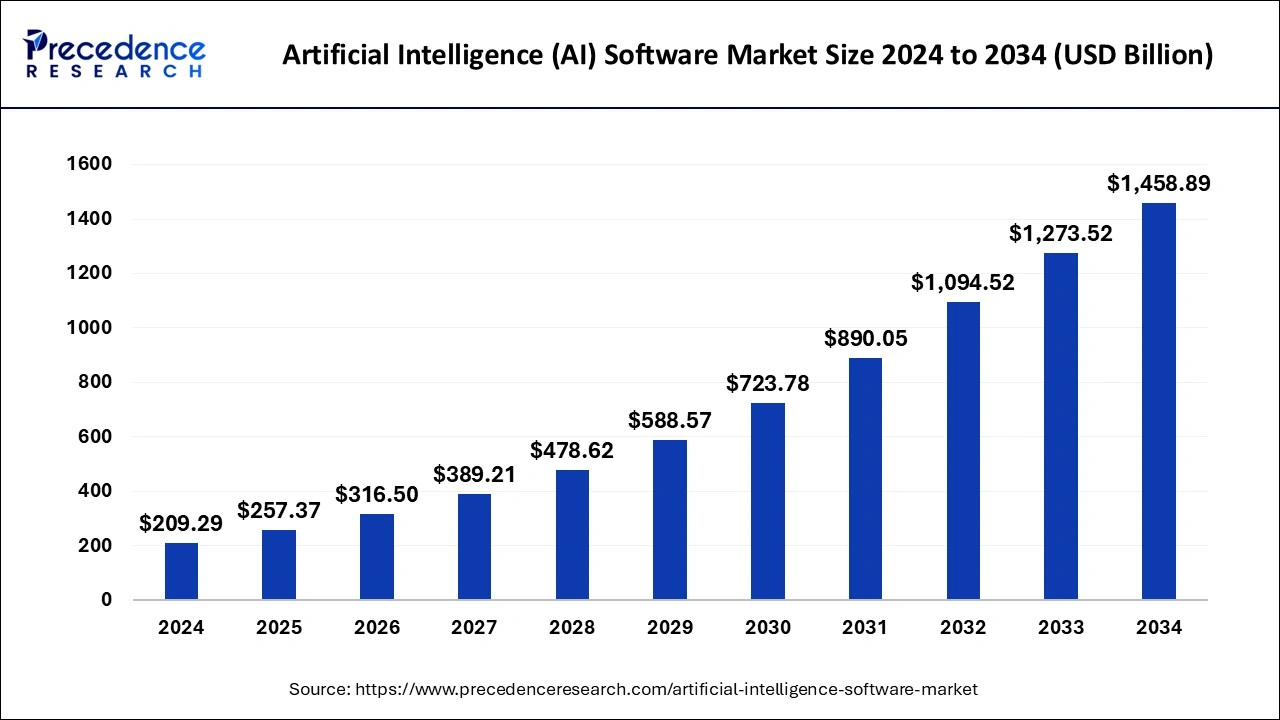
The global artificial intelligence (AI) software market size surpassed USD 316.50 billion in 2026 and is projected to reach around USD 1,640.51 billion by 2035, growing at a CAGR of 20.35% from 2026 to 2035. Market expansion is being fueled by increasing enterprise investments in generative AI, agentic AI, cloud-based AI platforms, automation technologies, and intelligent software solutions.
Source: https://www.precedenceresearch.com/artificial-intelligence-software-market
 Get a Sample
 Table Of Content


Artificial Intelligence (AI) Software Market Size and Forecast 2026 to 2035
The global artificial intelligence (AI) software market size was calculated at USD 257.37 billion in 2025 and is predicted to increase from USD 316.50 billion in 2026 to approximately USD 1,640.51 billion by 2035, expanding at a CAGR of 20.35% from 2026 to 2035. The market growth is driven by high demand for automation through intelligence, investment in AI technologies, and rising implementation of advanced software solutions in industries such as healthcare, BFSI, retail, manufacturing, and IT. The advent of agentic AI, multimodal AI models, and AI copilots is expected to accelerate the market growth rate globally.
Key Takeaways
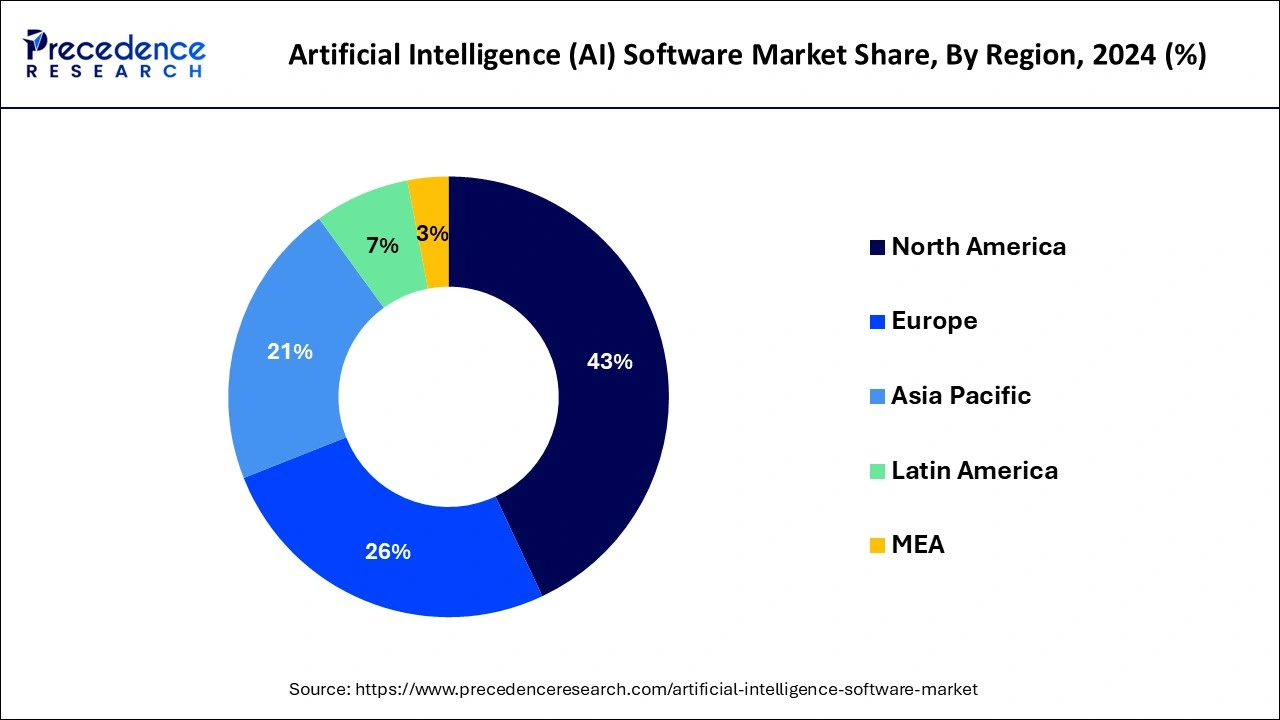
- North America dominated the global market with the largest share of 43% in 2025.
- Asia Pacific is expected to grow at the highest CAGR from 2026 to 2035.
- By deployment model, the cloud-based segment dominated the market in 2025.
- By deployment model, the on-premise segment is expected to grow at a significant CAGR during the forecast period.
- By offering, the software segment held the largest market share in 2025.
- By offering, the services segment is expected to grow at the fastest CAGR from 2026 to 2035.
- By application, the voice processing segment registered its dominance in the market in 2025.
- By application, the text processing segment is expected to expand rapidly in the coming years.
- By end-use, the advertising and media segment accounted for the largest market share in 2025.
- By end-use, the BFSI segment is anticipated to witness notable growth during the forecast period.
Global Artificial Intelligence (AI) Software Market Overview
AI software is described as an application or platform that allows machines to exhibit their capabilities by executing cognitive functions like learning, reasoning, making decisions, generating information and content, as well as performing other actions related to prediction. The development of AI software is aimed at increasing efficiency through automation of operations and making business operations more productive. The emergence of numerous digital transformation projects, cloud computing technologies, and increasing adoption of smart enterprise solutions is creating many growth opportunities. Industries like health care, finance, manufacturing, retail, transport, and telecommunication are adopting AI software solutions.
What is the Role of AI in Software Solutions?
Artificial intelligence (AI) plays a transformative role in modern software solutions by enabling systems to move beyond traditional rule-based operations toward intelligent automation, predictive decision-making, and adaptive learning. AI-powered software integrates technologies such as machine learning (ML), deep learning, natural language processing (NLP), computer vision, and generative AI to automate complex tasks, analyze large volumes of data, and improve operational efficiency across industries.
AI software is becoming deeply integrated across a wide range of applications, including productivity and collaboration tools, cybersecurity platforms, customer service solutions, healthcare diagnostics, financial analytics, and software development environments. Continuous advancements in AI models, cloud computing infrastructure, and enterprise automation are further accelerating the adoption of intelligent software solutions, making AI a fundamental driver of innovation and digital transformation across the global software industry.
Artificial Intelligence (AI) Software Market Trends
- Increased Use of Generative AI Systems: More companies are making use of generative AI software for content creation, coding, marketing campaign automation, and business analysis. This technology is useful in minimizing operational expenses and promoting efficiency in decision-making processes.
- Use of Agentic AI Agents: Organizations are using autonomous AI agents which can act on their own in completing tasks, making decisions, and executing processes without much human interaction. The use of such AI agents makes businesses run more efficiently and facilitates better automation of business processes.
- Expansion of AI-Powered Software Development: Software engineers use applications for code writing and optimization that are based on artificial intelligence technology. Such technologies enable quicker programming, minimize coding errors, ensure higher software quality, and boost the productivity of software engineers.
- AI Deployments in the Cloud: AI in cloud computing environments is allowing organizations to benefit from sophisticated AI technologies despite having limited IT infrastructure requirements. The benefits associated with using the cloud are encouraging more organizations to adopt AI technologies across the world.
- Enterprise Spending on AI: Firms are still increasing their investment in AI technologies in order to gain a competitive advantage and hasten digital transformation. Increased investment in AI software, hardware, and related services is an indicator of the growing belief in the power of AI technology.
How Do Government Initiatives Influence the Artificial Intelligence (AI) Software Industry?
- The U.S. government is involved in the promotion of AI research and innovations in AI software through the National AI Initiative, which focuses on developing the AI workforce and collaboration between private companies and the federal government.
- China's New Generation Artificial Intelligence Development Plan promotes the development of artificial intelligence software to make China the world leader in AI by investing in advanced computing systems and smart manufacturing.
- The IndiaAI initiative by the Government of India works towards the development of AI in India through initiatives like funding startups, computing systems, data platforms, skill development, and ethical AI.
- The EU supports innovations in AI through the development of AI Act, funding programs for Horizon Europe and investments in trust and ethical AI.
- UK National AI Strategy encourages innovation in AI software through funding AI research, AI regulatory framework, development of skills and talent, and other AI commercialization initiatives.
Market Report Coverage and Key Metrics
| Report Scope | Details |
| Market Size in 2025 | USD 257.37 Billion |
| Market Size in 2026 | USD 316.50 Billion |
| Market Size by 2035 | USD 1,640.51 Billion |
| Growth Rate from 2026 to 2035 | CAGR of 20.35% |
| Base Year | 2025 |
| Forecast Period | 2026 to 2035 |
| Largest Market | North America |
| Segments Covered | Deployment Model, Offering, Application, End-User, and Region |
| Regions Covered | North America, Europe, Asia-Pacific, Latin America, Middle East & Africa |
Market Dynamics
Rising demand for improved business IoT solutions, self-driving cars, and robots will likely drive the growth of the artificial intelligence software market. Artificial intelligence software is one of the most efficient ways to reduce human efforts consumption; thus, it is integrated into most fields, from healthcare to defense. Along with this, many prominent companies are launching new artificial intelligence software to sustain themselves in the artificial intelligence software market.
Considering the factors such as reduced risk, proper data management, improved production efficiency, reduced disruptions in the supply chain, and gained end-to-end visibility of operations that artificial intelligence software provides, the market is expected to show significant growth in the forecasted period of 2025-2034.
The artificial intelligence software market is widespread and carries multiple drivers. The unfolding market for 4IR technologies, such as the Internet of Things, robotics, or quantum computing, will fuel the artificial intelligence software market. Multiple enterprises are investing in artificial intelligence software to plan and implement business strategies and for better customer support. Rapidly increasing adoption of artificial intelligence software is seen as a major driver for the market.
The artificial intelligence software used in the healthcare sector (hospitals, clinics, and labs) enhanced the overall experience of work. Rising demand for artificial intelligence software from the healthcare sector will likely fuel the market in the upcoming years. Upgrading technology is also providing lucrative opportunities for market growth. By integrating artificial intelligence software into cyber security, businesses see it as a significant safeguard against cyber-attacks to protect their networks and confidential data. The demand for such software in the cyber security branch is another driver for the artificial intelligence software market. Artificial intelligence software is capable of providing an improved customer experience. Many companies are adapting artificial intelligence software to provide better customer service. Collectively, increasing investment in advanced artificial intelligence software is a considerable driver for the artificial intelligence software market.
Driver
Rising investment in AI start-ups
The future expansion of the artificial intelligence (AI) software industry is anticipated to be driven by the growing investments in AI startups. Businesses that focus on creating and deploying artificial intelligence (AI) solutions to address particular issues or satisfy consumer needs are known as AI startups. Due to the growing need for AI solutions across sectors, as well as their scalability and cost-effectiveness, investments in AI companies are expanding. By supporting marketing and sales initiatives, investments in AI startups will help AI businesses grow their market share and promote the use of software solutions.
Restraint
Artificial intelligence technology is being admired globally, and the limited skill set for implementing proper artificial intelligence software is seen as a major restraint for the artificial intelligence software market. Lack of technical expertise for such complex management hampers the growth of the artificial intelligence software market. The algorithms in artificial intelligence technology depend on the input data, and any unintended mistakes in input data can disrupt the programming of artificial intelligence software. Such incidents are seen as another restraint to the growth of the artificial intelligence software market.
Opportunity
Usage of generative AI
In addition to being ground-breaking tools, generative models, machine and deep learning algorithms, and artificial intelligence (AI) enable developers to push the boundaries of technology, produce individualized experiences, optimize workflows, and spur creativity. Utilizing generative AI's capabilities may greatly enhance internal operations, business processes, software development, and product creation. There are several advantages to using AI in software development, including increased creativity, code optimization, and the exploration of novel ideas. Additionally, by streamlining processes and automating time-consuming, repetitive tasks, generative AI may increase productivity and efficiency across the product development lifecycle.
Segmentation Analysis
Deployment Model Insights
Why Did the Cloud-Based Segment Dominate the Artificial Intelligence (AI) Software Market?
The cloud-based segment dominated the market with the largest share in 2025, owing to its scalability, lower costs of infrastructure, speedy implementation, and ease of use. Businesses have been increasingly using cloud-based AI software as they allow real-time analytics, deployment of machine learning models, and automation. Computing capabilities can be easily tailored according to needs by using cloud computing. AI as a service allows businesses to access advanced AI software without any substantial upfront costs.
Moreover, regular software upgrades, integration with enterprise applications, enhanced collaboration for distributed teams, and increased usage of hybrid cloud computing solutions have contributed to the segment's growth. The rising preference for remote working practices and digital transformation trends has boosted the usage of cloud-based AI software.
The on-premise segment is anticipated to experience the fastest growth throughout the forecast period due to increasing worries about data security, privacy concerns, and data sovereignty. Companies working within the framework of highly regulated industries are adopting on-premise AI software solutions to have better control over sensitive data and ensure compliance with industry standards. On the one hand, the adoption of such solutions is being facilitated by the need to implement customized AI ecosystems according to unique business needs.
Large corporations are more likely to opt for the deployment of AI software solutions on-premises because of latency and dependability issues. Moreover, on-premise AI software solutions are growing rapidly owing to cybersecurity worries, stricter government compliance requirements, growing investments into private AI infrastructure, secure data processing needs, and the requirement to work with proprietary data sets.
Offering Insights
The Software Segment Dominated the Market in 2025
The software segment dominated the artificial intelligence (AI) software market in 2025 due to the increasing adoption of AI-powered platforms, applications, and solutions across industries such as healthcare, finance, cybersecurity, retail, and enterprise operations. Growing demand for automation, predictive analytics, generative AI tools, and intelligent decision-making systems has accelerated the deployment of AI software solutions among organizations. Additionally, continuous advancements in machine learning models, cloud-based AI platforms, and AI integration capabilities have strengthened the role of software as the core component of AI adoption.
The services segment is expected to grow at the fastest rate in the coming years due to increasing demand for AI consulting, implementation, integration, and maintenance services among organizations adopting AI technologies. Businesses require specialized expertise to deploy AI solutions, manage complex AI infrastructure, customize models, and ensure effective integration with existing systems. Additionally, the rising adoption of generative AI, cloud-based AI services, and enterprise AI transformation initiatives is driving the need for professional and managed AI services.
Application Insights
Why Did the Voice Processing Segment Dominated the Artificial Intelligence (AI) Software Market?
The voice processing segment dominated the market while holding a major share in 2025. This is mainly due to the widespread adoption of voice-enabled AI assistants, speech recognition systems, and conversational AI applications across industries. Increasing use of virtual assistants, customer service automation, smart devices, and voice-based interfaces has accelerated demand for AI technologies capable of understanding and processing human speech.
The text processing segment is expected to expand at a significant rate in the coming years due to the rising adoption of natural language processing (NLP), generative AI, and automated text analytics solutions. Businesses are increasingly using AI-powered text processing for document analysis, content generation, sentiment analysis, search optimization, and workflow automation, driving strong growth across enterprise applications.
End-User Insights
Why Did the Advertising and Media Segment Lead the Artificial Intelligence (AI) Software Market?
The advertising and media segment dominated the market in 2025 due to the increasing adoption of AI-powered tools for content creation, audience analysis, personalization, and campaign optimization. AI technologies enable media companies and advertisers to analyze large volumes of consumer data, predict customer behavior, automate marketing processes, and deliver targeted experiences with greater efficiency. The rapid growth of generative AI for content generation, automated ad creation, and recommendation systems has further accelerated AI adoption across the advertising and media industry.
The BFSI segment is expected to grow at the fastest rate over the projection period due to the adoption of artificial intelligence applications in the banking, insurance, and finance industries. Some of the common areas in which AI software is applied include fraud detection, risk assessment, customer behavior analysis, monitoring compliance with regulations, and decision-making automation. The use of AI software in the form of chatbots, virtual assistants, predictive analytics, and algorithmic trading platforms is common among financial service companies for increased efficiency and customer satisfaction.
The healthcare segment is expected to experience significant growth in the upcoming period because of the increasing utilization of AI-based technologies in diagnostics, drug development, monitoring, and decision support systems. Healthcare organizations are integrating AI technology in their diagnostic procedures to increase the speed and precision of diagnosing diseases. Furthermore, the increasing adoption of AI in radiology, electronic medical records, and telemedicine is expected to propel growth in the market. In addition, rising capital investments in digital healthcare infrastructure, personalization of medicine, remote patient care services, and AI-based research programs are expected to provide major impetus to AI software in the healthcare industry.
Regional Analysis: North America, Europe, Asia-Pacific
U.S. Artificial Intelligence (AI) Software Market Size and Growth 2026 to 2035
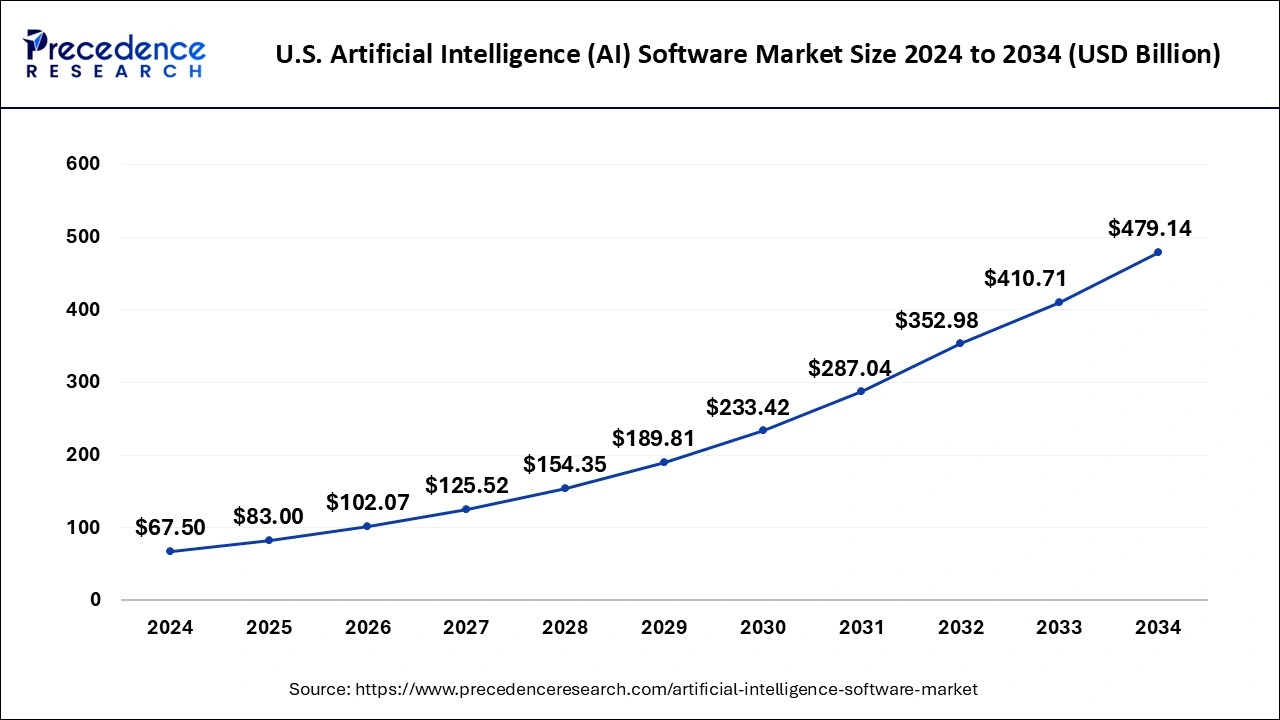
The U.S. artificial intelligence (AI) software market size was evaluated at USD 83 billion in 2025 and is predicted to be worth around USD 540.44 billion by 2035, rising at a CAGR of 20.61% from 2026 to 2035.
U.S. Market Analysis
U.S. leads the North American artificial intelligence (AI) software market due to substantial investments in the fields of AI technology research and development, cloud computing, and digital transformation in enterprises. Growth of the market is attributed to the availability of key technology providers, adoption of generative AI software, government initiatives, and implementation of AI across BFSI, healthcare, retail, and defense industries.
Why Did North America Dominated the Artificial Intelligence (AI) Software Market?
North America dominated the artificial intelligence (AI) software market with the largest share in 2025. This is mainly due to several factors, including the presence of excellent AI research capabilities, cloud computing, heavy investment by organizations in enterprise technologies, and top artificial intelligence firms. The region benefits from significant investments in AI research and development, cloud computing capabilities, and venture capital funding that support innovation across industries such as healthcare, finance, cybersecurity, and advertising. Additionally, the rapid adoption of generative AI, AI automation tools, and enterprise AI platforms by organizations in the U.S. and Canada has strengthened North America's leading position in the global market.
How is Asia-Pacific Growing in the Artificial Intelligence (AI) Software Market?
Asia-Pacific is expected to grow at the fastest CAGR during the forecast period due to rapid digital transformation, expanding cloud computing infrastructure, and increasing investments in AI-driven technologies. Countries such as China, India, Japan, and South Korea are accelerating AI adoption across industries, including manufacturing, healthcare, finance, retail, and automotive, supported by strong government initiatives and innovation programs. Additionally, the growth of AI startups, rising enterprise demand for automation, and increasing deployment of AI-powered software solutions are creating significant opportunities for market expansion across the region.
China Market Analysis
The market in China is driven by strong government backing, rapid digitalization, and large-scale AI adoption across manufacturing, healthcare, retail, and smart city projects. Rising investments in AI innovation, expanding cloud infrastructure, and the implementation of the New Generation AI Development Plan are driving the development and deployment of advanced AI software solutions nationwide.
How is the Opportunistic Rise of Europe in the Artificial Intelligence (AI) Software Market?
Europe is expected to witness strong growth in the artificial intelligence (AI) software market during the forecast period due to increasing AI adoption across key industries such as manufacturing, automotive, healthcare, and finance. The region's focus on industrial automation, intelligent systems, and digital transformation is encouraging organizations to integrate AI-powered software solutions to improve efficiency, decision-making, and operational performance. Government initiatives supporting AI research, ethical AI development, digitalization, and innovation are further strengthening market expansion across Europe.
Germany Market Analysis
Germany is one of the major markets for AI software in Europe. This is due to the presence of highly automated industries, advanced manufacturing facilities, and the increasing application of Industry 4.0. There is a surge in the adoption of AI software due to increased investment in production systems, predictive maintenance, automotive technology, and digital business transformation.
Why is the Market within the Middle East & Africa Gaining Momentum?
The artificial intelligence (AI) software market within the Middle East & Africa (MEA) is gaining momentum, owing to rising investments in digital transformation, smart city development, cloud computing, and automation initiatives. Governments and enterprises across the region are increasingly adopting AI software to improve operational efficiency, enhance public services, strengthen cybersecurity, and support advancements in sectors such as healthcare and finance. The implementation of national AI strategies, technology modernization programs, and increasing investments in digital infrastructure are creating favorable conditions for AI software adoption across MEA.
UAE Market Analysis
The UAE leads the market due to substantial backing from the government, AI investments, and the use of smart technology solutions. Various firms in the healthcare, banking, transportation, retail, and even governmental sectors are adopting AI software in order to improve their performance and enhance customer experience.
What Drives the Artificial Intelligence (AI) Software Market in Latin America?
The artificial intelligence (AI) software market in Latin America is driven by increasing digital transformation initiatives, growing adoption of cloud-based technologies, and rising demand for automation across industries. Businesses in sectors such as banking, healthcare, retail, manufacturing, and telecommunications are increasingly implementing AI software to improve operational efficiency, enhance customer experiences, and enable data-driven decision-making.
Brazil Market Analysis
Brazil is a major contributor to the Latin American market due to its large digital economy, expanding technology sector, and increasing adoption of AI solutions across industries such as finance, healthcare, retail, agriculture, and telecommunications. The country's growing investments in cloud infrastructure, digital transformation initiatives, and AI-driven automation are encouraging businesses to integrate intelligent software platforms to improve productivity and decision-making.
Competitive Landscape: Leading Companies and Strategies
The artificial intelligence (AI) software market is moderately consolidated, with major technology companies holding significant market positions while numerous startups continue to drive innovation through specialized AI solutions. The market has high entry barriers due to the requirement for substantial investments in computing infrastructure, large-scale datasets, advanced research capabilities, and proprietary AI technologies.
Leading players such as Microsoft Corporation, Google LLC, Amazon Web Services, IBM Corporation, and OpenAI are strengthening their market presence through advanced AI models, enterprise platforms, cloud-based AI services, and generative AI solutions.
Competition in the market is increasing through strategic partnerships, mergers and acquisitions, continuous development of new AI models, and investments in generative AI and agentic AI technologies. Emerging innovations such as multimodal AI, autonomous AI agents, and industry-specific AI platforms are expected to reshape competitive dynamics, while factors such as regulatory requirements, data privacy concerns, and high infrastructure costs remain key challenges for market participants.
Top Companies in the Artificial Intelligence (AI) Software Market
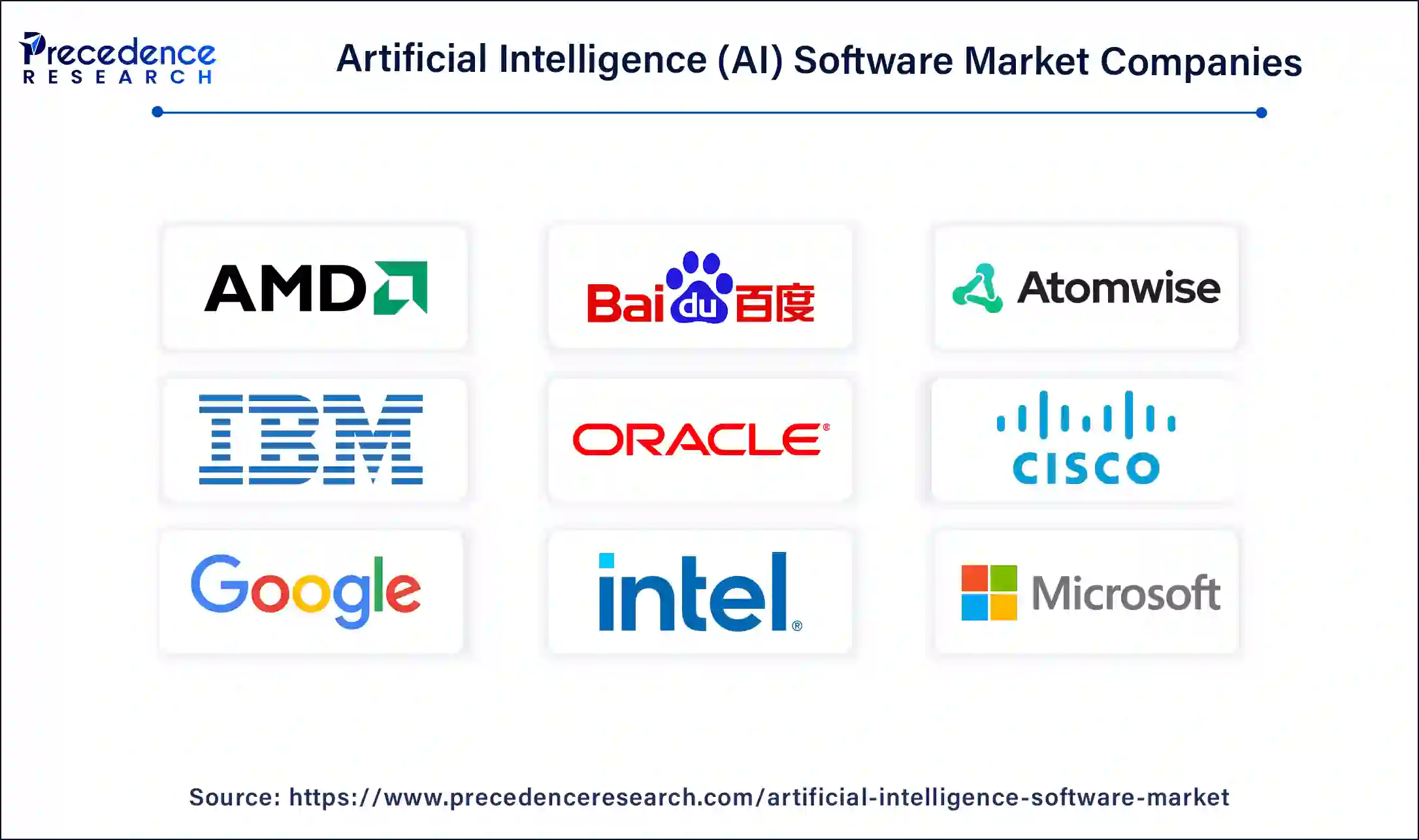
- Microsoft
- Amazon Web Services
- IBM
- Oracle
- SAP
- Salesforce
- OpenAI
- Anthropic
- NVIDIA
- Adobe
- C3.ai
- DataRobot
- SAS Institute
- Palantir Technologies
Recent Developments in the Artificial Intelligence (AI) Software Market (2025–2026)
- In May 2026, At Penn State Great Valley, an MBA program for AI was introduced, aiming to blend proficiency in AI technology with business acumen to produce leaders who can innovate with AI technology and develop businesses using AI.
(Source: https://www.psu.edu) - In July 2025, Knorr Bremse launched a Global AI Center in Chennai, India. The center aims at developing AI-based solutions as well as AI-based agents which can contribute towards making processes more efficient and enhance software development and accounting. (Source: https://newsroom.knorr-bremse.com)
- In January 2025, according to PitchBook statistics, artificial intelligence businesses have played a major role in helping the U.S. venture capital industry rebound from market lows. In 2024, the total amount of cash raised was about 30% greater than the previous year. A record 46.4% of the $209 billion funded last year went to AI businesses, up from fewer than 10% ten years ago.
- In January 2025, with an average check size of $0.5 million, Riceberg Ventures, a venture capital firm, intends to invest in 25–30 firms worldwide. Spacetech, medtech/life sciences, cybersecurity, AI, robots, new energy, semiconductors, and quantum computing are the industries they want to invest in. The company underlined the importance of helping deeptech firms, which sometimes struggle to get capital because of their lengthy R&D and incubation times.
- In June 2024, in order to support the startup ecosystem and advance the creation of safe and dependable AI solutions, Cisco Investments, the international corporate venture investment division of Cisco (NASDAQ: CSCO), established a $1 billion AI investment fund. To yet, Cisco has committed around $200 million of the $1 billion investment fund.
Segments Covered in the Report
By Deployment Model
- On-premises
- Cloud
By Offering
- Hardware
- Software
- Services
By Application
- Voice Processing
- Text Processing
- Image Processing
By End-User
- Law
- Retail
- Healthcare
- BFSI
- Advertising and Media
- Automotive & Transportation
- Agriculture
- Manufacturing
- Others
By Region
- North America
- Europe
- Asia-Pacific
- Latin America
- Middle East & Africa (MEA)
For inquiries regarding discounts, bulk purchases, or customization requests, please contact us at sales@precedenceresearch.com
Frequently Asked Questions





Ask For Sample
No cookie-cutter, only authentic analysis – take the 1st step to become a Precedence Research client
 Get a Sample




 sales@precedenceresearch.com
 Schedule a Meeting
